“If you want to buy some cloth, go to the weaver, if you want a hoe, ax or knife, then go to the blacksmith. But if you want to know the history of the people, you must go to the Griots.” — Foday Musa Suso
My favorite storyteller, known as the “Griot of Williamsburg,” passed away recently. I met Dylan Pritchett more than 25 years ago in Richmond while attending the National Association of Black Storytellers conference.
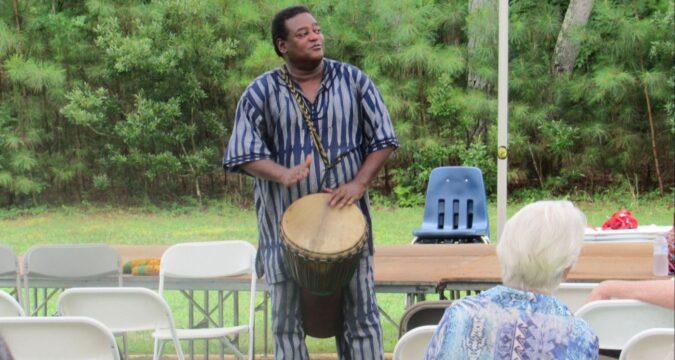
Dylan was weaving stories with costumes and music to educate in the rich African tradition. Not only were his stories entertaining, they were insightful, teaching morals, appropriate behavior and far-reaching truths. Dylan had a gift. He traveled nationwide to share his stories, wrote children’s books and even authored curriculum materials.
It would be nearly 20 years before our paths crossed again. This time, it was during an event at Freedom Park, one of the nation’s oldest free Black settlements, located in James City County.
In 2019, I was looking for a Juneteenth event. The Virginia Black Storytellers were partnering with JCC Parks and Recreation to host Freedom Stories featuring Dylan, a recurring event that included activities for children and soul food catered by Corey’s Chicken Shack.
Laura D. Hill
The recreated cabins were a fitting backdrop for the event. I admired children making colorful African masks and playing outside while I feasted on a lunch of fried catfish and collard greens. However, the highlight of the day was sitting under the large tent and listening to Dylan’s captivating storytelling that brought history to life.
In 2022, I was organizing Virginia Racial Healing Institute’s third annual Heal Greater Williamsburg/Heal the Nation event. I invited Dylan to share his stories. We brought him back by popular demand in the fall of 2023 for the same event at Legacy Hall. He had everyone on their feet dancing and playing instruments. During the community forum, he shared stories with the kids.
Losing Dylan is a great loss to our community. He always found a way to instill truth and humor in a story, especially the ones that addressed America’s painful racial history. He demonstrated why storytelling is vital. It’s through telling our stories that we begin to heal from racial wounds of the past. This benefits the community by helping to make reconciliation possible and by restoring community trust.
Lately, I have wondered what Dylan would think of recent news reports criticizing exhibits at the National Museum of African American History and Culture and other museums for their focus on slavery and historical injustices.
According to news reports, the White House is “upset” about Smithsonian slavery exhibits because they are perceived as focusing too much on the negative aspects of American history, particularly “how bad slavery was.” In response, the Smithsonian Institution issued a statement indicating that it is an independent entity governed by a board of regents, or board of trustees, and managed by Secretary Lonnie G. Bunch. ”Our own review of content to ensure our programming is factual and nonpartisan is ongoing, and it is consistent with our authority over our programming and content.”
When it comes to interpreting slavery, we cannot put the genie back in the bottle. We cannot whitewash the brutality of 200 years of institutionalized chattel slavery, how slavery divided our nation and led to a Civil War, killing more than 600,000 Americans. Nor can we turn a blind eye to the legacies of slavery today.
Efforts to cover up and erase history demonstrate that Americans are still grappling with the impact of slavery more than 150 years after it was abolished. In her book, “The 1619 Project: A New Origin Story,” Nikole Hannah-Jones states, “White Americans desire to be free of a past they do not want to remember, while Black Americans are bound to a past they can not forget.”
It’s time to commit to healing racial wounds of the past. The Virginia Racial Healing Institute is “a healing place!” We provide safe and welcoming spaces to engage in civil dialogue, training classes and interactive community events to foster racial healing and reconciliation. Join us this fall for our monthly programs, which include Coming to the Table gatherings, Racial Healing Book Club and the faith-based Be the Bridge group.
Our fall programming culminates in November with the sixth annual Heal Greater Williamsburg/Heal the Nation Community Forum, where we will bring community leaders together to discuss the complexities of interracial marriage and raising biracial children. There’s a seat at the table for you.
When we come together to build a more truthful and just community, we all win!
Laura D. Hill is the executive director of the Virginia Racial Healing Institute, which manages Coming to the Table-Historic Triangle. Learn more about her work at varacialhealinginstitute.org.
https://www.dailypress.com/2025/09/05/building-a-bigger-table-the-power-of-storytelling/