Hurricanes, thunderstorms and earthquakes are deemed acts of God — things completely beyond human control. Social, political, and religious evolutions, while influenced by man to a degree, are often inspired by divine winds that somehow escape domination by mere mortals.
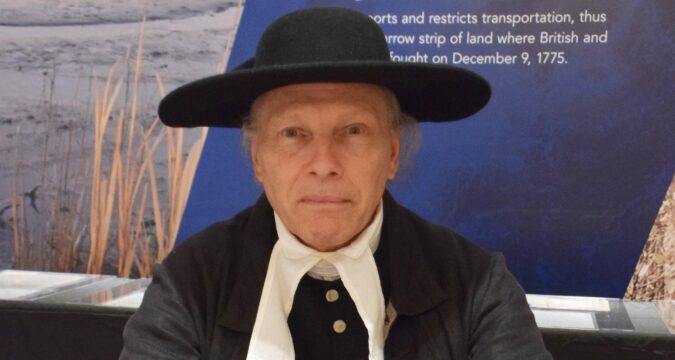
Historical interpreter Tim Platek of Chesapeake understands the influences — political and social changes — that can affect the course of human life and survival in the struggle along life’s path.
“I had always done ministry work in the churches. I felt more of a calling to go out to engage people outside the church,” Platek said. “I wanted to bring the church aspect to people where they are,” he said.
“I didn’t know quite what that was going to look like. I got involved with a group of reenactors.”
Tim Platek has chosen to portray an ordained Anglican minister — the Rev. Thomas Davis Jr. — as a vehicle to “minister” to audiences and reenactors regarding the history of the American Revolutionary War era. While the portrayal he offers is traditional and factual, Platek’s perspective is unique.
“I would hope that Reverend Davis would think that there was some accuracy to my portrayal of him. I hope I do him justice,” Platek said. “I hope for the most part that everything is accurate and right. He would, I think, be pleased overall.”
Platek’s interpretive ministry was inspired by a visit to George Washington’s Mount Vernon estate during a Revolutionary War Days program. Returning home after the event, Platek joined the 1st Continental Light Dragoons, a reenactment unit that had Reverend Davis as its chaplain.
Platek volunteered his services to the folks at Mount Vernon initially, but his offer was declined.
The Rev. Tim Platek holds a replica of the Bible printed in Philadelphia for distribution to soldiers. (Bob Ruegsegger/For The Virginian-Pilot)
Two weeks before the Plateks moved to Chesapeake in Virginia, however Platek received a call from Mount Vernon requesting that he perform a church service during an upcoming historical program.
“My wife and I packed up our car. All of our belongings had already left for Chesapeake. We drove to Mount Vernon. I did the church service,” Platek said. “I spent the whole weekend as the minister. From there on Sunday, we drove to our house in Chesapeake.”
Davis followed in his father’s footsteps as an ordained Anglican minister. He was born in England near Liverpool, raised in Virginia and educated at William & Mary, and ordained in London in 1773.
His father, the Rev. Reverend Thomas Davis Sr., served as rector from 1773 to 1776 at the Borough Church of the Elizabeth River Parish. Davis Jr. assisted his father at the church in Norfolk until the city was completely destroyed following the Battle of Great Bridge. While the walls of the Borough Church — now St. Paul’s — were left standing, little else was left of the edifice.
Davis Jr. “cast his lot” with the patriot cause. He volunteered for service as a chaplain with the 1st Virginia Regiment of Light Dragoons, a cavalry unit organized in Williamsburg.
After Platek relocated to Chesapeake, he noticed the Great Bridge Battlefield Park with the monument, interpretive signs and flags, and stopped to investigate. Previously, he had known nothing of the Battle of Great Bridge.
At the time of his initial visit, there was no museum, just a battlefield park with a couple of volunteer interpreters who suggested that he contact the 7th Virginia Regiment that hosts the annual Battle of Great Bridge reenactment. Platek called Drummond Ball, a veteran reenactor with the 7th Virginia.
“We’d love to have you,” Ball said. “I do a lot of our church services, but we need a minister. I’m not a minister.”
Platek got connected. He joined the 7th as the regimental chaplain and does church services at all unit events.
His interpretive ministry has grown over the years. He still goes back to Mount Vernon and also participates as a chaplain in historically oriented events in Pennsylvania, New Jersey, New York and the Carolinas.
“I’m perceived as the chaplain of the Continental Army so I perform church services and sometimes address the troops before battle,” Platek said. “I pray for the troops and engage people. I go on the battlefield and tend to the wounded and minister to the people on the field.”
When Washington arrived in Boston as the newly appointed commander in chief of the Continental Army, he was appalled at the undisciplined behavior of his ragtag army of militiamen. They were sitting around camp swearing, gambling and drinking. Washington realized immediately that he had get his fledgling army in shape.
“One of the things Washington understood as an Anglican — and a God-fearing man — was that his army needed some spiritual guidance and decency,” Platek said. “Good soldiers are disciplined, trained soldiers — decent and moral people. He requested, early on in 1775, a Chaplain Corps.”
Chaplains were role models who led exemplary Christian lives and obeyed their officers. Sunday service was a crucial duty for chaplains, and soldiers were expected to attend.
Chaplains were disciplined and respected by the officers and men. When an army chaplain was in camp, the general atmosphere among the troops seemed different — in a positive way.
“Washington was very private about his faith. We also know that he did not want to alienate denominations,” Platek said. “He would go to other services. He never promoted one denomination.”
Davis was a typical minister of the time period. He was an ordinary man who struggled through extraordinary times. When many other Anglican ministers left their congregations and abandoned their ministries, Davis remained loyal to his faith and duties.
“I give Reverend Davis a lot of respect. I appreciate the fact that he stuck with the ministry. He served his country. He served his congregants,” Platek said. “He did that to the end. He was not one of the great historic figures of the times.”
Davis was serving as rector of Christ Church in Alexandria when he received word that Washington had died. Tobias Lear, Washington’s secretary, notified Davis of Washington’s death and requested that he officiate at the funeral and burial at Mount Vernon.
Over the past decade, Platek’s ministry of historical interpretation has grown considerably. Recently he has been involved in speaking engagements as a way of connecting with people. Ideally, he wants his ministry to become better, rather than bigger.
“On the East Coast, in Virginia, there are so many groups involved with historic things, clubs and museums. There’s this crossover,” Platek said. “There’s satisfaction in what I’ve done but not contentment. I always want to be better in what I do. I want to be a better minister, a better historian and a better communicator.”
Note: The Rev. Tim Platek is scheduled to make a presentation at St. Paul’s Church in Norfolk on Jan. 31. The Rev. Thomas Davis, Sr. and the Rev. Thomas Davis, Jr. served the congregation at the Borough Church in Elizabeth River Parish (now St. Paul’s) before British troops and Patriots torched Norfolk in January 1776.