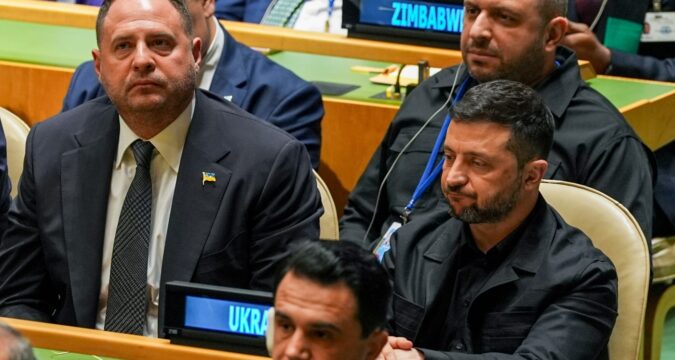
As President Donald Trump takes a victory lap for brokering a ceasefire in Gaza, his attention may now turn back toward ending the war in Ukraine. During a contentious United Nations General Assembly last month, Trump made what seemed like a startling reversal on Ukraine policy. In a post on Truth Social following his meeting with Ukrainian President Volodymyr Zelenskyy, Trump incredibly asserted that Ukraine could now win back all its territory and perhaps even take some territory from Russia.
Some interpreted the remarks as a sign that Trump, having reached a diplomatic dead end with Moscow, is now preparing to take a harder line in order to force Russian President Vladimir Putin to make a deal. The Trump administration has indicated it is considering Zelenskyy’s request for long-range Tomahawk missiles that could strike deep into Russian territory, which Moscow would undoubtedly see as a significant escalation. Trump also told reporters during his meeting with Zelenskyy that European members of NATO should shoot down Russian aircraft entering their airspace, a response to recent Russian incursions. All this would appear to be evidence that Trump is adopting a more intransigent stance toward Russia.
However, it is more likely that Trump’s statements signify the opposite. Given Trump’s inability to make good on his bold promises to quickly end the Ukraine war, the administration is finding its own face-saving way of shifting the burden of the war over to Europe.
In his social media post, Trump said, “We will continue to supply weapons to NATO for NATO to do what they want with them,” indicating that by “NATO,” he really means “Europe.” This may be a shift from what has otherwise been a continuation of then-President Joe Biden’s policy, in which the U.S. has not only armed and provided intelligence to Ukraine, but also has been deeply involved in its war planning. This might mean the U.S. will relegate its role to selling weapons to the Europeans, who can in turn provide them to Ukraine, but it would still represent a significant change in the U.S. role in the war.
Furthermore, it is unlikely that Trump has actually changed his assessment of Ukraine’s prospects. His “reversal” is itself the result of a diplomatic impasse with Moscow caused by Russia continuing to press its military advantage, giving it little incentive to strike a deal now rather than later. His sudden declaration that Ukraine could take back all its territory contradicts not only the facts on the battlefield but Trump’s acknowledgement during his Oval Office blowup with Zelenskyy in February that Ukraine doesn’t “have the cards.”
The U.S. is unable to tip the balance in Kyiv’s favor to force Putin to make a deal given Ukraine’s structural manpower deficit. Meanwhile, Washington’s ability to continue supplying Ukraine with weaponry has been unsustainably strained by the United States’ simultaneous support for Israel and readiness efforts aimed at deterring a Chinese attack on Taiwan.
The Europeans seem to have interpreted Trump’s statement as an indication that the administration is handing off responsibility to them. In response to Trump’s remarks, Kaja Kallas, the head diplomat for the European Union, claims that Europe is unable to back Ukraine without U.S. support. This would seem to belie the even more demanding proposal made by the United Kingdom and France to provide a European “reassurance force” as part of a security guarantee to a postwar Ukraine — a plan already coming into question. Russia, of course, will not accept any deal involving NATO member forces in Ukraine, and Moscow’s recent provocations in NATO airspace are likely a response to such proposals.
Nor, as my colleague Jennifer Kavanagh has pointed out, is it likely that the U.S. will fulfill Ukraine’s request for Tomahawk missiles given both the scarcity and vulnerability of the delivery systems Ukraine would need to launch them. Providing Tomahawks also lacks a strategic justification: Why would the administration escalate a conflict on Russian territory it has already acknowledged cannot be won, and has repeatedly said it has little interest in continuing? As Trump said during his February dressing down of Zelenskyy, “You’re playing with World War III.”
Shifting the burden to Europe is the right move under the circumstances. It would be ideal if Trump could reach an agreement with Russia that ends the bloodletting in Ukraine and addresses the underlying causes of the war, but neither Russia nor Ukraine is prepared yet to make a deal on terms acceptable to the other. This leaves Trump with few options. By continuing to sign checks to Ukraine, Trump would be encouraging all the parties involved to keep fighting and directly undermining his own efforts to end the war.
Ukraine’s fate is more important to Europe than to the United States, which makes the escalation risks that Washington has run throughout the war on behalf of Ukraine unsustainable. The Europeans have the latent power to counterbalance Russia, but their continuing security dependence on Washington has perversely made them both more neglectful of their own capabilities and more intransigent toward Russia’s security concerns. The United States has little to show for its involvement in the war, but it’s time to cut its losses before things get worse.
It is typical of Trump’s rhetorical style to cultivate a sense of ambiguity — or perhaps just incoherence — about how far the U.S. is still willing to provide support to Ukraine. Trump wants to make peace in Ukraine, but he also wants to have it on terms that make him appear strong. His abrupt pivot may just be his unique way of declaring victory while tacitly conceding defeat.
Christopher McCallion is a fellow at Defense Priorities.
Submit a letter, of no more than 400 words, to the editor here or email letters@chicagotribune.com.
https://www.chicagotribune.com/2025/10/16/opinion-ukraine-russia-donald-trump-europe/