Eliot Dudik grew up on a sheep farm in Central Pennsylvania.
Now, he’s an award-winning photographer and associate professor of photography at William & Mary — and 20 of his photographs were recently acquired by the Library of Congress.
Ten of the acquired prints come from his photo series “Broken Land,” the other 10 from “Paradise Road.” Most were landscapes, which he credits to his rural upbringing.
“I think that probably had a lot to do with it, just the fact that I was in the landscape on the land every day of my life,” Dudik said. “I’ve always felt more comfortable trying to communicate with the landscape, trying to communicate with the imagery of the landscape.”
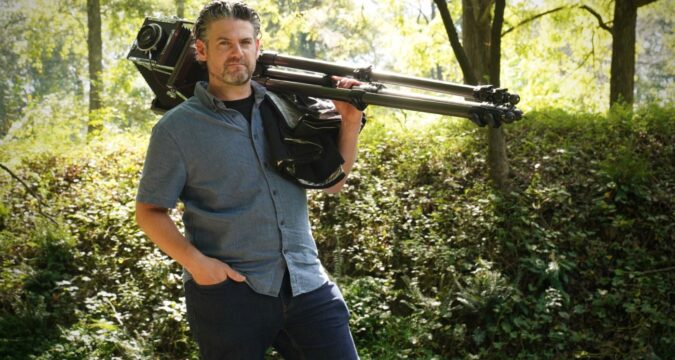
For both of these series, Dudik shot exclusively on an 8×20 view camera, a “banquet camera” traditionally used for large group portraits in the early 20th century. Taking a picture with a banquet camera requires composing an inverted image on a glass screen, then replacing it with film — all under a dark cloth.
“It’s very, very slow and meditative and deliberate,” he said. “And through that you can be very, very precise with everything. Composition, focus, exposure.”
As a professor, he teaches his students to use view cameras. These in-the-moment adjustments replace the need for later digital editing. So for Dudik, editing means wandering until he finds the perfect subject and composition. Sometimes that means hiking as far as need to go with a big camera over his shoulder, looking for just the right vantage point.
Because of the cost and time of large-format photographs, Dudik typically takes only one photograph at each location. “It’s a bit of a challenge,” he said, “but almost always, it’s just one photograph.”
This image taken in Ball’s Bluff is one of photographer Eliot Dudik’s favorites from his “Broken Land” series, which documents lesser-known Civil War battlefields. In it, a dark vignette of tree branches frames the Potomac River, and the white sky meets blue hills on a distant horizon. (Eliot Dudik)
The Library of Congress
Micah Messenheimer, an associate curator at the Library of Congress, first saw Dudik’s works on display in Colorado. He reached out to the William & Mary professor after joining the Library of Congress, expressing interest in “Broken Land,” Dudik’s series documenting lesser-known Civil War battlefields. In a 2019 interview with the Library of Congress, Messenheimer shared his interest in photographers who offer new perspectives on historical events.
“Prints & Photographs has strong Civil War-era collections, and it can be valuable to consider these images in juxtaposition with this historic material,” Messenheimer said.
Dudik agreed that his work provided a “contemporary counterbalance” to traditional Civil War imagery. “Broken Land” (2011-2016) was inspired by Dudik’s time in South Carolina, where he encountered deep anger in rural communities.
“It was frightening how unbelievably upset they were,” Dudik said. “That was what started me, and got me thinking about these divisions in the country and that we were heading in a place that was quite scary.”
He realized these divisions spanned the country, despite blame often being pinned on the South. This influenced his emphasis on battlefields “as far away from the South as possible.” He also aimed to capture landscapes that felt familiar to viewers.
“When I set up the camera to make a photograph, I tried to eliminate a lot of the monuments and canons and things like that, again, in order to make the image feel familiar to people, and feel like it could be their backyard,” he said. “I was trying to bring that idea of ultimate division and conflict to the present, and to their very lives.”
Traveling for his craft
In 2013, Dudik started working on “Paradise Road,” traveling across the country to document roads by that name. He sought to investigate how Americans’ sense of identity and the American dream manifest in the landscape. Working on the projects concurrently, he said, felt odd at times.
“The idea of happiness and fulfillment rather than division and conflict — it was kind of strange to move back and forth, zigzagging across the country.”
Eliot Dudik photographed two men in Hermosa, South Dakota, while capturing images for his “Paradise Road” series. (Eliot Dudik)
Ultimately, Dudik was surprised by the similarity of the Paradise Roads.
“When I set out to do the work, I had expected a great variety of results, and a great variety of subjects and scenes and situations,” he said. “What I found was actually far, far more similar across the country.”
What differed, he said, was why and how “paradise” was used. “I found a lot of Paradise Roads that seemed to use the name of the road as a way of brightening the space,” Dudik said. At the same time, many Paradise Roads were isolated.
“It felt like somebody had achieved success or achieved paradise and then they roped it off and they put ‘No Trespassing’ signs up, and they wanted to make sure that nobody else was going to encroach on their slice of paradise,” he said.
Across diverse landscapes, Dudik’s techniques remain consistent: above all, he prioritizes lighting.
“What I’m photographing, or when I’m photographing, is largely dependent on the light. When I’m traveling around the country, that’s something that has proved to be very challenging,” he said.
His second priority is composition.
“I’m thinking about movement in the landscape, and depth and layering sometimes. Sometimes there’s an opportunity for foreground, middle ground, background elements to sort of weave through the landscape, framing elements that sort of help direct a viewer’s attention from the edges towards the center of the picture and keeps them there,” he said.
One of his favorites is “Balls Bluff, Virginia” from his “Broken Land” series. In it, a dark vignette of tree branches frames the Potomac River, and the white sky meets blue hills on a distant horizon.
“What I like about (Ball’s Bluff) is that it’s very layered,” Dudik said. “You’re up high — the viewpoint is from up high — and you’re looking through all these branches.”
He noted the white barks contrasted colors, and the blurred red leaves in the foreground. “That has this symbolic power, it kind of feels like blood in the context of this work.” This is one of the few photographs he revisited. “I went back multiple times, I think three times, and tried to get a decent photograph there, and that one is the very culmination of that.”
Another favorite is “Paradise Road, Waldo, Kansas,” from the “Paradise Road” series. “I think that photo is very beautiful, and the rolling hills and the desolation of it feels beautiful to me too,” he said, remarking on the vivid reds and oranges of the dusty landscape.
The images Eliot Dudik composes appear upside down and backward as he prepares to create the photograph. (Stephen Salpukas/William & Mary)
A lifelong hobby
For Dudik, taking pictures is not only a career, but also a lifelong hobby and dream. His first photograph, taken in Cub Scouts, was of animal tracks in the snow. “That was intriguing,” he said. “It was like capturing evidence of something.”
Then, his mother lent him a point-and-shoot camera for a trip to Yellowstone with his grandmother. “I remember her being completely shocked when I got back with how many rolls of film I shot, that she had to then go develop. But that was the first time I made a lot of pictures, and was really excited about it.”
He soon bought his own camera and used it incessantly. “I was taking pictures of everything,” he said — even sometimes to his own detriment. “I actually got kicked out of a Coca Cola factory in Baltimore for taking pictures,” Dudik said. “I didn’t realize they weren’t allowing pictures in there. I was supposed to be doing electrical work.”
He studied art history and anthropology at the College of Charleston in South Carolina, then continued with photography in grad school, getting his master’s degree in fine arts from the Savannah College of Art and Design in 2010. He began lecturing at William & Mary in 2014 and is now a full-time associate professor — until the semester ends.
“When I finish a semester I’m often just packing up and heading out immediately, and I’m spending every minute of that time on the road making pictures,” he said.
Dudik combines camping with staying in Airbnbs and hotels to cover as much ground as possible on his projects, which are usually off-the-beaten-path.
“That’s what I love about it. Both for ‘Broken Land’ and ‘Paradise Road,’ it took me off the highway,” he said. “It’s almost exclusively rural America.”
His sheep-farm roots make him most at ease in these types of landscapes.
“It’s the same reason I’m interested in the landscape, and tend to gravitate towards the landscape as a way to communicate,” he said. “I feel at home, and a sort of peace when I ride through the countryside.”
And while he said he doesn’t know if it’s “the dream,” Dudik said it’s definitely his dream to be able to do what he does.
“I feel incredibly fortunate to have the opportunity to do those kinds of things, and kind of forged a life and a career that allowed me to do that.”
Dudik’s work is currently on display at the Muscarelle Museum of Art at William & Mary. His work can also be viewed on his website, EliotDudik.com.
Lelia Cottin-Rack, lcottinrack@gmail.com