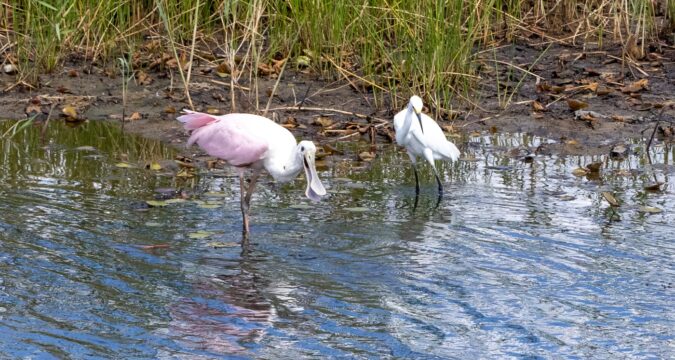
Michael Schimmel sent a photo of a pair of roseate spoonbills spotted at Back Bay National Wildlife Refuge in Virginia Beach. “Imagine my surprise coming across this pair,” Schimmel wrote. The roseate spoonbill is a rare visitor to the Hampton Roads area, normally seen along the coastal southeastern coast where they forage in shallow fresh and saltwater pools.
Cody Chaplain photographed a bald eagle perched on a dead tree branch at Shipp’s Bay in Virginia Beach on a day when the temperature was in the triple digits. “I caught this guy panting in the evening summer sun,” Chaplain wrote.
A bald eagle cools off on a dead tree branch at Shipps Bay in Virginia Beach. (Courtesy of Cody Chaplain)
Michael Schimmel spotted a juvenile yellow-crowned night heron while hiking the trails at First Landing State Park in Virginia Beach.
A juvenile yellow-crowned night heron feeds in the shallow waters at First Landing State Park in Virginia Beach. (Courtesy of Michael Schimmel)
Jean Broughton sent photos of a snowy egret that has been hanging around her house in the Morgans Walke neighborhood in Virginia Beach. “I usually just spot them walking through the water in the woods,” Broughton wrote.
Jane Hughey sent photos of a female hummingbird visiting her hibiscus flowers in the East Lynn neighborhood in Norfolk. By mid-August to September, hummingbirds migrate south and feed mainly in the morning and evening and travel by day.
Ed Obermeyer sent photos of aerial ballets being performed by hummingbirds in his garden in the Castleton area of Virginia Beach. “The hummers are definitely migrating,” Obermeyer wrote.
A female hummingbird performs aerial ballet in the Castleton area of Virginia Beach. (Courtesy of Ed Obermeyer)
Joy Lyon sent a photo of a bumblebee foraging for nectar in her flower garden in the Lynnhaven area of Virginia Beach.
Heather Duggan photographed a black swallowtail butterfly in her garden in the Kempsville area of Virginia Beach. “I had loads of cats on my carrot tops, but the wasps found them and started eating them,” Duggan wrote. “I was able to save six of them, and all six were released over the last week after emerging from their cocoons.”
Sue Rice captured a photo of a beautiful spicebush butterfly that she spotted while on a morning hike in the Great Neck Estates area of Virginia Beach. Spicebush and sassafras are the primary host plants for the spicebush swallowtail.
A spicebush swallowtail butterfly makes an appearance in the Great Neck Estates in Virginia Beach. (Courtesy of Sue Rice)
While Sandra Porter Leon was photographing a ruby-throated hummingbird that was feeding on firecracker blooms in her garden, she spotted a tagged monarch butterfly. “Through MWTAG.org, I hope to trace its journey!” Porter Leon wrote.
Paul Kotarides sent photos of a black swallowtail and a monarch visiting his zinnias and sunflowers in the West Ghent area of Norfolk. “This year has been a banner year for the butterflies visiting my flowerbeds,” Kotarides wrote.
Cody Chaplain photographed a beautiful polyphemus moth that was hanging out on his oak tree in the Pungo area of Virginia Beach. The polyphemus moth is a large silk moth found in wooded areas where oak, hickory and birch grow, the host plants for this large moth.
A polyphemus moth hangs out on an oak tree in the Pungo area of Virginia Beach. (Courtesy of Cody Chaplain)
Connie Owen photographed an amazing looking pumpkin spider in her yard in the Robinhood Forest area of Virginia Beach. Pumpkin spiders are large orb weavers and are named for the orange abdomen that resembles a fat pumpkin. They make their appearance in the fall about the time pumpkins mature.
A pumpkin spider makes an appearance in the Robinhood Forest area of Virginia Beach. (Courtesy of Connie Owen)
While riding her bike through the Lakeside neighborhood near downtown Suffolk, Gin Staylor glanced up and saw what appeared to be a raccoon high up in a tree which had branches that had been removed by Dominion Energy. “We stopped, looked again, and indeed it was a raccoon,” Staylor wrote.
A raccoon looks out from his perch high up in the tree. (Courtesy of Gin Staylor)
Vickie Shufer, wildfood@cox.net
If you go
What: Back Bay National Wildlife Refuge is Accepting Applications for competitive events for 2025-26 season.
When: Deadline for applications is Sept. 30.
More information: Visit fws.gov/refuge/back-bay for applications.
https://www.dailypress.com/2025/09/13/close-encounters-virginia-beach/