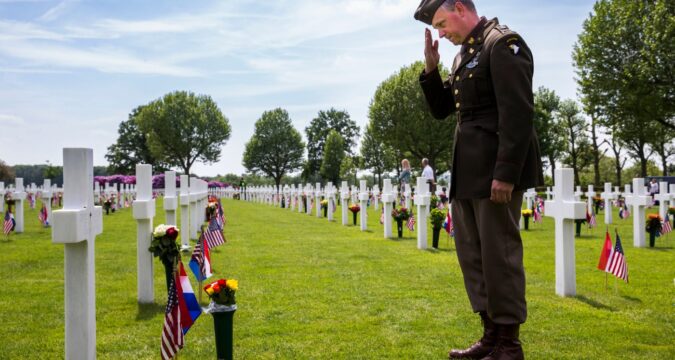
The attempted erasure of Black history within the U.S. military has gotten itself into a quagmire of resistance in a land far away and a time long ago, back to the days of Jim Crow.
In 2024, the American Battle Monuments Commission (ABMC) and the people of the Limburg province of the Netherlands came together in the creation of commemorative panels of the role of World War II Black soldiers in the liberation of Limburg in late 1944, and the building there of the Margraten American Cemetery. The material reflected the recognition of the Dutch people of the two-front war they were fighting at the time against the Nazis and against the rules and norms of American Jim Crow, which traveled with them across the ocean and into the war.
It also reflected recent efforts in the Netherlands to learn more about and make note of 172 African Americans buried at Margraten, including three from our region: John Clark, Jr. and Richard Willoughby of Norfolk, and Alpheus Hughes of Charles City County.
In March, prompted by the Heritage Foundation, the ABMC removed the commemorative material from Margraten, quietly and without comment. Officials and citizens of Limburg have turned angry and activist, including my co-author Mieke Kirkels, with whom I’ve written about the export of Jim Crow to wartime Netherlands and the rest of Europe. She, and others I’ve worked with, will not accept the actions of the ABMC. Members of the Provincial Council have called the removal “indecent” and “unacceptable.”
For the Dutch, the Margraten displays were recognition of what Black soldiers faced in their country in 1944-45. It’s history that should not be forgotten, if it is even known in the present day.
The American fighting force could be no more than 10% Black, and even during wartime was limited to laboring in maintenance, transportation, food services, gravedigging and similar work. Those rare few who fought were not eligible for the military’s highest honor, the Medal of Honor. And they traveled the breadth of the Second World War under the norms and rules of a segregated American society, which the military attempted to duplicate in the foreign societies in which they operated. Black soldiers and white civilians were urged to stay away from each other.
Black Americans did the rehabilitation work of a devastated country. Most notably in Limburg, they excavated and built the Margraten cemetery during the course of a historically brutal European winter and with the unceasing arrival of thousands of dead from the last battles of the war. They were rewarded in the classic book about the development of Margraten, “Crosses in the Wind,” which narrated the unrelenting horror of their work, then described them in the language that catered to the worst stereotypes of the day.
In the most difficult moments of the cemetery’s development, the Dutch people came to work beside them to tame their own requisitioned farmland and to give it grace and beauty with flora from the surrounding countryside. Then they took it deeply into their hearts and care. Each of the eventual 8,300 burials was adopted by the families of the region, and a waiting list to adopt remains to this day. I have been there on a Memorial Day as an American far outnumbered by the Dutch. It is a beautiful place, and as much their place as it is ours.
The remembrance community surrounding Margraten has been proactive since the beginning, and reactive when it needs to be.
Kees Ribbens, Ph.D, is director of the Institute for War, Holocaust and Genocide Studies in Amsterdam.
“Dutch memory culture of WWII,” he told me, “has become more inclusive over the years, coming to realize that war isn’t just about simplistic stories about heroes but comes with pain, ambiguity, and complexity … of what previous generations went through, and we figure out that contemporary societies have a duty to confront the past in a critical way.”
There is a lot to confront here, and I predict in this case that if the ABMC and the Trump administration try to run away from this powerful and human history, they will get to a place about 4,000 miles across an ocean from here and bounce off a wall of enduring resistance. As should be the case here in America.
Chris Dickon of Portsmouth is author of “The Foreign Burial of American War Dead,” and, with co-author Mieke Kirkels of the Netherlands, “Dutch Children of African American Liberators.”