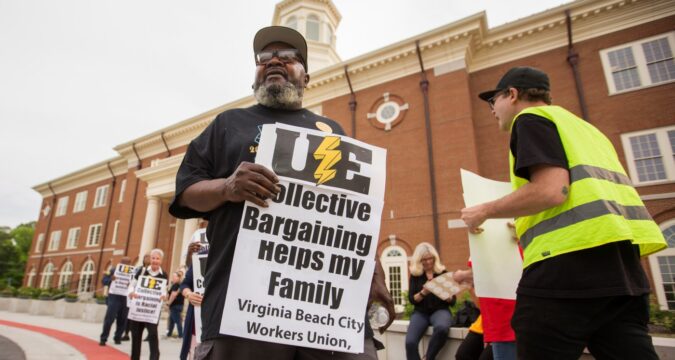
In a Jan. 30 letter, the seven mayors of Hampton Roads did something painfully familiar. They told working people to wait.
They asked workers to wait for a voice, for dignity and for rights that should never have been conditional in the first place. In opposing legislation that would allow public sector workers to decide for themselves whether to organize, these mayors made their position clear. They believe that the choice belongs not to workers, but to the bosses.
In May 2021, Virginia took a small and cautious step forward by allowing some public-sector workers a limited voice in their workplaces. That step came with a fatal flaw. Each city was allowed to decide whether workers would be permitted to organize at all. State employees were excluded entirely. Workers’ rights became optional, granted only when city leadership felt generous.
This year’s proposed legislation corrects that mistake. It establishes an oversight structure modeled on existing national systems and replaces a chaotic, city-by-city approach with a consistent framework. Most importantly, it takes the decision about union representation out of the hands of city governments and places it where it belongs, with the workers themselves.
That is what the mayors are objecting to.
Under the current system, city governments decide whether their own employees are allowed a voice. The conflict of interest could not be clearer, and the result is predictable. When workers whisper the word “union” in break rooms or storage closets, they are met with the same tired responses. “We don’t need a third party.” “We have an open-door policy.” Workers are called team members, partners, even family, right up until they ask for something real.
This language is not accidental. It is designed to replace rights with reassurance and power with patience. Bosses have used it for generations. Whether they are CEOs, robber barons or mayors, the message never changes. We love you, just do not speak up.
What they fear most is not unions. It is choice.
Virginia has heard this song before. In 1947, the state adopted so-called right-to-work laws under the banner of “free choice.” Workers were told these policies protected liberty and political freedom. In reality, they weakened collective power while pretending to expand individual rights.
Those policies did not emerge in a vacuum. They were part of a broader effort to preserve Jim Crow labor systems, an uncomfortable truth that Virginia has never fully confronted.
What makes the mayors’ position especially troubling is its historical blindness. We are in the early days of Black History Month. We have just honored Martin Luther King Jr. Yet these officials appear to have forgotten how King spent his final days.
King was assassinated in Memphis while supporting public sanitation workers who were demanding union recognition. They were asking for dignity, safety, and a voice in their workplace. They marched under signs that declared, “I Am a Man.”
The mayor of Memphis insisted that only the city had the authority to recognize a union. He argued that worker organization was bad for business and unnecessary for employees. King rejected that logic. He understood that civil rights without economic dignity are hollow, and that democracy does not stop at the workplace door.
At the Mason’s Temple, in his final speech, King reminded the world that, “We, as a people, will get to the promised land.” More than half a century later, working people are still being told to wait.
When today’s mayors argue that workers need more time, more flexibility or fewer rights, they are repeating the same arguments used in 1896, 1963 and 1968. They are not standing on the side of progress. They are standing in its way.
This debate is not about budgets or management convenience. It is about whether working people are trusted to make decisions about their own lives.
We are people.
We deserve a choice.
And we will not wait forever.
Paul Trujillo of Yorktown is a 20-year union worker and communications director of Teamsters Local 822 in Norfolk.