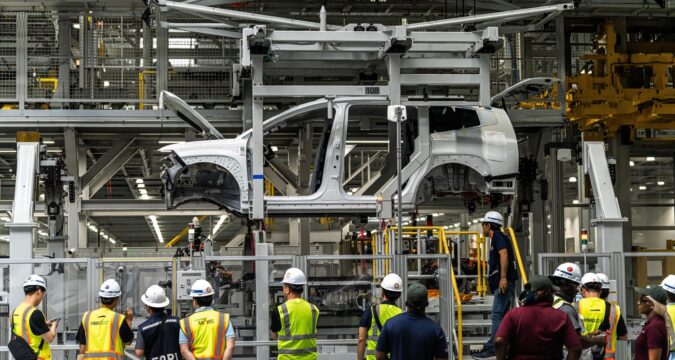
It doesn’t make any sense. Last week, the Trump administration executed the largest single-site immigration raid in U.S. history at a Hyundai Motor Co.-LG Energy Solution Ltd. battery plant in Ellabell, Georgia.
The surprise raid antagonized South Korea, one of America’s closest allies and a country that had signed a $350 billion trade pact with President Donald Trump just weeks earlier. It contradicted Trump’s stated immigration policy of removing the “worst of the worst” by detaining workers employed to help meet Trump’s goal of expanding manufacturing in the U.S. And by releasing video footage of South Korean nationals shackled at the wrists and ankles, Immigration and Customs Enforcement managed to humiliate South Korean businesses and investment firms that had recently pledged billions to expand operations in the U.S.
What’s the upside? It’s hard to see one. Automakers with factories in the U.S. are counting on EV battery deliveries to meet demand. Trump is hoping to stimulate foreign investment in American manufacturing. This raid helps achieve neither.
Immigration attorney Charles Kuck, who represents some of the workers, told MSNBC on Monday that many of the employees at the plant had “valid visas” from the U.S. and were installing the equipment needed to make the batteries “so the plant could then employ U.S. workers.” He said ICE was looking for workers from Latin American countries and didn’t expect to apprehend Koreans, so the agents hadn’t even brought a translator.
It’s starting to look like another bumbling, high-profile error — but it also underscores a major flaw in Trump’s immigration policy. He would like to use his heavy-handed tariff policy to incentivize foreign investment in multibillion-dollar manufacturing plants, but building those facilities requires companies to bring engineers and contractors to the U.S. to help complete the job. The Trump administration has done nothing to make it any easier for the South Korean companies involved with the Hyundai Metaplant America site to secure the work visas needed.
Several officials associated with the project told Bloomberg News that they have struggled to get work visas under the Trump administration, especially for contractors and engineers with expertise in production line design. Complaints have also surfaced recently from members of local unions. Barry Zeigler, the business manager of UA Local Union 188, which represents plumbers, pipe-fitters, welders, and air-conditioning technicians, told the New York Times that about 65 union members had been initially hired at the plant but were laid off earlier this month. He claimed they were replaced with undocumented workers.
The Trump administration should have sorted out the labor complaints from both sides of the equation here. Trump’s Border Czar Tom Homan and ICE should have given the South Korean companies a firm deadline to make sure their employees had valid and up-to-date visas, and then put in place a process to fast-track those visas.
But of course, that kind of response would not have produced the headlines or sensational videos. And it would have required leadership and political finesse — skills that Trump’s Homeland Security team seems not to possess.
The raid also made no sense politically. When Georgia Gov. Brian Kemp, a Republican, unveiled the $7.6 billion Hyundai Motor Group deal in 2022 — with nearly $2 billion in taxpayer-funded incentives — he predicted it would help Georgia become the hub of U.S. electric vehicle manufacturing. Now, the raid has turned one of Kemp’s greatest achievements into a liability.
Trump has not had smooth relations with Kemp since the governor refused to go along with his illegal quest to manufacture votes in 2020, but Kemp has otherwise been a reliable foot soldier. Kemp doesn’t have authority over immigration enforcement. Trump does, but his administration’s focus on deportations over governing is no way to revive manufacturing in this country. The U.S. is long overdue for an overhaul of its work visa program, and the Georgia fiasco should be the catalyst.
Mary Ellen Klas is a politics and policy columnist for Bloomberg Opinion. A former capital bureau chief for the Miami Herald, she has covered politics and government for more than three decades.