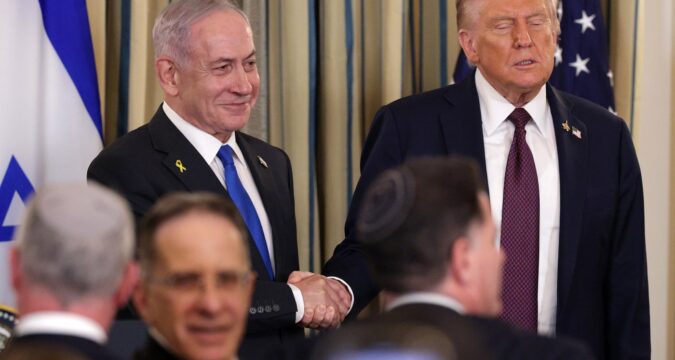
President Donald Trump’s latest plan for ending the war in Gaza has potential to add a genuine peace-making success to his growing list of imaginary ones. But if this proposal is no longer silly, it is not yet serious. It remains too short on critical details and, to qualify, would need more than the three or four days he has offered for negotiations.
The test of this proposal will not, after all, be whether Hamas is happy accept it quickly. Hamas is not a negotiating partner, but the problem that needs solving. This deal aims to write it out of Gaza, exile its leaders and disarm its foot soldiers. That would be good for Gazans, Israel and the region, but not for Hamas, whose ability to use the territory as a base from which to pursue its jihad against Israel’s existence would be severely curtailed.
The test of these draft terms of surrender is, instead, whether they can unite ordinary Palestinians behind them, together with not just those Middle Eastern powers — Egypt, Jordan, Saudi Arabia and the United Arab Emirates — that oppose the Muslim Brotherhood from which Hamas originated, but also those that support it, including Qatar and Turkey. That’s what it will take to pressure Hamas into accepting its defeat.
The potential is there, but while support is gathering that is not the same as commitment. It’s telling that the agreement does not name any of those regional powers as owners of the project, that is, contributing to its financing or its international security force.
Trump’s 20 points get a lot right. That includes a top-line focus on securing the release of all remaining hostages, dead or alive, in exchange for a permanent end to the war; likewise, the offer of amnesty or exile to Hamas fighters who accept the deal and hand over their weapons. Most welcome above all is the explicit pledge that Gaza’s Palestinian population would be able to stay where they are, return if they do choose to leave, and benefit from reconstruction.
However, timing, sequencing and guarantees are always critical to the kinds of deals that successfully persuade warring parties to lay down their arms. In these areas, the published text is woefully vague. Too much has to be taken on trust, in an environment where there is none.
That applies to when Israel would fully withdraw its military and to where; who will enforce the deal and how; who will pay how much for reconstruction; and what will be the modalities of the re-transition to Palestinian self-rule. Nor is there any timeframe or indication of a mechanism for the promise to put Palestinians on a path to statehood. This remains key to gaining genuine buy-in from any regional actor but Israel.
Israel’s neighbors have reason to be cautious, as do Palestinians. Prime Minister Benjamin Netanyahu’s public comments on the agreement suggest he sees it as a ticket to continuing Israel’s “security control” of Gaza, and to creating security buffers within it that would require permanent occupation.
Maybe Hamas will fold. Maybe Arab governments will jump onboard, even with Israeli troops still present and holding the ring. Everything is possible. But, even then, the approach would not bode well for the sustainability of any peace achieved.
It isn’t Hamas, but Israel’s Arab neighbors with whom Trump should be negotiating the terms of this deal. If Trump can build that consensus, Hamas will not be happy. Netanyahu’s far-right cabinet members will not be happy. And that will be the time to deliver an ultimatum and deadline to both. The backing achieved from regional leaders as well as from the vast majority of Palestinians and Israelis will provide the pressure, resources and engagement needed for such a deal to work. If a little time is taken, Trump’s Gaza Plan 2.0 can become not only serious, but successful.
Marc Champion is a Bloomberg Opinion columnist covering Europe, Russia and the Middle East. He was previously Istanbul bureau chief for the Wall Street Journal.
https://www.dailypress.com/2025/10/08/column-trumps-gaza-plan-needs-israels-neighbors-to-buy-it/