After running a campaign centered on Virginia’s energy-affordability crisis, Gov.-elect Abigail Spanberger pledged in her victory speech to make sure data center operators and utilities “pay their fair share.”
That promise matters — not just politically, but substantively. Spanberger named one of the toughest challenges facing Virginia’s leaders: how to tackle rising energy bills and the mounting impact of data center growth on local communities.
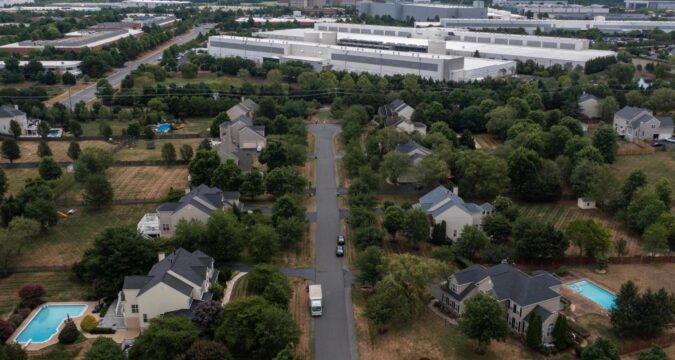
Nowhere on Earth has a higher concentration of data centers than Virginia. To power the next generation of artificial intelligence, there are already roughly 10 gigawatts of these energy-hungry complexes — or about one-third of the total generating capacity of Virginia as a whole — and demand is surging. That strain is driving up prices for everyone.
We’re the co-founders of an electrification nonprofit focused on money-saving energy solutions for communities. As the new administration begins its transition, there’s a clear path forward to show what paying a “fair share” really looks like.
It starts with electrifying households. Our analysis shows that if data center operators help fund electric home upgrades, they can turn Virginia’s homes into active energy assets — unlocking the capacity they need while lowering bills and strengthening the grid. It’s a win for families, a win for hyperscalers, and a win for the commonwealth’s clean-energy future.
For example, converting the 440,000 Virginia homes that still rely on inefficient electric resistance heat to modern heat pumps would create about 1.6 gigawatts of capacity and save families roughly $1,500 a year. Pairing rooftop solar and home batteries on suitable single-family homes adds another 4 gigawatts, all at costs below most new generation. Together, that’s 5.6 gigawatts — about a quarter of Virginia’s projected demand growth over the next five years.
Compared to the alternatives, using our homes to meet rising energy demand is the fastest, cleanest and fairest way to get the job done.
First, the speed. Building new power plants and transmission lines takes years — often close to a decade — to permit, finance and connect. Home upgrades can be deployed within months, delivering capacity faster and without the red tape.
Second, the emissions. Virginia has committed to 100% carbon-free power by midcentury. Adding new gas or reopening coal plants would only set the state back while increasing water use and pollution. Household upgrades reduce emissions and system strain while helping keep those goals on track.
Finally, fairness. Upgrades let neighbors living beside the data center boom share in the benefits. Instead of opening their mail to higher bills, they get lower costs, more comfortable homes, and higher resale values. Families aren’t left to shoulder new infrastructure costs alone.
This approach also keeps Virginia competitive. The data center industry contributes $9 billion to the economy each year. Rather than slowing that growth, homeowner-centered solutions allow it to continue while putting savings back into local communities — supporting restaurants, shops and small businesses. They also create steady, local contracting jobs that can’t be outsourced or automated.
With the election behind us, commonwealth leaders should move quickly to deliver on voters’ concerns about affordable, reliable energy. The governor should call on the State Corporation Commission to recognize verified heat pumps, rooftop solar and home batteries as real, measurable capacity. Data center operators should help fund these upgrades in the communities where they build, and the General Assembly should expand workforce training and streamline permitting to make it happen.
Together, that’s a fair deal for Virginia — more capacity, lower bills and less friction for growth. As data centers continue to expand, the state’s energy future doesn’t have to be a zero-sum fight between families, the economy and the environment.
With Tuesday’s mandate, Gov.-elect Spanberger and state leaders can make households the heroes of Virginia’s energy story — cutting costs, cleaning the air and driving new economic growth. That’s how to deliver real gains for the commonwealth.
Alex Laskey of Washington, Virginia, and Ari Matusiak of San Diego, California, are co-founders of Rewiring America.