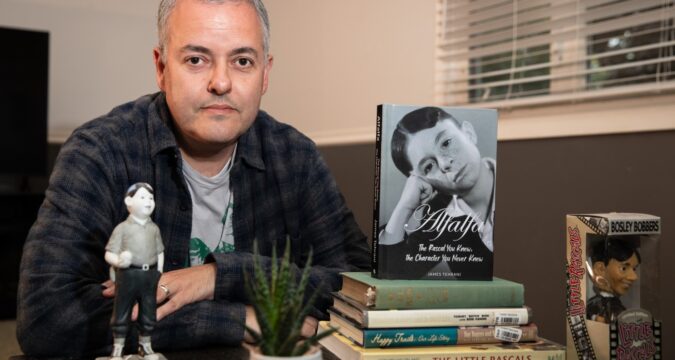
Of all the minor memories that kids carry into adulthood, some of the dearest and most vivid are the faces of other kids, the little characters met on movie or TV screens.
For James Tehrani, one of those faces is that of Alfalfa, who he first encountered on a Zenith TV set in the basement of his grandparents’ home. He and his twin brother Justin were especially fond of all the characters who cavorted in the TV rebirth of the “Our Gang” film series as “The Little Rascals” shows, along with Spanky, Darla, Porky, Buckwheat and the playful others.
At the time, in the early 1980s, Tehrani didn’t know anything else about the “real” Alfalfa, an actor named Carl Switzer, or the others who, he now says, made “an endearing package. Their personalities resonated with every innocent smile, gulp, mispronunciation or funny gesture.”
Of course, Tehrani would give up childish things and move into adulthood and by the late 1990s, he was a successful journalist, working here for Electronic Media magazine, married and living in the suburbs with two young children.
And that’s when Alfalfa came back into his life, in the form of an announcement of a new edition of “E! Mysteries and Scandals” titled “Alfalfa and the Gang,” broadcast on the E! network.
He watched the program and was especially intrigued when Alfalfa was referred to as “a pint-sized ‘Dirty Harry.’” He was ravenously curious about Switzer’s life post-“Our Gang.”
“I knew nothing at the time about his early demise or reputation as a difficult kid, perhaps even a bully,” he said. “I wanted to know more and went looking for a book, but couldn’t find one.”
He wanted to write one, deciding “the time was finally right to take the plunge and a deep dive into his life to become Alfalfa’s first biographer.”
But that dive wouldn’t begin until 2020, when his kids were grown and his career was on steady ground. Five years later, he now knows more about Carl Switzer/Alfalfa than anyone on the planet, and the proof peppers the pages of his entertaining book “Alfalfa: The Rascal You Knew, the Character You Never Knew.”
“It took me five years to tell his story,” writes Tehrani. “And while his sensational death is certainly one of the main reasons I thought this project was a worthy one to pursue, what I challenged myself to do was try to figure out why he became such a polarizing figure.”
How polarizing?
As Tehrani writes, “One source I contacted called him ‘a dirty son of a (expletive) who took money from everyone’ before hanging up on me. Another source told me ‘He was absolutely hysterical to be around. He was always funny. He was a wild, crazy guy.’”
Tehrani is able to provide a full and compelling portrait of this man, from childhood in downstate Paris, where he and a brother became noted for their musical talent; discovery in Phoenix and Hollywood and being cast in “Our Gang” shorts, with ever increasingly public popularity; struggling to find film work after leaving the series in 1940, when he was 12, but appearing in blink-and-you’ll-miss-him parts in such films as “It’s a Wonderful Life” and “Pat and Mike”; becoming a noted dog breeder and hunting guide for such high-profile clients as Henry Fonda and Roy Rogers and Dale Evans; marriage to an heiress named Diantha Collingwood and the birth of a son in 1956; divorce the next year and, in 1959, a disagreement that led to his death at 31.
It is a life story enlivened by Tehrani’s tireless research and smoothly propulsive writing style. His subject is not, of course, the only former child star to come to a mournful end. The showbiz landscape is littered with such lives. But Tehrani doesn’t sensationalize. He is admirably even-handed and has interviewed dozens.
He tells me, “This was tough, a hard story to tell. There were some real frustrations and every time my research would turn a new corner, I wound up saying, ‘This just can’t be real.’ But it was. The only person I was not able to connect with was Switzer’s son, but I understood why. He had distanced himself from his father, being only 3 years old when he died.”
Tehrani is gratified by the praise that has come his way on the internet, where “Our Gang” fans keep up lively conversations.
It is not difficult to find Switzer a sympathetic figure, in part because Tehrani is wisely nonjudgemental. But he is terrific at clearing up some of the misinformation that has shadowed Switzer’s life and what keeps many so-called grown-ups tied to the past.
As he writes “As you grow older, you yearn for a simple time… No matter how hard we deny it, we are all kids at heart in some way, shape or form because our childhood is a big part of who we are as adults.”
rkogan@chicagotribune.com
https://www.chicagotribune.com/2025/09/09/james-tehrani-alfalfa/