For something so admired, so synonymous with merit, the concept of intelligence is remarkably poorly understood. Our society operates on the assumption that people with greater intelligence deserve access to better schools and better jobs. Many people believe that animals with higher intelligence deserve to be treated more humanely, or at least not used for food. Our tech leaders obsess over comparing human intelligence with the latest AI systems. Many claim that once these systems surpass us in intelligence, they will quickly enslave us, destroy us, or solve all our problems.
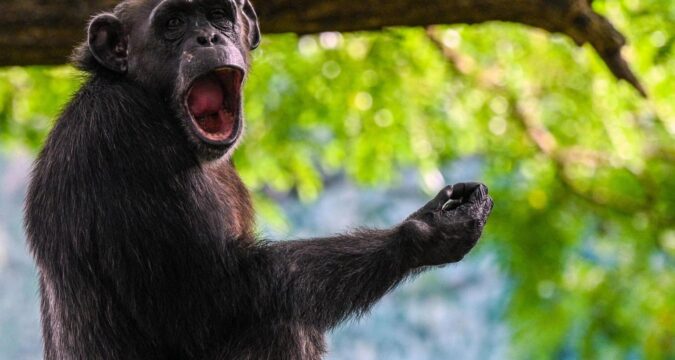
Scientists who study human or animal behavior and brainpower were impressed by a recent paper providing experimental evidence that chimpanzees can use reasoning to weigh different strengths of evidence, draw rational conclusions, update beliefs, and recognize the strengths and weaknesses of their own knowledge.
This finding refutes centuries of philosophy that equated reason with human uniqueness, but it makes sense in evolutionary terms, given our relationship to chimps and the understanding that human traits were inherited and shaped by natural selection rather than bestowed by gods. “It’s the strongest evidence yet that we share the planet with another rational being,” said Duke University evolutionary anthropologist Brian Hare, who praised the new research in a commentary piece for Science. The significance isn’t about measuring the amount of chimp intelligence, but in understanding how our animal relatives think.
Alison Gopnik, a psychology professor at the University of California, Berkeley, who has pioneered techniques for studying the cognitive abilities of babies and children, explained that in our culture, intelligence is often seen as a mysterious, magical substance people are born with in varying quantities. “It’s this really funny kind of folk idea, and it’s very prevalent among AI researchers,” she said, “and it doesn’t make any sense from the cognitive science perspective.”
What does make sense, she said, is the latest evidence showing that animals can reason. The project was similar in some ways to experiments she’s conducted with preschool-age children. The researchers worked with orphaned chimps rescued from the wild and living at the Ngamba Island Chimpanzee Sanctuary in Uganda.
The chimpanzees were asked to choose between two canisters that might contain a treat, such as apple slices. In some cases, the researchers used a transparent window to let the chimps see where the treats were, while in others, they shook the containers so the animals could hear whether anything was inside.
Sometimes the researchers would add, remove or alter evidence, then give the chimps a chance to change their minds and choose the other canister. In one case, they even presented the chimps with “fake news,” revealing a picture of fruit rather than the real thing. The chimps then discounted the false evidence, recalled other weak clues, and used them to get the correct answer.
F.D. Flam, science writer for Bloomberg
Many animals update their beliefs through learning, said Gopnik, but this experiment demonstrated something new; the animals were not just learning but weighing evidence, both new and remembered. And they combined all that information to decide whether they had good reason to change their minds. That requires what Gopnik calls metacognition — the ability to evaluate what they know and what they don’t.
Coincidentally, this month, Science reported that ChatGPT and similar systems are programmed to lack strong metacognition. As many users have noticed, these systems often give confidently incorrect answers rather than admitting they don’t know. The training, as Science reported, is designed to “reward confident guesses and penalize honest uncertainty.” Chatbots might have superhuman language skills and instant access to vast amounts of accumulated human knowledge, but they lack curiosity and the kind of probabilistic logic that’s critical for sound judgment.
We’re driven to equate higher rank with dominance, and so it feels natural to assume that if intelligence determines rank, and AI climbs above us, it will dominate — or even drive us to extinction. But then, destroying or crowding out animals that have so much to teach us about ourselves isn’t very intelligent.
F.D. Flam is a Bloomberg Opinion columnist covering science.
https://www.orlandosentinel.com/2025/11/22/f-d-flam-ai-thinks-its-smart-chimps-may-beg-to-differ/