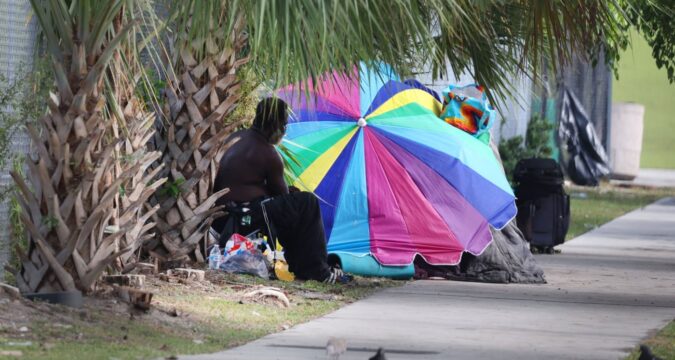
One year ago, HB 1365 took effect across the state. The bill prohibits counties and municipalities throughout Florida from allowing “public sleeping” or “camping.” Violators face citations, fines and jail time, while noncompliant counties may be sued. The bill is intended to counteract issues related to homelessness, and, on its face, this sounds good — cleaner streets, fewer homeless in public parks and other public spaces, and perhaps improved public safety.
There’s just one issue — it doesn’t fix the real problems.
Florida’s issue isn’t homelessness itself; it’s a lack of affordable housing and poor treatment for mental illness and substance abuse.
Homelessness is a multifaceted issue. Mental health challenges are prevalent among the homeless population. The experience of homelessness often exacerbates these conditions. Roughly one-third of homeless individuals also struggle with substance abuse. Yet, homelessness is not only a public health concern; it is fundamentally an economic issue.
Nowhere is this clearer than in Florida’s housing market. It occurs when demand for housing, especially affordable housing, exceeds supply. Rising housing costs intensify this imbalance, with research consistently showing a direct connection between unaffordable rents and higher rates of homelessness. More than 2.4 million households in Florida spend over 30% of their income on housing, placing them at an increased risk for homelessness.
Patrik Ward is an economics student at the University of Tampa. (courtesy, Patrik Ward)
Among the homeless population suffering from addiction or mental illness, treatment rarely works without stable housing. “Housing First” programs are known to be more effective and more economical than the alternatives. So, addressing Florida’s housing, even from this point of view, is not separate from the solution; it is the foundation.
HB 1365 does precisely nothing to increase housing supply; it simply tries to hide the homeless from public view. Hiding that problem isn’t cheap — and those paying the price are police officers, emergency rooms and the Florida taxpayer.
People without housing are more likely to seek medical treatment in emergency rooms, often for preventable conditions. Emergency room care is the most expensive form of treatment, and taxpayers pick up much of the bill through Medicaid, local subsidies and uncompensated care. A law that indirectly funnels individuals from sidewalks to stretchers does not save money; it exacerbates costs.
At the same time, policing public sleeping and camping diverts public safety personnel and resources toward sweeps, arrests, court appearances and incarcerations. These short-term measures do little to reduce homelessness, often pushing people further from stability.
Abigail R. Hall is an associate professor of economics at the University of Tampa. (courtesy, Abigail R. Hall)
Supporters of HB 1365 also argue that encampments burden businesses and quality of life. This point is well taken. No one wants someone sitting in front of their business, potentially deterring customers. But if business owners don’t like the idea of losing customers due to the presence of the homeless, they really won’t like the cost of pretending they don’t exist.
Ignoring the root cause of homelessness creates down sides as well. Pushing people out of encampments without offering long-term alternatives increases repeat encounters with police and emergency rooms, driving up public costs. Individuals forced into this cycle often lose what little stability they had, making recovery harder and lengthening the time spent homeless. The result is more preventable hospital visits, higher uncompensated care, and an entrenched cycle of arrests and court costs. The “cure” becomes more expensive than the “disease” itself. Businesses may feel relief when tents disappear, but they still pay indirectly through local taxes and insurance premiums.
So, what can we do differently?
There are better options. Florida could tailor policy to increase the supply of affordable housing through expanded local tax incentives for developers, zoning reform and workforce housing initiatives. Short-term rental assistance programs can help keep families in homes before crises occur. “Housing First” programs could provide foundations for treatment, employment and stability. These approaches do not simply move people out of sight; they reduce long-run costs while building healthier, safer communities.
HB 1365 is a taxpayer-funded shell game. It works to disguise the true costs of ignoring homelessness. In the end, taxpayers pay more, health care systems are strained further, and the shortage of affordable housing remains unaddressed.
Floridians deserve evidence-based policy, not empty, symbolic gestures. Real solutions begin with housing and health care — not handcuffs or hospital beds.
Patrik Ward is an economics student at the University of Tampa. Abigail R. Hall is an associate professor of economics at the University of Tampa.