Growing up, my rabbi in Altamonte Springs often stressed the difference between rights and responsibilities. He used this distinction to highlight how we as young Jews might view biblical commandments. The Ninth Commandment, for example, tells us not to bear false witness against our neighbor — in other words, don’t lie. My rabbi noted that there might not be a quick punishment for breaking this commandment — God is unlikely to immediately strike us down after a lie. However, even if we as humans have the right to lie, the Ninth Commandment reminds us that lying is not the responsible action to take for those who want to make the world a better place.
This lesson is more relevant than ever. Across the country, politicians are debating redrawing congressional districts purely for partisan gain. Even though it’s 2025, they’re considering redistricting outside of the typical redistricting cycle that occurs every 10 years after the census. Republican legislative majorities in Florida, Indiana, Missouri and Texas are responding to explicit pressure from the White House to find more Republican congressional seats before the 2026 midterms. In response, Democrats in California and New York are promising to retaliate by passing their own highly partisan gerrymanders.
How did we get here? This standoff has its roots in a 2019 Supreme Court ruling, Rucho v. Common Cause. The Court declared that while “[partisan] gerrymandering is ‘incompatible with democratic principles’…[such] gerrymandering claims present political questions beyond the reach of federal courts.” In other words, the Court acknowledged that partisan gerrymandering is bad for democracy. However, they did not believe the Constitution provides federal courts with the power to fix the problem by invalidating the partisan gerrymanders.
Since then, politicians from both parties have misconstrued the Rucho ruling. Some have taken it as providing free rein to politically gerrymander. Texas State Rep. Carl Tepper (R), who sits on the redistricting committee in the Texas House of Representatives, said it clear as day: “We are allowed to be partisan in drawing on the maps and that’s what we’re going to do. The courts have been very clear on that and that’s absolutely what we’re doing.”
However, Tepper is wrong. The Court only limits federal courts’ jurisdiction in partisan gerrymandering cases but does not bless this kind of election hacking as legal, constitutional or democratic.
Power-hungry party hacks might respond, “So what? If the Supreme Court will not enforce any restrictions, why should we care? We have the right to draw the boundaries to benefit our party, so we will.” However, all Americans should acknowledge that political gerrymandering is not the responsible action to take for those who want a more perfect union.
We should remember President George Washington’s warning about political parties: “engines by which cunning, ambitious, and unprincipled men will be enabled to subvert the power of the people and to usurp for themselves the reins of government.” Uncompetitive congressional districts lead to lower voter turnout and increased political polarization. More political polarization leads to worse policy outcomes, as both Democrats and Republicans rush to overturn policies enacted solely by the other party. Conversely, legislation passed in a bipartisan fashion is more likely to stick around, providing more certainty for both businesses and consumers as they plan for the future.
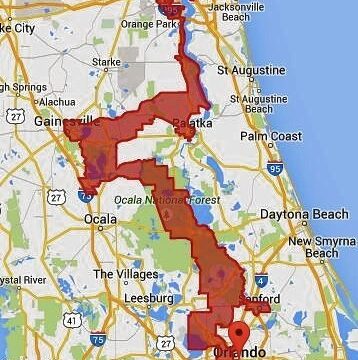
For those who favor a responsible government, the Rucho majority spells out how we can fight partisan gerrymanders: Congress and the states are free to pass laws to restrict partisan gerrymandering, and state courts can apply state law to restrict such gerrymanders. We should call on Congress to use this opportunity to adopt one of the many proposed anti-gerrymandering bills to ban the practice nationwide. In Florida, I hope state courts will continue to uphold the anti-political gerrymandering parts of the Fair Districts Amendments, as they did in 2015.
In his final concurrence before retiring, Justice Anthony Kennedy reminds us that “there are numerous instances in which the […] actions of Government officials are not subject to judicial […] intervention. That does not mean those officials are free to disregard the Constitution.” If Congress or state legislatures fail to restrain themselves, I encourage everyone to elect candidates from either party that will place their responsibility to the Constitution and its ideals above any quick right to political power.
Ryan Mackler is a native of Lake Mary. He graduated from George Washington University in 2021 and served as a Fulbright fellow to Jordan from 2022 to 2023.
https://www.orlandosentinel.com/2025/09/12/commentary-gerrymandering-is-legal-but-irresponsible/