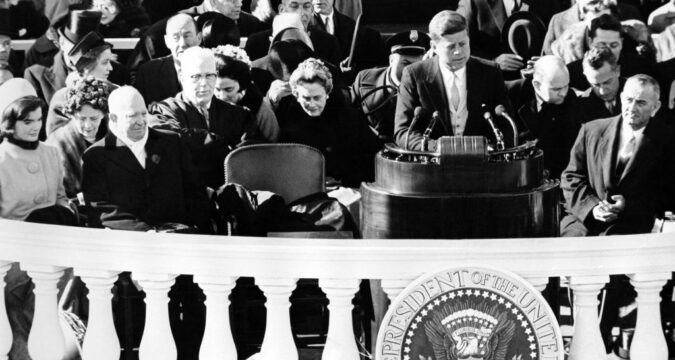
The authors of the 25th Amendment to the Constitution established and explained the complete order of presidential succession, as well as a series of contingency plans to fill any executive vacancies. It was written as a response to the weaknesses found in Article II after the assassination of President John F. Kennedy and what was learned about the inadequacies related to presidential illnesses and hospitalizations.
It feels like the time is not only right but needed for another updated response.
On June 27, 2024, Americans joined the rest of the world in watching the infamous presidential debate between then President Joe Biden and then former President Donald Trump. Yet, despite watching with our own eyes a president of the United States seemingly unable to complete a coherent thought during the debate, Biden remained in the presidency for 207 days afterwards.
The attention immediately went to the presidential race, and very few focused on whether or not Biden could complete his term in office. So as America grapples with an aging political class, the question of reforming the 25th Amendment must become part of the country’s discourse.
The 25th Amendment to the Constitution, ratified in 1967, was designed to address presidential succession and disability in an era of nuclear weapons and global superpower responsibilities. Yet nearly six decades later, this constitutional provision has proven inadequate for the realities of modern governance, revealing dangerous gaps that leave America vulnerable during presidential health crises.
The amendment’s most glaring weakness lies in Section 4, which addresses presidential incapacity when the president cannot or will not acknowledge their disability.
The process requires the vice president and a majority of cabinet members to declare the president unable to perform their duties — a standard that is both too vague and too political. What constitutes “inability to discharge the powers and duties” remains undefined, leaving interpretation to officials who serve at the president’s pleasure and may face retaliation.
Cabinet members, appointed by and loyal to the president, are unlikely to vote against their benefactor except in the most extreme circumstances. The amendment essentially asks political appointees to commit political career suicide while navigating a constitutional crisis — a recipe for paralysis and politicization when decisive action is needed most.
The amendment should define specific criteria for incapacity, including mental illness, cognitive decline, substance abuse, or any condition that substantially impairs judgment or decision-making capacity. The determination process of a president’s capacity should be removed from purely political actors. Instead of relying solely on cabinet members, a reformed amendment could replace the current system’s reliance on political intuition with medical expertise.
An update to the amendment must also account for technological and national security realities unknown to the 1960s drafters. The president’s role in nuclear command and control requires special consideration. The procedures for transferring such responsibilities cannot wait for lengthy political deliberations.
The reformed amendment should also address transparency and attempt to restore public trust and confidence. While medical privacy deserves protection, the American people have a right to know about their president’s fitness for office. Additionally, the amendment should address succession beyond the vice president more comprehensively.
With our current hyperpolarized society, changes are not likely to be enacted, especially because the amendment process is arduous and is intentionally difficult, requiring a broad consensus that reflects the gravity of changing our fundamental law.
Reform advocates should emphasize that a stronger 25th Amendment protects the presidency itself by ensuring smooth transitions and public confidence in executive leadership and that the proposed reforms serve the national interest rather than partisan advantage. A clear, fair, and efficient system for addressing presidential incapacity strengthens rather than weakens our constitutional order.
The 25th Amendment was a crucial step forward in 1967, but constitutional evolution must continue. By addressing its shortcomings now, we can ensure that future generations inherit a more perfect system for preserving democratic governance in times of crisis.
Lynn Schmidt is a columnist and Editorial Board member with the St. Louis Post-Dispatch.