The recent announcement from the Florida Surgeon General that the state will work to eliminate all vaccine mandates weighs heavily on us. As developmental psychologists, we have dedicated our careers to teaching college students about the conditions that enable children to thrive and to advocating for the well-being of children. We are also daughters of polio survivors, who’ve witnessed firsthand the lifelong consequences of this devastating disease.
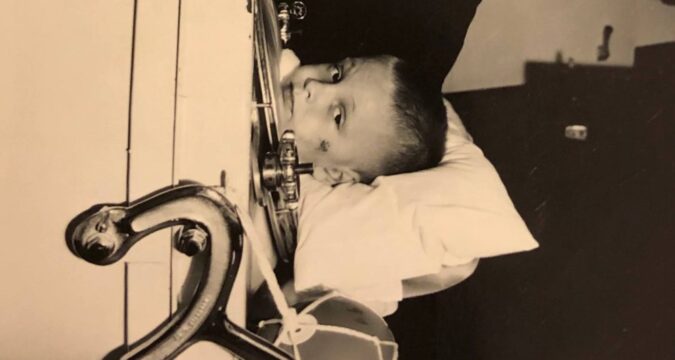
On an October football Friday night in Dripping Springs, Texas, Alice’s grandparents, Dot and Nelson, left their daughter with friends before rushing their feverish, nauseous four-year-old son to the hospital in Austin. As they prepared to leave their home early Saturday, Nelson grabbed the polio insurance policy he’d purchased. The year was 1951, and Alice’s dad, Mike, would not return home for five months.
Mike Davidson (age 4) in an iron lung at Brackenridge Hospital in Austin, Texas in 1951. (Photo courtesy of Alice Davidson)
Mike was diagnosed with polio and became paralyzed from the neck down. He was moved to a rehabilitation facility where he remained for months — mostly flat on his back, sometimes in an iron lung. His parents and sister were permitted to visit only two hours a week on Sundays. The toll on a small child and his family is hard to fathom. Although Mike regained the use of most limbs and went on to become a loving husband, father, and attorney, he lived with permanent paralysis in his left arm and endured physical challenges until his death at 66.
Sharon’s father was leading a wilderness canoe trip in the Quetico in 1953 when a forest ranger’s plane landed to whisk him away to his wife in Chicago, where she had just been hospitalized with polio. Newly married and pregnant, Marene Carnahan spent her whole first pregnancy in an iron lung in an open gymnasium filled with respirators. The baby was delivered via C-section inside the machine. The family asked the doctor: “How bad is the baby?” He replied, “She has 10 fingers and toes, and as far as we can tell, she can see and hear.” All wept for joy.
It was a year of therapy before Marene could hold baby Ellen on her own. Like one in 75 survivors, Marene was left partially paralyzed in her stomach, neck, chest muscles and one arm. She walked slowly, always in pain, and often had pneumonia. Still, she was Sharon’s Girl Scout leader, reading companion, and algebra teacher. She died of polio’s complications at age 42.
Sharon Carnahan is professor emerita and Alice Davidson is a professor of psychology at Rollins College. Sharon is the former and Alice is the current executive director of the Child Development and Student Research Center at Rollins.
These stories remind us how fragile public health can be without vaccines. There is no cure for polio, but it can be prevented with vaccination. Along with Mike and Marene, polio paralyzed or killed more than half a million people worldwide every year during the 1950s. Thanks to global vaccination efforts, there were few cases of wild poliovirus (WPV) and circulating vaccine-derived poliovirus (cVDPV) in 2023. This progress must not be taken for granted.
Vaccine safeguards are strong: rigorous clinical trials, regulatory review and continuous monitoring. Some vaccines never make it to market because they fail these tests. Confirmed vaccine injuries are extraordinarily rare — about one in every 400,000 doses. The system isn’t perfect, but it has saved millions of lives.
Florida is a global crossroads. Orlando alone welcomes more than 75 million visitors annually. In these crowded spaces, diseases like measles can spread rapidly, infecting about 20 people for every one case. A 2025 outbreak in rural Texas gives us a glimpse of what could unfold in a densely populated, tourist-heavy environment like Central Florida. And while polio no longer circulates in the U.S., the virus still exists in the environment and can reemerge if vaccination rates fall.
In the 1990s, Japan eliminated vaccine mandates under pressure, but immunization rates remained high because scientists were trusted. The U.S. is different. Here, skepticism of science is rising. When parents assume others are vaccinated and skip their own child’s shots, dangerous outbreaks follow.
If trends continue, child-care workers may find themselves responsible for spotting measles among toddlers. Schools could close for weeks when pertussis spreads. We may once again see babies born blind or deaf from congenital rubella. We will see families losing work time, children suffering needlessly, and health systems overwhelmed by preventable outbreaks.
We must not turn our backs on public health in the name of personal freedom. Vaccines work only when most of us participate — 95% for measles, 80% for polio. When vaccination rates slip, diseases spread. Our parents’ generation endured the horrors of polio so that ours would not. Let us honor their witness by protecting today’s children with the tools they never had — safe, effective vaccines.
Sharon Carnahan is professor emerita and Alice Davidson is a professor of psychology at Rollins College. Sharon is the former and Alice is the current executive director of the Child Development and Student Research Center at Rollins.