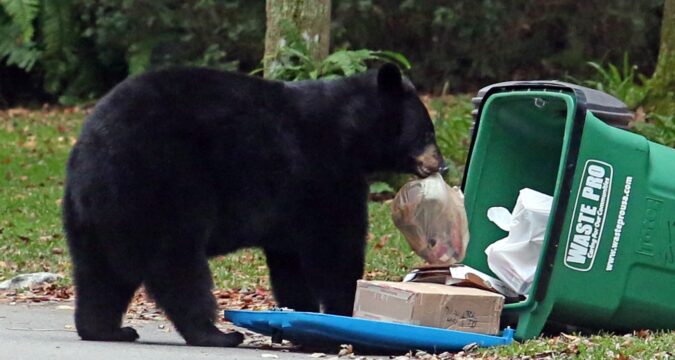
As I recently watched the Florida Fish and Wildlife Conservation Commissioners hastily approve the annual hunting of Florida black bears, one thought crossed my mind: It’s time we had a conservation commission that actually knows — and values — biology, recovery and wildlife science.
Despite commissioners throwing around the term “science-based management,” their decision was riddled with logical inconsistencies that cut against available science and the agency’s own black bear management plan. A term used often enough, and in enough contradictory ways, loses all meaning.
Regardless of your opinion on black bear hunting in Florida, everyone can likely agree on one thing: Science should drive wildlife management decisions. So why doesn’t it?
The FWC’s staff certainly has immense scientific expertise. The commission not only has a host of wildlife biologists spread across the state, but it also has nine staffers who are “specifically trained and solely dedicated to bear management.”
But the scientists are not the decisionmakers. The commission itself is composed of seven politically appointed commissioners who serve five-year terms. They’re appointed at the discretion of the governor and confirmed by the Florida Senate. No baseline qualifications are required to be on the commission.
Under the current administration, the commission is headed by real-estate acquisition and land-development representatives, with little to no experience or education in wildlife management or demonstrated commitment to conserving wild Florida.
Unfortunately, as the recently approved bear hunt highlights, commissioners can direct proposals regardless of the expert recommendations of staff biologists and the opinions of the vast majority of Floridians.
I was present at the FWC’s December 2024 meeting in Lakeland where staff presented to the commission about the Black Bear Management Plan. Staff first detailed how a lack of management and over-hunting had reduced a population of more than 11,000 bears down to only a few hundred. Then staff explained how the FWC’s recovery efforts have helped that number rebound to an estimated 4,000.
The FWC staff’s remarkable work has helped pull many of Florida black bear populations back from the brink.
Staff also explained that statewide abundance estimates are a decade old, demographic studies for some individual bear management units are from the ‘90s and early 2000s, and that it may take several years for updated studies to be completed. This forthcoming data is needed to understand individual subpopulation health and to complete harvest model simulations that dictate what a hunt’s impact may be.
For example, several of Florida’s seven black-bear subpopulations are still below the FWC’s viability threshold of 200 individuals. These vulnerable subpopulations rely on larger, nearby populations as a population source, and the data detailing the overlapping impacts of a hunt is still forthcoming.
Likely because of the need for more information, the FWC’s staff experts recommended no action be taken back in December. But that wasn’t enough for Commissioner Gary Lester, an FWC commissioner who was appointed without any wildlife expertise and concurrently served as vice president of community relations for The Villages, the largest gated retirement development in the world.
Lester groaned upon learning that the necessary modeling would take a few more years. Then he bluntly ordered the staff to come back as soon as possible with a recommendation to hunt.
Staff followed orders. A proposed rule and voting item were drafted, and an annual black bear hunt was established without any consideration of the forthcoming science.
This is not a condemnation of the FWC biologists who followed orders. This is a condemnation of the order. Whether or not you believe Florida black bears can sustain a regulated annual hunt, the process can’t be rationally seen as science-based.
It is not surprising that public trust in Florida’s wildlife commission is eroding. Floridians need to trust that science will matter in wildlife management decisions. That is the definition of science-based management we should all agree on.
Commissioners groaning about the time that science takes and ordering a pre-determined outcome puts our wildlife at risk. It also fundamentally undermines faith in our wildlife agencies.
It’s time for reform. Our wildlife commission needs experienced, committed experts who will return science to the forefront of management decisions.
Ragan Whitlock is a St. Petersburg-based staff attorney at the Center for Biological Diversity.