Internal documents released by the Public Utility Regulatory Authority support the longstanding complaint by critics that the authority may have ignored some laws or bent others under the leadership of its former chairman in order to manipulate the outcome of proceedings.
PURA released more than 100 pages of emails and other documents in response to a public records, or Freedom of Information request by state utilities. A year earlier, before former Chairman Marissa Gillett’s resignation, PURA told the utilities, in response to the same request, that it had no relevant records.
One of the newly disclosed records, an email from a now-former commissioner announcing his intention to recuse himself from an unusual regulatory inquiry, calls into question the reasons PURA gave a year ago for canceling the proceeding.
The 124 pages of documents produced last week can be viewed here, here and here.
The effect of PURA’s initial denial that it possessed relevant records was to derail — temporarily, it turned out — efforts by the state’s leading utilities to build a legal case against the regulatory authority by showing that it had been bending rules to reach decisions adverse to their interests.
Marissa Paslick Gillett, then head of the Public Utilities Regulatory Authority, answers a question during the Executive and Legislative Nominations Committee reappointment hearing in February 2025. She resigned in October. (Aaron Flaum/Hartford Courant)
The utilities ultimately made their case. A Superior Court ruled in November that PURA had violated regulatory law when imposing rate decisions. Gillett resigned weeks before the court decision was released and Gov. Ned Lamont replaced her as PURA chair with Thomas Wiehl, the former senior lawyer in the state Office of Consumer Counsel, and expanded PURA to five commissioners from three.
CT judge rules state agency broke laws, interfered with rights and misled ‘the court itself’
Wiehl and the office of Attorney General William Tong agreed on Thursday to make public the records sought a year ago by Eversource, United Illuminating and their subsidiaries but concealed by PURA. The release settles one of three public record, or Freedom of Information, complaints the utilities filed against PURA before Gillett’s resignation.
PURA gave copies of the records to the Courant late Friday after initially declining to acknowledge the settlement.
The disclosed records pertain to PURA’s short-lived offer early last year to open a proceeding known as a docket, ostensibly to inquire into the complaint by the utilities that Gillett was biased against the industry and was deviating from law, policy and procedure in order to exert unilateral control over regulatory decisions.
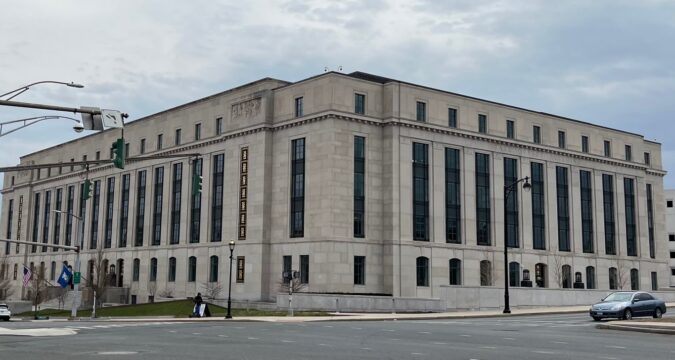
The Public Utilities Regulatory Authority (PURA) at the Joseph H. Harper, Jr. Building at 10 Franklin Square in New Britain in March 2025. (Aaron Flaum/Hartford Courant)
PURA proposed its inquiry during a period of unusual public hostility between the regulators and the industry. The utilities believed Gillett was acting more like a consumer advocate than an impartial arbiter, orchestrating unfair rate decisions that discouraged investors and raised borrowing costs. Gillett’s supporters, notably Tong and Gov. Ned Lamont, argued she was finally bringing the utilities to account.
There were some on both sides of the question who suspected the offer to air utility complaints was an attempt by Gillett to demonstrate her open-mindedness as she prepared to face the Legislature at a confirmation hearing connected to her appointment to a second term.
The utilities were skeptical of Gillett’s offer and responded by questioning PURA’s objectivity . They said two of the three commissioners assigned to the inquiry — Gillett and former commissioner Michael Caron — should recuse themselves because they had been at PURA so long they would be asked to pass judgement on their own work.
Eversource and United Illuminating further argued that Gillett could not be impartial. Their lawyers wrote in a regulatory filing that she had been aware of their complaints for months, but had “ignored, dismissed and impugned those concerns” while “staunchly defending” her work. With two or three commissioners recused, the utilities argued PURA would lack a quorum, which meant the inquiry should be abandoned.
PURA maintained that its proposed “proceeding” was the “proper mechanism to address any concerns related to the Authority’s procedural practices.” But less than a month after proposing the inquiry, PURA released a decision abruptly canceling it and blaming the cancellation on utility recalcitrance.
“The investor-owned utilities are opposed to the continuation of this agency-initiated proceeding,” PURA wrote in a decision. “Absent the meaningful participation by this essential stakeholder group, this proceeding would not be an effective use of the Authority’s limited resources.”
Not mentioned in PURA’s cancellation notice — according to the material released late last week — was former Commissioner Caron’s decision, consistent with the utility argument on impartiality, to recuse himself.
Included in the newly released material is a February 13, 2025 email — written a day before PURA’s announced decision to cancel the inquiry because of the lack of cooperation by the utilities — in which Caron wrote to authority lawyer Scott Muska: “After no small amount of thought and reflection upon this matter I have decided to recuse myself. Thanks for your input and discussion about it.”
The material released last week also shows that Caron attached to the email a prospective press statement — never issued — which attributed his recusal to his belief that “he cannot be persuaded and consequently impartial in this proceeding.”
Caron’s recusal meant that PURA lacked a quorum. That meant, with only two of three commissioners, the authority could not proceed with an inquiry regardless of utility cooperation.
The newly released material also includes what appears to be a proposed, but apparently never released, press statement from Gillett repeating the suggestion that the utilities — and not the lack of a quorum — were responsible for preventing the PURA inquiry.
“The objective of this proceeding was intended to transparently and collectively reflect on agency practices and procedures to ensure ongoing compliance with applicable statutes,” the statement said. “However, given the current environment, this objective is currently not achievable in the collaborative spirit with which it was intended.”
In addition to meaning PURA could not continue with its “proceeding,” Caron’s recusal and the resulting lack of a quorum mean that the authority could not close the inquiry by a vote of the commissioners and would have to do so by some other, administrative means.
PURA announced it was closing the proceedings the following day in a regulatory filing written over the signature of the authority’s executive secretary. Whether the filing suggests there had been a vote of three commissioners — as if there had been no recusal — has become a point of contention.
Among the issues complained about by the utilities is the allegation that Gillett had frozen fellow commissioners out of the regulatory process and had concealed her control of decisions by issuing them above the signature of the executive secretary. The judge who ruled for the utilities in November found the complaint to be valid.
Ruling for the utilities in one of two suits they filed against PURA, Superior Court Judge Mathew Budzik wrote in a Nov. 19 decision that “procedural errors and irregularities set forth below have so permeated the proceedings, evidence, and record“ that the “fundamental fitness” of PURA rate process had been undermined.
Within days of the PURA’s announcement that it was closing its inquiry into the utility complaints, the utilities filed their Freedom of Information request with PURA for records concerning a vote to cancel the hearings and all related documents.
“This request includes, but is not limited to, all writings, communications, or other records reflecting the decision or stated intent of any Commissioner to recuse from, or otherwise decline to participate …,” the request by utility lawyers Cowdery, Murphy & Healy said.
PURA lawyer Scott Muska replied that the authority was in possession of no documents responsive to the requests. He did not mention Caron’s recusals and said PURA closed the docket “without taking any action or issuing a decision” after determining it “would not be an effective use” of limited resources. Because there was no vote, there were no related documents, he said.
There followed some unproductive correspondence concerning questions by Muska over how to “interpret” the utility record requests. At one point, the utility lawyers asked Muska to “either produce the record of the vote of each member of the PURA panel relating to the decision to close the docket or provide a statement that no such record of votes by the panel exist for this ruling.”
PURA produced nothing.
Last week, PURA — under new leadership — disclosed that it had located relevant records and agreed to produce them if the utilities dropped their complaint before the Freedom of Information Commission. The utilities, which have another public records complaint pending before the Commission, agreed.
Under Gillett’s chairmanship, PURA experienced difficulties with public record laws.
A 2024 text message exchange between Gillett and one of her legislative allies, obtained by the Courant, talked about communicating on personal telephones and concern “about getting FOI’d.”
An image of the text exchange between PURA Chair Marissa Gillett and state Rep. Jonathan Steinberg, D-Westport, obtained through a Freedom of Information request. The portions blocked out are private numbers. Hartford Courant.
Gillett later admitted in court, through PURA’s lawyer, that an automatic delete function on the personal mobile phone she often used for work inadvertently deleted her side of the exchange.
A Superior Court judge referred Muska to an agency that disciplines lawyers to determine if or how was in what the court characterized as an intentional effort by PURA to keep him from learning about the deletion of the text messages.
In December, the Freedom of Information Commission took the unusual step of increasing a fine imposed on Gillett for what it called as PURA’s inadequate response to third, related utility industry request for records about authority policies and decisions. A hearing officer recommended a $1,000 fine but the full commission raised it to $2,500.
CT consumer costs could increase as state agency restructures. ‘There was a bad culture,’: lawmaker
Among the talk about legislative proposals circulating at the Capitol this year is one that would require PURA employees to undergo remedial training on public record laws.