When Australia’s prime minister visits Washington next week, shipbuilders from Groton to Adelaide will be watching the White House for a signal on the future of AUKUS, the trilateral security agreement that would send cutting edge U.S. submarines to Australia to balance China’s growing influence over the Indo-Pacific region.
It is unlikely anyone will watch more closely than U.S. Rep. Joe Courtney; the eastern Connecticut Democrat recently returned from his latest trip to Australia. Courtney’s district includes the U.S. Naval Submarine Base in Groton and General Dynamics’s Electric Boat division, builder of the Navy’s new Virginia class attack submarines, which are at the center of the four-year old agreement between Australia, the United Kingdom and the U.S.
“The State Department was with us on our visit in August,” Courtney said. “From a diplomatic point of view — not just from the perspective of Australia, but for the whole region — the need for the U.S. to follow through on this is inestimable. The damage if they cancel it, God forbid, or truncate it in a significant way is … the prime minister of Singapore has been quoted as saying it will take a generation to recover U.S credibility.”
As ranking member of the House Armed Services Committee’s Seapower subcommittee, Courtney is an influential Congressional voice on shipbuilding and naval technology. There may be no greater advocate for AUKUS than Courtney, who sees the agreement as a means of making Australia, defended currently by a half dozen outdated diesel submarines, a partner in a western effort to maintain free transit across the strategically important southeast Asian sealanes.
FILE – General Dynamics Electric Boat is seen in Groton, Conn., Wednesday, April 16, 2025. (AP Photo/Julia Demaree Nikhinson, File)
President Joe Biden signed AUKUS with the leaders of Australia and Great Britain in 2021. Under the agreement, the U.S. provides Australia with 3 to 5 Virginia class submarines beginning in 2032 as part of a broader plan to use U.S. nuclear technology combined with U.S. and British industrial capacity to bootstrap Australia’s outdated submarine force into a credible barrier to the Chinese.
Since taking office in part on his promise of “America First,” Trump has at times sounded supportive of AUKUS. But his administration rattled the defense and foreign policy establishments earlier this year when the Pentagon announced it is reviewing the agreement. Shortly before the review began, the man in charge, Undersecretary for Policy Elbridge Colby, was widely quoted as asking, “Why are we giving away this crown jewel asset when we most need it?”
Colby was referring to the problem bedeviling U.S.efforts to rebuild its own aging and shrinking submarine fleet at a time when China is in the midst of an extraordinary expansion: A shortage of American shipbuilders.
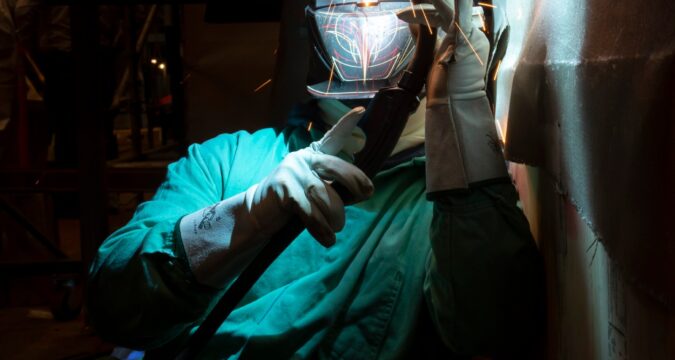
The decades of flat, post-Cold War spending that shrunk the U.S. Naval fleet by half also depleted the ranks of welders, shipfitters and riggers who build ships, not to mention their employers, the companies that form the submarine industrial base. Until relatively recently, American had not built submarines since 1995 when, with the collapse of the Soviet Union and China not yet a concern, Congress killed the 29-boat Seawolf class after EB built only three boats.
Electric Boat, arguably the world’s premier builder of submarines, is taking an array of steps to ramp up production. It has invested hundreds of millions in technological improvements at its facilities in Groton and Quonset Point, RI. It has been hiring and continues to hire and train new shipbuilders at a rate of from 3,000 to 5,000 a year. It and others have invested in four shipyards from Philadelphia to Alabama that, if used as intended, will produce modular sub components for shipment to Groton.
The shipyard, which also builds the massive Columbia class ballistic missile submarines, is producing Virginia class submarines, which now cost more than $4 billion a ship with the latest design modifications, at a rate of 1.2 a year. The Navy says it needs production of 2.3 a year to meet its goal associated with a fleet of as many as 66, more than a third of which have been delivered.
The nuclear-powered Virginia class submarines are unmatched in technology and are at the front line of U.S. defense. They are armed with cruise missiles and capable of open-ocean and inshore missions, among them intelligence gathering and anti-submarine warfare.
The question raised by Colby is, how can the U.S. afford to give the 3 – 5 Virginia class submarines to Australia called for under AUKUS beginning in 2032 if current production rates mean the U.S. doesn’t have enough ships for its own defense?
AUKUS, submarines and the billions Australia has committed to its own security as a signatory have put Colby’s review at the center of the news and politics there for months. Interest is high in Washington as well. Not surprisingly, people on both sides of the world are waiting to see whether there is an announcement on October 20, when Prime Minister Anthony Albanese is scheduled to meet Trump at the White House.
There have been hopeful signs for AUKUS supporters in recent weeks. A Japanese newspaper boldly reported in late September that AUKUS will survive the Pentagon review. Secretary of state Marco Rubio, an AUKUS supporter while in the U.S. Senate, has hinted that AUKUS will survive. The Washington-based news site Punchbowl News reported Monday that Rubio told Republican Senators at a private luncheon last week that AUKUS will emerge “stronger” from Colby’s review.
Kevin Rudd, Australia’s ambassador to the U.S, speaking last week at a policy forum in Washington, said there is no guarantee the Trump-Albanese meeting will produce a definitive answer.
“In terms of what we hear … there is, I would say, almost universal support for getting this thing done,” Rudd said. “But the timing for its conclusion is a matter for the United States. We Australians, counter intuitively, are a patient people.”
Electric Boat referred questions about AUKUS and its implication for shipbuilding to the U.S. Navy.
Under AUKUS as written, the U.S. is committed to taking 3 to 5 Virginia submarines out of service beginning in 2032 and selling them to the Australians. With contracts for 66 Virginia class submarines and another dozen or so Columbia subs stretching decades into the future, the shipyard is concentrated on building its workforce and supply chain to meet the Navy’s ambitious delivery schedule.
Repudiation of any AUKUS provisions by Washington would raise questions about U.S. reliability and could have devastating political consequences in Australia, which is worried enough about increasing Chinese aggressiveness to want to protect itself, but reliant on China as a major trading partner.
The implications of AUKUS for Australia go far beyond a handful of nuclear powered submarines. Costs are projected to reach into the hundreds of billions of dollars. The sale of 3 to 5 Virginia class submarines are meant to be a short term measure while Australia collaborates with the U.S. and Britain on a new, follow-on class of attack submarines.
To build those ships, Australia needs to build, from scratch, the enormously costly infrastructure necessary to construct highly complex, nuclear-powered vessels. Australia also is committed to expanding a western Australian naval base at Perth to host U.S. and British nuclear submarines in addition to its own.
Rep. Joe Courtney in February 2020. Michael McAndrews | Special to the Hartford Courant
Australia has already invested nearly $2 billion in the U.S. submarine industrial base, a sign of self interest in speeding U.S. submarine construction. Former Australian intelligence analyst James Curran wrote in Foreign Affairs earlier this month that altogether AUKUS could cost Australia more than $200 billion.
Courtney said that on his recent trip to Australia he toured construction already underway at the site of the shipyard and the naval base expansion near Perth.
“They are going full speed,” Courtney said.
He said U.S. Virginia class submarines will begin rotating out of Perth next year and housing is being built for the sailors. In Connecticut, also as part of the treaty, Australian officers are studying at the U.S. Navy’s nuclear training school in Groton.
Courtney warned against any significant alteration of AUKUS, which he said has support from the U.S. Navy. Among other things, he said the U.S. Navy’s Indo Pacific command “enthusiastically supports” having a base in western Australia.
“It is a straight shot into the Indian Ocean and the transit time to the South China Sea compared to Guam or Hawaii is a fraction,” he said. “It is invaluable.”
He said it is “premature” to try to answer questions in 2025 about whether giving up three submarines in 2032 weakens U.S. security. Undr AUKUS legislation, the U.S. president has until 270 days before transfer of the submarines to determine whether doing so is contrary to U.S. security interests.
Courtney said he expects U.S. submarine production to have met the Navy’s delivery scheduled by the time a decision is made.
“We are kind of rushing the judgment in 2025, given the fact that we are just starting to see the real expansion of the capacity,” Courtney said.