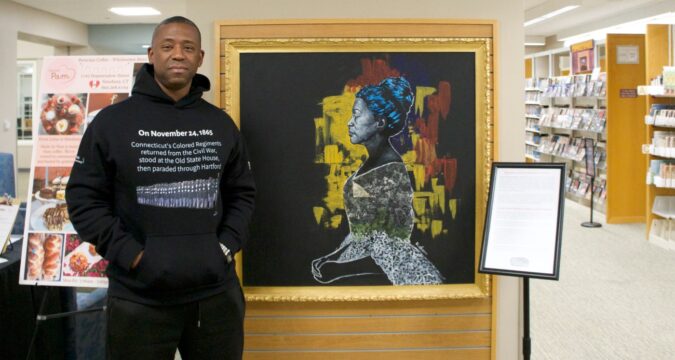
By day, Bloomfield resident John Mills is a software architect. At night and on weekends, his passion is his nonprofit, which provides Black Americans with a family history they have never known.
Mills, 55, is the founder of the Alex Breanne Corporation, “an organization focused on promoting social clarity and informed context regarding the African American experience through nonprofit equity advocacy.”
“We just do genealogical research tied to historical research and we find African American families that are related to these people that we find from 200 or 300 years ago,” Mills said. “We give people their history. Then we try to inject those stories and those people into the communities that they’re from. We try to re-inject them into the history of that community.”
Mills was raised in San Diego. He said his father was aligned with revolutionary civil rights groups like the Black Panthers.
“For me, coming up in the ‘70s in California, I got a lot of messaging around being proud of who I was and my skin color and my hair and all that stuff,” Mills said. “But later in life, I recognized that wasn’t the case. I really actually had shame for being Black. And I saw white Americans are just more valuable.
“I didn’t realize I was thinking that way. I was in corporate America,” Mills added. “One night, I realized how I was treated by other people was based on value and based on color, and that’s upsetting.”
Bloomfield resident John Mills uncovers the history of African American families in Connecticut and provides his findings to their current descendants. (Courtesy of John Mills)
The realization started Mills’ path on genealogy. He said his sister became involved in learning the family history beginning in the 1980s and ’90 and eventually it compelled him to start his nonprofit a few years after moving to Connecticut in 1998.
“I learned more about my family’s deep history in the country and how many enslaved people that I was related to. Before that, I didn’t know anything about my past,” Mills said.
He learned that many of his ancestors were enslaved in Texas. He and his sister traveled to see where they were buried.
“My grandfather never talked about his past. He was from Texas and he died at 87 I never knew anything about his parents. I learned that they were buried in a segregated cemetery in East Texas. In 2003, my sister and I went there to visit and we had to walk past the ‘whites only’ cemetery in the woods to find our great grandparents. … It was very empowering. I felt a strength cause I was like ‘My grandfather had to walk past this ‘whites only’ cemetery to visit his parents in the woods.’ What was he thinking of his value at that point? I wonder if he had the same realization that I had, this thinking I was of less value,” Mills said.
Mills said the information about his past gave him pride about the strength of his ancestors who survive during a time when they were segregated — even in death.
“I just got a real deep pride at that point for my ancestors, and I wanted to give other people that same pride,” Mills said. “It’s a lot of early mornings and a lot of late nights to make it all work. It’s a little tough, but it’s very rewarding to give people the same gift that my sister ultimately gave me. … That helped me see myself and my ancestors in a completely different way.”
John Mills conducts research at the Connecticut State Library. (Courtesy of John Mills)
Mills said what he does is reverse genealogy. For that, he starts with someone in the past and works his way to a living person.
“I now had this desire to give people their history and I was intending to start with someone that was mentioned in somebody’s will in 1780, I would start with that person and then I would find all this information and I would start tracing forward in time.”
Mills said he learned genealogy strategies from a course at Boston University. He learned to study military records and acquire information from decades ago in other countries to trace them back to a current person with the goal of finding them and telling them who their ancestors were.
Mills said he’s sent out hundreds and hundreds of letters to families of ancestors he has uncovered tover the last 20-plus years.
“I always have my email address and phone number and a good amount of information that I’ve discovered leading back to themselves. I include it free so they can look at it. They’ll see their ancestors and they can follow the tree down and then they’ll see their name,” Mills said. “The letters have a summarization of the story of the person that I was researching in information that might be interesting to them.”
Mills said some people will call him back and noted that he has fascinating conversations.
“As you tell them all this stuff and how deeply entwined they are in the soil of this country, it’s quite a gift that you give.”
John Mills and the Alex Breanne Corporation unveiled a mural at the North End Recreation Center in Waterbury in 2024. (Courtesy of John Mills)
One of the people who received that gift is Michael Lathrop of New Haven.
“I don’t know if I’ve met a kinder, more generous guy in terms of impacting peoples’ lives. I came upon John after relocating back here to Connecticut. I was doing some crude research on my family’s ancestry,” the 64-year-old said. “He was fixated on my family. I reached out to my second cousin (Dawn Lathrop-Goode). She was talking to him because she was tracing her family history.”
“She was tracing her father’s lineage, but Mills got hooked on my family history and is in the process of writing a book. She’s been in touch with him for the last few years. We linked up, and it was quite amazing.”
Lathrop said Mills changed his life.
“Each day I have to pinch myself and say, ‘Is this real?’ I knew nothing about my family on my father’s side other than my great-grandfather who fought in the Civil War in Connecticut,” Lathrop said. “John has enriched my life. As an African American, our race history isn’t discussed or maybe even erased. A lot of our history is not talked about and is certainly not taught in schools. Having this feeling of a lost identity for much of my life, I wondered where my family came from.”
Lathrop said he now has a history that goes back many generations starting in Africa.
“It made me walk taller in my shoes. I now had a sense of who I was, and it was empowering. My family persevered in spite of all the obstacles,” Lathrop said.
“John gave me more and more information about my family’s history, not only in the Norwich area but in the New Haven area. In the 1830’s my great grandfather came to New Haven and walked the same streets that I walk today. It’s quite amazing. There’s no price to put on for what John does. He has a full-time job, and he does this outside of that. I can’t thank him enough for what he’s done for me.”
John Mills with Angela Leavy following a ceremony honoring Leavy’s ancestors in New Haven. (Courtesy of John Mills)
Mills just completed a book about one of Lathrop’s ancestors. He’s been working on the project for three years. Primus was the patriarch of the Lathrop family in Norwich.
The book “uncovers the remarkable, nearly forgotten story of a 10-year-old boy taken from his mother’s bedside in West Africa and forced aboard a slave ship bound for America. That boy, Primus, survived the Middle Passage, endured decades of enslavement in colonial Connecticut, raised a family, and-through faith, resilience, and grace, laid a foundation that would ripple across generations.”
Lathrop-Goode, 50, of Hamden, had been working on her family’s genealogy when Mills helped her fill in many gaps after meeting him in 2024.
“I always tell John he’s doing God’s work,” Lathrop-Goode said. “If it weren’t for him, a lot of families would not know stories about their ancestry. These stories have fallen by the wayside. Primus is how my ancestry began. I’ve had a sneak preview of the book, and it’s really good.”
Lathrop-Goode said noted that, as a Black person in America, you’re going to hit a wall when researching the past. Names stop and records stop. “But thank God for John,” she said. “He’s pushed past those walls. African Americans were brought over and were just kind of recorded like cattle. You have no real way of knowing. So the fact that John was able to get me names and places and dates is incredible,.”
Mills said everything his nonprofit is done for free and they raise funds for their work through donations.
“We are funded by hundreds of small donations from individuals around the world who believe in our work. We publish all of our efforts on social media, which has created a following, which drives our donations. There are four of us on my board, but the bulk of the work is performed by me and my wife, Erica Mills. We hire out for larger headstone restoration work, but small cleaning efforts, we do ourselves,” Mills said.
Mills continues to speak around Connecticut, with several lectures planned this year. This month, he will be giving a lecture on Connecticut, Color and the Fight for Freedom on Wednesday at the Silas Bronson Library in Waterbury from 6:30 p.m. to 7:30 p.m.; a Black History Month program on Feb. 21 at 2 p.m. at the Portland Senior Center and a lecture on Connecticut, Color and the Fight for Freedom on Feb. 23 at 6:30 p.m. at the Manchester Public Library.
Last November, Mills celebrated the 160th anniversary of the return of the 29th and 30th Connecticut Colored Regiments from the Civil War with a memorial walk. On Juneteenth in 2025, Mills unveiled a monument in Simsbury honoring a historic Black couple and their family. The Lathrop family also said Mills plans to unveil a mural in Norwich for their ancestors. The unveiling is expected in May or June.
From left, Aisha Tyler, John Mills, Angela Leavy, Kelly Clarkson in June 2024. Mills’ work was featured on “The Kelly Clarkson Show” on a Juneteenth episode in 2024. (Weiss Eubanks/NBCUniversal)
In 2024, Mills had a mural placed at the North End Recreation Center in Waterbury in 2024. The mural depicts a man named Fortune, “an 18th-century enslaved man whose story is a significant yet often overlooked part of Connecticut’s history.” Shortly after, Mills’ nonprofit received national attention with a story in the Washington Post and an interview on “The Kelly Clarkson Show” with a Florida woman he helped trace her history back to Connecticut.
Angela Leavy received her letter from Mills in January 2024.The two met later that year for a ceremony in New Haven at Evergreen Cemetery, where Mills repaired the headstones of Leavy’s ancestors, Mary and Thaddeus Newton.
“It was truly a blessing for my family. It was pretty amazing because he shared with me my ancestry,” Leavy said. “I didn’t know about my third great-grandparents, the Newtons. I didn’t know about my uncles that served in the Civil War. It was just pretty amazing to learn that history and that part of me. To have that to share with my children and grandchildren — I’m fortunate and I’m glad he found the information and reached out to share it with me.”
Leavy and Mills appeared together on “The Kelly Clarkson Show.”
“I was just glad to be a part of that whole experience and to be able to share an amazing story of a free woman (Mary) who was a property owner. She did marry someone who was enslaved (Thaddeus). But she freed him. She raised money to free him. John also shared with me that she had also freed other people. Just a powerful woman in time period to be able to do the things that she did. We hear sadness, the horrors of slavery, but even though there’s that part of it, I think there was beauty in this story where this woman had someone that she loved, loved him enough to get him freed from slavery,” Leavy said.
“John didn’t know me from Adam but he found this story and wanted to share it and also raised the funds to restore their headstones and my husband and I got to attend the memorial service and it was a beautiful service,” Leavy added. “The work that he does is truly a blessing.”