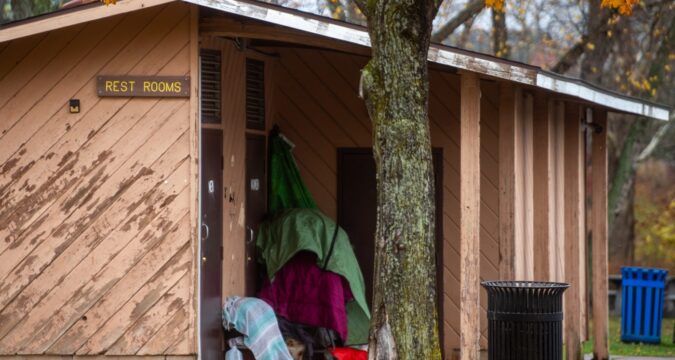
Homelessness in Connecticut has increased by 10% in the past year, with hundreds of children living in homeless shelters, people living in tents and cars and and more seniors going without shelter.
To address the growing need, the United Way of Central and Northeastern Connecticut is creating a new fund to head off homelessness before it starts.
The nonprofit organization has launched a Rapid Response Fund, investing an initial $100,000, to help people stay housed this winter.
“Our goal is to keep people housed and we don’t want people to fall into a shelter system,” said Eric Harrison, president and CEO of the United Way of Central and Northeastern Connecticut at a press event with state officials. “We want them to be warm and housed this coming season.”
The state has seen a 45% increase in unsheltered homelessness, Sarah Fox, CEO of the Connecticut Coalition to End Homelessness has said, meaning more than 800 people are sleeping outside in freezing temperatures, often in tents or cars. The increase was from the one night point-in-time count in 2024 to the count in 2025.
The goal of the Rapid Response Fund is to meet “immediate housing needs such as emergency assistance for rent and utilities to prevent people from experiencing homelessness,” according to the United Way. The United Way will provide direct monetary assistance to those struggling financially and are at risk of losing their homes, with the goal of keeping people in stable housing, the organization has stated.
Municipalities across the region will make referrals to the United Way so people can receive assistance, according to the United Way.
Harrison noted how many Connecticut residents continue to face new challenges, particularly the state’s working poor — those United Way classifies as “ALICE,” for asset-limited, income-constrained and employed. Its 2025 report says two in five of the state’s households fall into that category.
“Our Connecticut United Way ALICE report details the fact that more households are struggling with financial hardship: 40%,” he said. “At the same time, people are experiencing reductions in their SNAP and health care benefits. This means that people are having to make very difficult choices every day in our community and our United Way is prepared to step up.”
Harrison said United Way has partnered with Rep. Jaime Foster, D-Ellington, and Rep. Jennifer Leeper, D-Fairfield and co-chair of the state’s Education Committee, to make emergency grocery assistance available to residents across Connecticut.
“We have seen firsthand how many of our citizens are living on the edge,” Gov. Ned Lamont said, referring to the government shutdown and its impact on food insecurity.
“All of a sudden hundreds of people lining up at food shelters,” he continued.
Lamont lauded progress in the state concerning homelessness over the last 10 years, citing former Gov. Dannel P. Malloy for his efforts.
To address the increase in unhoused people, the state is focusing on new shelter beds, rental vouchers and intervention to keep people in their homes, he said.
“It is not easy,” he said. “The federal government is yanking back all the time.”
On Jan. 28 of this year there were 3,735 sheltered and unsheltered people experiencing homelessness in the state, representing an overall increase of 9.5%, according to Lt. Gov. Susan Bysiewicz. In 2024, Bysiewicz there was an overall increase of 13% of people experiencing homelessness. She said progress has been made but there still is more work to do.
Bysiewicz said there are so many things that can result in a family being homeless.
“Every year we know more and more people are looking for emergency shelter and could need the assistance United Way is offering to ensure they keep their housing,” Bysiewicz said. “The activation of this fund is truly a lifeline for families that provides direct cash assistance to ensure that people get the help they need quickly and efficiently so they can stay in their homes.”
Fox told the Courant the great thing about the Rapid Response Fund is it is focused on preventing people from coming into the homeless response system.
“It gives them the resources to either meet their needs in the moment so they don’t become homeless,” she said, and in the event they are homeless, the fund helps to stabilize housing.
Fox has said to address the increase in homelessness, more funding is needed to help bring the unsheltered population in from the cold this winter.
“We are working diligently with providers across the state to protect the state resources and ensure we have resources to keep more than 9,000 of our neighbors housed because if they lose their housing it will be a tidal wave,” she said.
Selia Mosquera-Bruno, the state’s commissioner of housing, said in addition to the United Way’s contributions, the state Department of Housing has allocated $12.5 million in emergency funding for this winter, including $4.5 million to increase capacity for warming centers, increasing 935 beds for this winter.
Further, Mosquera-Bruno said $3.5 million will be allocated for HUBS, (which helps those experiencing a housing crisis); $3 million for addiction prevention and to make sure people stay in their homes; $1.5 million for a pilot program to move nine families out of shelter in the Fairfield area with five years subsidy to make sure they have a path forward; and $400,000 flex funds for urgent needs.
Mosquera-Bruno said the Department of Housing is also allocating $110 million toward initiatives such as studios for the homeless and capital needs for shelters.
Last week, a compromise housing bill passed the legislature to encourage development of more housing in the state but Lamont acknowledged more needed to be done.
Foster said for people to live and survive and thrive in their communities, they need housing and they need healthy food and heat and to be able to afford the prescriptions their families need.
“For most families, they are one unexpected bill away from that balance,” she said. “When the economy is like it is right now where the cost of groceries is higher than ever before and utility costs are higher than ever before and rent and every little thing adds up, that treacherous balance that so many families live in is just so much closer to the edge of that cliff that they fall off.”
Lamont also urged the public to donate to United Way’s Rapid Response Fund. To do that or find out more, go to unitedwayinc.org.