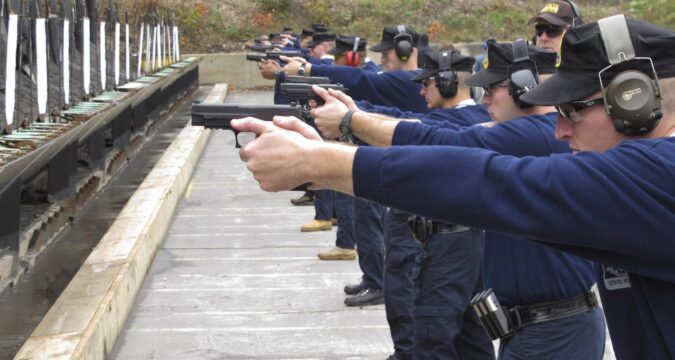
Five months after being closed, the state police firing range reopened this week in Simsbury after health concerns were addressed.
The range had been closed after high levels of lead were generated from the constant firing of guns at the range, where troopers fire toward a mountainside that is across the street from the Farmington River and near the Avon border.
As part of the improvements, state police purchased two new trailers, one as a classroom for troopers and another as an office for the six instructors who work at the site. In addition, the instructors will now wear filtered masks when working in the area of the shooting due to the large amount of dust and particles in the air.
Andrew Matthews, a retired sergeant who is now executive director of the troopers’ union, said the union will drop a grievance because troopers are pleased with the improvements that were overseen by public safety Commissioner Ronnell Higgins and Colonel Daniel Loughman.
“It was relatively quick in our agency for a solution,” Matthews told The Courant in an interview.
“They showed real leadership on it. In other administrations, we’ve brought up safety issues with mold, questions of asbestos and unhealthy work environments, and we’ve gotten the attitude of ‘work now, grieve later.’ … Previous administrations would look at the cost of things, and that’s why they wouldn’t take proper and immediate action. The commissioner and the colonel didn’t sacrifice the health and safety of our troopers for expense.”
In addition to cleaning the facilities on a regular basis, the state police also will use a specialized vacuum to clean off the clothing that the instructors wear at the range so they would not contaminate the area when they return to their work space, he said.
“Our troopers change [clothes] before they go home,” said Matthews. “They also vacuum the clothing that they wore while they were on the line training people to reduce any contamination or exposure. It was never done in the past. I don’t even recall in the 20 years I was on the job that the workplace [at the range] was ever deep-cleaned.”
Matthews added, “If you’re on the line, instructing all day, you’re filled with lead. Before you enter into the classroom to finish the day or you enter your office workspace to do your paperwork and administrative duties, you would vacuum yourself off before you go into the work zone because it’s less contamination to the workplace.”
While the union provided details, state police administrators did not comment on the range’s reopening. State police have declined to reveal any names, but two of the six full-time instructors at the range were affected, including one who had a blood test during an annual physical examination.
Hearing the gunfire
Simsbury residents said it had been noticeably quieter during the past five months when the range was closed. But this week, the sounds could be heard outside the nearby Latimer Lane School, which is across the Farmington River and west on Route 10.
While union officials are pleased with the progress, the closest property owner, Robert Patricelli, is not.
Patricelli has been unable to arrange a meeting with the state police commissioner, but he and state Rep. Melissa Osborne of Simsbury met with Gov. Ned Lamont’s chief of staff, Matthew Brokman, after the range was shut down to discuss Patricelli’s push for a modern, indoor range – rather than the state’s plan for improving the current outdoor range.
Patricelli, a former high-level health care executive with CIGNA and other companies, said he has filed requests under the state Freedom of Information act to obtain information on “what was going on in terms of lead poisoning, and they have stiff-armed us and not responded to any of that.”
A modern, indoor range would cost about $30 million, which Patricelli said is not far beyond the $15 million to $20 million that he believes the state will eventually spend in Simsbury. The state has spent about $2 million to design the new range, which is expected to cost about $12 million. When the current range was temporarily closed, officials said the groundbreaking for the new range might be in the spring of 2026.
“Modern ranges are fully vented and air conditioned,” Patricelli said.
But Patricelli said he was never given the chance to have a meeting with the state police to discuss indoor ranges.
“I’m very disappointed in Governor Lamont for not pursuing this issue more open-mindedly,” said Patricelli, adding that he has not personally spoken to Lamont or Higgins about the matter.
While Patricelli, whose Folly Farm is about 175 acres, has said in the past that he was considering legal action, he said Wednesday that he would need to talk to various officials before deciding on his next steps.
Simsbury resident Robert Patricelli is not pleased with the planned expansion of the state police firing range near his longtime property. A retired business executive, he previously co-chaired a state committee charged with finding ways to boost Connecticut’s competitiveness and improve state finances.
Police training
The availability of the firing range is critically important, police say, as troopers need training because they might be called upon to fire their guns in a department that operates 24 hours a day, seven days a week.
Nearly 900 troopers head to the Simsbury range twice each year to be recertified, but their exposure to lead is low when compared to the instructors who are there every day. In addition, FBI and Drug Enforcement Administration agents sometimes come to the range to improve their skills.
Osborne said that she supports the state police and their need for training, but is also interested in the possibility of an indoor range. In addition, she said there was no evidence of any spread of environmental contamination off the site.
“Our water is safe,” Osborne said.
When the range was closed, state police released a list of the steps they would take before the range would reopen.
“Conduct voluntary occupational health screenings for all personnel currently assigned to the firearms training unit,” police said. “Engage OSHA for an onsite consultation and assessment regarding operational suitability. Initiate employee training on lead and noise hazard mitigation. Review and implement risk-mitigation strategies that can reduce occupational exposure to airborne lead, noise, and other potential hazards associated with firearms training environments.”
The Simsbury firing range has reopened after five months following health concerns with lead. Here, U.S. Sen. Chris Murphy stands at the state police firing range in Simsbury with Sgt. Shawn Corey, a member of the state police firearms unit who explained the difference between several military-style rifles in 2013. Sgt. Corey later demonstrated several of the weapons to illustrate their power.
Christopher Keating can be reached at ckeating@courant.com