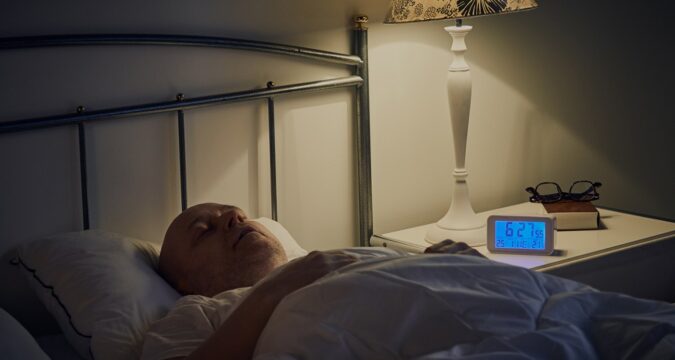
Often I wake up at night, and I’m not sure why.
Maybe the refrigerator compressor kicked on. Or the moon was shining through the window. I am a light sleeper.
If it happens at two or three in the morning, I fluff my two pillows and nod off. If it’s later, say four-thirty or five, it’s not so easy. Still, if I turn on my side or onto my stomach, I usually go back to sleep. And it seems that whenever I get seven hours or more, I dream.
The dreams are all different, but some have a common theme.
In one of them I am wearing a suit jacket and tie, walking through the hallway of my school building. No one is in sight because I am late to an English teachers’ meeting. I am hurrying, sweating, wanting to loosen my tie. When I finally enter the room where my dean and the other teachers wait, they’re all staring at me … because I am not wearing pants.
Another has me wearing foul weather gear while steering a boat. Half a dozen students are along — it is some sort of field trip — when a storm comes up and we are bucking 5-foot waves. They fall overboard, one by one. I try to turn around and go back to where they are thrashing in the whitecaps, but the engine stalls and I cannot restart it.
Many readers can relate since psychologists maintain that imposter dreams are common.
Dr. Paul Hokemeyer, a mental health expert and author of “Fragile Power: Why Having Everything is Never Enough,” writes that such dreams are symptoms of “imposter syndrome,” which affect many ambitious people. Even if they are competent and successful at what they do, deep down they may feel like frauds or, at the very least, not who people think they are. Their secret fear is they’ll be exposed.
U.S. presidents are prime candidates for imposter dreams, since, after all, the expectations people have of them are prodigious. You hold the most impactful position in the world, and more than 300 million Americans count on you as chief executive to enforce the laws and uphold the Constitution, to defend and protect citizens as commander-in-chief, to work with Congress to pass laws for the common health and welfare, and to be the unifying force for the entire country and world.
It’s easy to imagine a vivid imposter dream that a president might have: Perhaps he is golfing, enjoying his favorite pastime, until a man who looks familiar bursts from behind a tree, wailing about the death of his 3-year-old child from measles. As Secret Service agents lead the man away, an aide tells the president the arrestee had been a loyal supporter from a state where the plague has killed his and hundreds of other children. The president wakes up but cannot unhear the man’s pain.
On another night, the president might dream he is alone in his private study in the West Wing, scrolling through headlines on his phone, when he reads, “Masked federal agents blamed for massacre in city park.” His thumb hovers above the screen, but he does not click on it. Instead, he drops the phone in a drawer and shuts it. Someone is knocking on the door, and he closes his eyes. The knocking gets louder, so loud that it wakes him up.
Interestingly, imposter syndrome can actually strengthen decision-making abilities, according to “Five Surprising Benefits of Imposter Syndrome” by leadership expert Melissa Eisler.
“The self-doubt helps you slow down your decision-making process,” she writes, “and you will be more likely to test your gut rather than make a rash decision based on hunch … you are able to make smarter decisions because you are willing to question yourself and do additional research to gather more data before making a decision.”
I mention all this because the White House reports the current president sleeps only four or five hours a night, which is insufficient for REM sleep and dreaming.
I’ll say no more but that probably explains a number of things.
David McGrath is an emeritus English professor at the College of DuPage and author of “Far Enough Away,” a collection of Chicagoland stories. Email him at mcgrathd@dupage.edu.
https://www.chicagotribune.com/2025/10/10/mcgrath-imposter-dreams-president/