Throughout Tony Elliott’s 11 seasons as a Clemson assistant coach, the Tigers played an annual game against an in-state Football Championship Subdivision program, rotating among South Carolina State, Wofford, The Citadel and Furman.
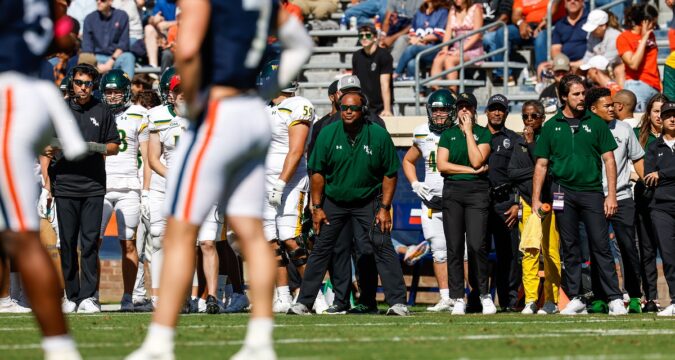
Elliott’s four subsequent years as Virginia’s head coach have compounded his appreciation of such matchups. Indeed, his inaugural game leading the Cavaliers was a 2022 contest versus FCS Richmond, and Saturday’s date with William & Mary (1-1) marks the 17th time in 18 seasons — the wonky 2020 pandemic year was the exception — that Virginia (1-1) will host an in-state FCS opponent.
For now, that ritual is set to continue. The Cavaliers are contracted to play either Norfolk State, W&M, Richmond or VMI in six of the next seven seasons.
But contracts are made to be broken, and the industry’s evolution is conspiring against these games.
As the College Football Playoff has expanded and become more lucrative, Power Four executives have instructed the selection committee to underscore strength of schedule.
As Power Four schools such as UVA and Virginia Tech strive to compensate athletes at the highest permissible levels — this year’s revenue-sharing cap is $20.5 million — ticket sales are paramount. In the ACC, home to the Cavaliers and Hokies, and where television revenue is distributed based largely on viewership, ratings carry similar importance.
And, no offense intended, FCS teams do not drive ticket sales or television ratings for Power Four programs. But that doesn’t mean the games are without merit, their frequent lopsided margins notwithstanding.
David Teel: UVA offense stalls at worst possible time in loss at NC State
The issue becomes, as economic pressures continually mount, and as the sport perhaps moves to centralized governance and scheduling far removed from the traditional conference structure, whether these games survive.
Count Elliott and his W&M counterpart, Mike London, among those who hope so, and given their FCS roots, that’s natural.
Elliott coached at South Carolina State and Furman before heading to Clemson, his alma mater. London is a former Virginia assistant and head coach, but his FCS chops are unassailable. He played at Richmond, and his professional track includes assistant jobs at Richmond and W&M, plus big-whistle stops at UR and Howard, in addition to W&M.
“I think it’s great for the state for the bigger schools to play some of the smaller schools,” Elliott said Tuesday at his weekly news conference, “to give them a (chance) to play on this stage … because every kid wants to play Power Four, but there’s not enough spots for every kid that’s getting recruited to play at the Power Four, or maybe they’ve got to develop a little bit more.
“It’s a great opportunity for them to see, hey, I can go to William & Mary, I can go to these smaller schools and develop and then have an opportunity to compete against the higher level and then possibly maybe elevate my status over time. I think it’s just good for football.”
Virginia’s roster is testament to those opportunities.
Virginia’s J’Mari Taylor runs past Coastal Carolina’s Myles Woods, top, and Xamarion Gordon for a touchdown. (Ryan M. Kelly/Getty)
At North Carolina Central in 2024 and ’23, running back J’Mari Taylor competed against North Carolina and UCLA. This season he’s been UVA’s most productive player, rushing for 182 yards (6.7 per carry) and five touchdowns.
Against eventual Mid-American Conference champion Ohio last season, Ja’son Prevard intercepted a pass for Morgan State. Now he’s Virginia’s starting nickel back.
But the transfer portal works both ways. Ten W&M players are FBS transfers, six from power conferences, and several are playing prominent roles.
Safety Aidan Ryan (Virginia), linebacker Jorden McDonald (Virginia Tech), defensive end Ty Gordon (Syracuse), cornerback Latrelle Smith-Leaks (Ball State) and placekicker Keegan Shackford (Iowa State) are starters. Reserve linebacker Stephon Hicks (Virginia Tech) blocked a punt in last week’s victory over Maine.
Each of the FCS programs London has led have defeated FBS opponents: Richmond over Duke in 2009, Howard over Nevada-Las Vegas in 2017, and W&M over Charlotte in 2022.
In addition to competitive opportunities, these games — Norfolk State at Rutgers, and Richmond at North Carolina are other examples this week — are financial windfalls for FCS athletic departments, netting them $400,000 or more.
“We look forward to going back up there and trying to meet the challenge that these kids say they want to have,” London said Monday on the Coastal Athletic Association’s media call. “When you’re an FCS program, you want to play FBS teams and be in those arenas and those stadiums and on the television networks.”
A Tribe victory Saturday would be quite the homecoming for assistant coaches Perry Jones, Darryl Blackstock, Ras-I Dowling and Keenan Carter, all of whom played at UVA. An upset also would be London’s 100th head-coaching win, a milestone he was unaware of until asked Monday.
“If it happens, it happens,” he said, “but the goal is to make sure our players are prepared to go up there and be highly competitive.”
David Teel: david.teel@virginiamedia.com