Hundreds of apartments, parking spaces and retail space are in the plans.
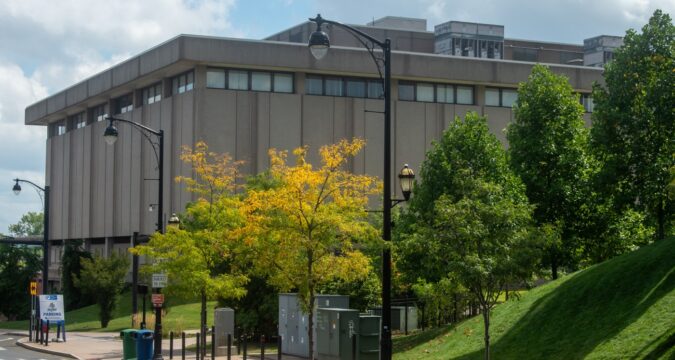
And, as another regular season of the Yard Goats draws to a close at Dunkin’ Park, the 1960s data center just beyond center field is still standing — vacant and an eyesore — but a new view from the city’s minor league ballpark is expected at the start of next season.
“We are all working hard on a schedule that should have the center field view at Yard Goats stadium clear by opening day next year,” Jeff Auker, Hartford’s director of development services, said. “On opening day, there will be a nice clear view.”
Demolition, which could take up to six months, is expected to begin this fall, Auker said.
The state is wrapping up its review of the redevelopment plans for the site that include a $90 million applied artificial intelligence center, a $30 million, 120-room boutique hotel and a 200-space parking garage. In addition to the hotel, with a possible rooftop lounge overlooking the ballpark, and the AI center, the garage could provide parking for Dunkin’ Park.
The review by the state Department of Economic and Community Development — known as “scoping” — kicked in after the state awarded $6 million toward the redevelopment of the data center, part of the larger North Crossing development around the ballpark.
The former Windsor Street data processing center in Hartford on Friday, Sept. 5, 2025. (Aaron Flaum/Hartford Courant)
The $6 million in state brownfields funds will be used to demolish and rid the nearly 3-acre property just east of Dunkin’ Park of contamination. Because there are redevelopment plans, the scoping was launched to give the public — and other state agencies — the opportunity to weigh in.
Demolition of the former Windsor Street data processing center in Hartford is expected to start this fall to make way for redevelopment. (Aaron Flaum/Hartford Courant)
Just one comment was submitted by last week’s deadline, from the state Department of Energy and Environmental Protection. DEEP raised no major concerns, except to point out that the need for attention to managing storm water flowing from the site, given the closeness to the Connecticut River.
Leveling the data center is expected to cost $9.4 million including other state and city funds.
Matthew J. Pugliese, DECD’s deputy commissioner and chief investment officer, said scoping helps identify environmental, social and economic impacts of projects qualifying for state funding under the Connecticut Environmental Policy Act. DECD regularly scopes projects that are approved for brownfields clean-up funding, Pugliese said.
“The agency is excited to award funding to the City of Hartford for the remediation and demolition of the vacant data center at 150 Windsor Street, which will pave the way for future development,” Pugliese said. “At this time, DECD does not anticipate any issues that would negatively impact the project from moving forward.”
Hotel may come first
So far, North Crossing — often still referred to by its former name, DoNo, short for Downtown North — has focused on apartments and storefronts.
The first phase, known as “The Pennant,” added 228 apartments in 2022 and has an occupancy of 95%, according to state statistics from June. The apartments cost $56 million to build and financing included a $12 million, state-taxpayer backed loan from the Capital Region Development Authority.
The first half of a second phase will soon add another 237 apartments, plus a 541-space parking garage at a cost of $63 million, partly financed with a $13.5 million CRDA loan. The parking garage will provide spaces for both halves of the phase.
Stamford-based RMS Cos., the developer of North Crossing, said the first of the apartments now under construction should be ready for leasing early next year, likely February or March. And as the heavy construction starts to wind down in the next two or three months, RMS will be looking to begin building the second half of the residential rentals, according to RMS founder and chief executive Randy Salvatore.
Stamford-based RMS Cos. expects the apartments in first half of the second phase of North Crossing to begin leasing in February or March. File photo from June. (Sean Patrick Fowler/Special to The Courant)
“We going to get right into getting going on the site work next door,” Salvatore said. “Our intention is to flow right into the second building.”
All together, the second phase will have 532 apartments, plus 10,000 square feet of storefront space, at an estimated cost of $120 million.
RMS also would be the developer of the data center site. Once the building is demolished, Salvatore expects construction on the hotel and parking garage to start first. Planning for the Connecticut Center for Applied AI also is expected to require a longer timeline.
Construction of the AI center also heavily depends on a roughly $50 million for the state’s “Innovation Clusters” program. The program seeks to promote the expansion of next-generation technology such as AI and quantum computing that are expected to drive future economic development and job growth.
Hartford also is competing with New Haven and Stamford as finalists for funding from the state’s program.
A DECD spokesman said Friday there is not an expected timeframe for an announcement on the grants.
Consequential technology
If it is successful, the city said it is confident it will be able to line up the balance for the AI Center not covered by the Innovation Clusters grant. Online giant Google already has expressed interest in helping an applied AI center in Hartford outfit itself with crucial, rapidly-evolving technology.
Auker acknowledged that some might question pursuing new construction when there is a glut of empty office space downtown.
“It’s an area that incredibly important to the look and the flow of people around the city,” Auker said.
A rendering of how the proposed Connecticut Center for Applied AI could look along Market Street in downtown Hartford as seen from the northeast. (JCJ Architecture)
The area around the ballpark was listed in 2020 in the city’s 15-year plan of development as one of the top 10 spots that could transform Hartford by 2035. In 2035, Hartford will mark its 400th anniversary.
“It’s a key point of why we want to develop there,” Auker said. “It will inspire and activate redevelopment around there. Not just the hotel but hopefully makes the (former Rensselaer Polytechnic} campus more attractive and we already have folks that own the lots across (Market Street) looking for development opportunities.”
City officials have said the AI center would be separate from what the corporations are spending on AI — estimated to be in the hundreds of millions of dollars. But collaborations with them — especially in insurance and health care — are absolutely foreseen, they said.
The city also isn’t focusing on the incubator space for start-ups that could too easily relocate.
Hartford’s sweet spot is the area between the large companies and the start-ups. This is where new ideas — some developed at colleges and universities — are tested and worked on in a lab using digital tools that are commercially available.
But a key part of the vision also targets training to prepare a workforce for using AI, which many believe will be the most consequential technology in the future, its impact even deeper than the development of the internet.
A survey released last week by the Connecticut Business & Industry Association found that many small businesses in the state are unsure of how to use AI.
“In the urban centers, we certainly have not provided on-ramps, points of access for our residents and some of our small businesses who don’t have the capital to invest in some of these technologies,” Auker told the Courant in June. “So, the essence of this is really to create a center and then make the declaration that Hartford is here to unlock the value of AI.”
That means also collaborating with institutions of higher learning and nonprofits focused on technology “to really funnel that into ways that our residents and our small businesses can get access to those skills and capabilities that AI is transforming all around us,” Auker said.
Kenneth R. Gosselin can be reached at kgosselin@courant.com.