Despite German State Stimulus: Machinery Industry Braces For A Catastrophic Year
Submitted by Thomas Kolbe
Friedrich Merz does not make it easy to interpret current economic data correctly. The debt king from Brilon is not only distorting the statistics with his “special (debt) assets”: More than 320 billion euros in direct and indirect state subsidies are flowing, according to Freiburg economist Lars Feld, through subsidy channels that are penetrating ever deeper into the German economy. Artificial economies are emerging there, economic homunculi that will remain permanently dependent on the taxpayer.
What Is Still Growth, and What Is Debt-Financed Illusion?
In July, the Federal Statistical Office reported a strong increase in orders for German industry: Real order backlogs rose by 2.5 percent compared with the previous month, and by as much as 10.9 percent year-on-year – a figure of Olympic proportions.
Behind the statistical facade, however, it quickly becomes clear where the wind is actually coming from: Above all, the Other Transport Equipment sector increased its order backlog by 3.9 percent compared with the previous month – the billions in debt for the defense industry are creating a positive mood at Rheinmetall, Hensoldt and Co.
What a contrast to the real economy! The automotive industry, still the backbone of the German economy, can no longer escape its downward spiral: In July, carmakers once again recorded a decline in their order volume, this time by 1.7 percent compared with the previous month.
Adjusted for debt-financed defense orders, it becomes clear that the trend is still heading south. The fact is that with every additional month of the current policy, the economy is losing ground to foreign competitors. Who is surprised, given the sky-high energy costs and Brussels’ increasingly aggressive regulatory agenda?
The election campaign team of the Federal Chancellor had barely finished celebrating the good news from industry when the band of illusions snapped and reality came rushing back like an arrow.
A current assessment of the actual situation in the engine room of the German economy gives reason to fear the worst for this year: On Thursday, the German Engineering Federation VDMA reported a real decline in production of 4.1 percent for the first seven months compared with the same period of the previous year.
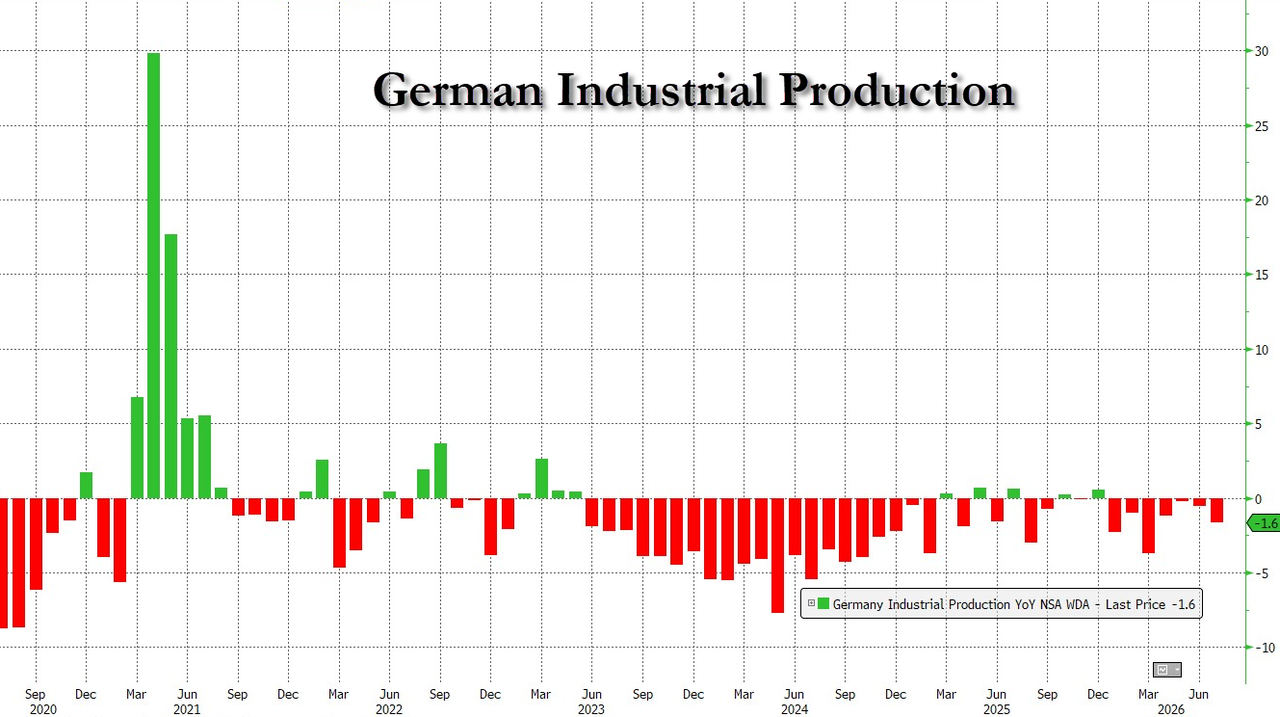
That is a horror figure, descending on the Federal Chancellor like a media guillotine. The outlook is dark: Since 2018, the sector has lost almost one-fifth of its production activity.
This dramatic development is not part of a typical economic cycle. Germany is caught in a spiral of deindustrialization that even historically unprecedented government debt programs will no longer be able to slow down. The parties of eco-socialism bear responsibility for this disaster, above all Merz and the CDU.
Confused, yet firmly committed to this political ideology, the Chancellor steers his government through the fog. At the ceremony marking the 150th birthday of Konrad Adenauer, Merz emphasized his unwavering commitment to reform and was met with icy silence.
He had only one of 630 votes in the Bundestag, Merz said. His authority to set policy guidelines did not extend beyond the cabinet either. After that, he said, one found oneself on the high seas of the Bundestag.
It is always the same game: A commitment to reform and an awareness of the problems are staged for the cameras. In reality, the government remains committed to the joint strategy of the CDU/CSU and SPD: the debt-financed expansion of the state economy.
It seems almost comical when Friedrich Merz resorts to nautical metaphors in his hour of need. Is he not himself the captain who, to put it somewhat pathetically, is steering the state ship straight toward the iceberg visible to everyone?
Where is even the attempt at reform? Why does Merz not dare to break with the destructive climate policy and begin a serious path toward consolidating public finances, one that includes a remigration program, encompasses an end to the senseless development aid, and also includes a rejection of the taxpayer-funded NGO establishment? A return to diplomacy with the Russians would also be the order of the day.
Of course, it would mean the end of the coalition. Merz would have only the AfD left as an option. Yet Merz remains trapped inside the firewall cocoon. Despite the visible crisis, the Chancellor shows no progress in understanding the situation and refuses any willingness to reform. Politically speaking, Merz is a globalist who firmly believes in the success of his military Keynesianism. It is supposed to support the collapsing economy and, if necessary, at the price of geopolitical risks in relations with Russia.
Yet the collapse of the economy is moving faster than he is. How far exactly was described by consulting firm Roland Berger, which in its analysis of the automotive industry drew a definitive line under the Chancellor’s hopes for a rapid recovery. In the coming years, Berger forecasts, another 200,000 jobs will be cut in this sector. A catastrophe is taking shape that everyone can see, yet which is not leading to a political change of course.
Within a few years, only around half a million people will still be employed in the former German key industry, according to Berger. A development with drastic consequences for the entire sclerotic German economy.
Volkswagen alone counts around 63,000 individual companies in its global supply chain – more than 10,000 of them in Germany.
The true significance of the decline of this industrial powerhouse is almost impossible to grasp amid the current dynamics. It is telling that the media mainstream attempted to consistently exclude this historically unprecedented collapse from this year’s election coverage.
The fact remains, however, that the CDU in particular bears a considerable share of the responsibility for Germany’s deindustrialization. Whether it was the nuclear phase-out, largely decided by the Union, the aggressive policy of CO₂ taxation, or ever stricter climate regulation – the CDU has created facts both in Berlin and in Brussels together with its green socialist partner parties.
And against this secular trend, the Federal Chancellor’s military Keynesianism will not be able to hold out for long.
* * *
About the author: Thomas Kolbe, a graduate economist, has worked for or over 25 years as a journalist and media producer for clients from various industries and business associations. As a publicist, he focuses on economic processes and observes geopolitical events from the perspective of the capital markets. His publications follow a philosophy that focuses on the individual and their right to self-determination.
Tyler Durden
Tue, 09/22/2026 – 05:00