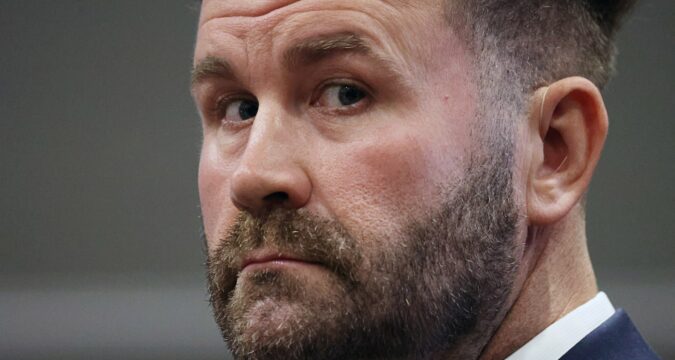
The former Kissimmee cop who admitted brutally beating a suspect was sentenced Monday to nine months in the Osceola County Jail, a year after a grand jury indicted him and decried a police “culture of cover-up” that initially hid his crime.
Andrew Baseggio later pleaded guilty to felony battery, witness tampering and official misconduct.
The case began in April 2023 when Baseggio responded to a disturbance at a house on Brack Street, where body-worn camera video showed him entering without a warrant and attacking Sean Kastner by kneeing him in the face and stunning him multiple times with a Taser. Kastner was not resisting arrest, authorities said.
Baseggio lied on his reports about what took place, setting off a chain of events in which fellow officers and top officials downplayed and obscured what happened. The “culture of cover-up” described by the grand jury eventually resulted in several officers being fired or forced to resign, including former Chief Betty Holland.
Under the terms of his plea, Baseggio, 41, agreed to relinquish his law enforcement certification. The disgraced officer looked on as Circuit Judge Keith Carsten read his sentence, which includes 18 months probation and a required anger management course. He initially faced a 40-year term in state prison.
“I don’t believe Officer Baseggio got up that morning with a joyful intent to go and hurt somebody, but because of anger or frustration or hubris, that is exactly what happened,” Carsten said. Following the sentence, Baseggio was handcuffed and led out of the courtroom by a deputy, as the tearful sniffles of his family were heard in the gallery.
Speaking before the court, Baseggio apologized for his actions against Kastner and his attempts to stymie efforts to investigate him.
“I don’t have any justification,” Baseggio told the court. “I was trained better than that, and I knew better than that.”
Ahead of sentencing, Baseggio’s lawyers Jay Rooth and David Bigney noted his current neurological disabilities, the product of a car crash last year while on duty that left him with hearing issues, seizures and other injuries. They also said that until the incident, Baseggio had a spotless career dating back to his hiring by the Kissimmee Police Department in 2007. In pleading to Carsten for a lighter sentence, Bigney said Baseggio “thrived” despite a “cancer” plaguing the department and argued his cooperation has helped changed that.
“A large part of that is credited towards my client’s accountability and cooperation” with authorities, Bigney said.
Assistant State Attorney Sean Wiggins, however, countered by describing the lengths Baseggio took to cover up his crimes, including by seeking to manipulate the testimony of his fellow officers.
As he announced the former officer’s sentence, Carsten agreed.
“It appears to this court that Officer Baseggio was not a victim or a product of that culture, but a participant of that culture,” the judge said.
Baseggio’s sentence marks the end of a significant chapter in the saga he started by beating Kastner, whose parents attended the hearing. The incident was first revealed by a TV news report that aired October 2023 and showcased what happened with video from officers’ body-worn cameras. That report was the first time prosecutors under then-Orange-Osceola State Attorney Andrew Bain were made aware of the beating, according to the grand jury.
In a scathing, publicly released 35-page presentment, the grand jury accused Baseggio along with several high-ranking KPD officials and his fellow officers banding together in an effort to conceal what really happened to Kastner that night. The grand jury charged that Baseggio worked to manipulate the testimony of officers who were at the scene with him and that Holland and others kept him aware of how the internal investigation against him was proceeding.
Meanwhile, officers conducting the investigation sought to frame the violent arrest as “objectively reasonable” by falsely claiming Kastner kicked at Baseggio.
Baseggio was later disciplined with just an eight-hour suspension, while Kastner sat in jail for a month before charges against him were dropped.
“Sean Kastner ultimately served 34 days in the Osceola County jail for the charges that were filed by this defendant, but it could have been much worse for Mr. Kastner,” Wiggins said. “… This defendant was willing to subject another citizen to that consequence to escape accountability.”
Even after prosecutors became aware of the beating, the grand jury found Holland and deputy chiefs Camille Alicea and Wilson Muñoz sought to block attempts at criminally investigating Baseggio. It wasn’t until Holland met with Bain and high-ranking officials of the Florida Department of Law Enforcement that she relented.
Holland was later forced to resign ahead of the grand jury indictment in October 2024, while a month earlier, Alicea decided to retire rather than face termination for an unrelated matter. Three other officers, including Baseggio’s then-girlfriend, were fired as a result of the affair, which further resulted in two officers being demoted while three received 24-hour suspensions. Just one officer accused of compromising the investigation into Baseggio was cleared of wrongdoing.
One of the fired officers, Michael Strickland, dismissed for “derogatory” text messages about civilians found on his phone through the investigation, wrote a letter for the sentencing hearing supporting Baseggio, saying that police are “human and occasionally make mistakes.”
What remains is the internal investigation into Muñoz, who served as one of the agency’s top-ranking leaders under three chiefs and was seemingly safe from scrutiny until new Chief Charles Broadway, billed as the reformer tasked with rebuilding KPD’s reputation, announced he was placed on paid leave since June 20. It’s not clear what policies Muñoz is accused of violating, but the grand jury’s report noted he “could not specify what, if any, crimes were evaluated” in Baseggio’s case, though he was among the key people who decided not to open a criminal probe against Baseggio.
A KPD spokesperson did not immediately respond to an email seeking comment on Baseggio’s sentence and an update on Muñoz’s case.