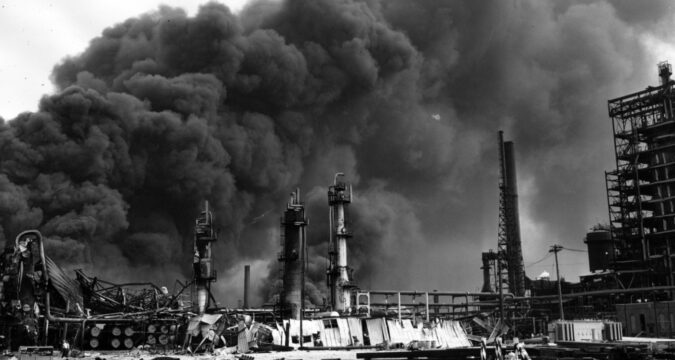
It was at “one minute after sunrise” on Aug. 27, 1955 when a massive explosion at the Standard Oil Refinery in Whiting shook Northwest Indiana and beyond, followed by devastation that would last several days and remain in local memory.
Wednesday marks the 70th Anniversary of the Standard Oil explosion tragedy, and residents will trade recollections at a special event open to the public at 5 p.m. Tuesday in lecture room 200 at Calumet College of St. Joseph, 2400 New York Ave. in Whiting. The presentation is hosted by The Whiting-Robertsdale Historical Society, and there is a $10 donation admission for those over age 12 with more information at www.WRhistoricalsociety.com or by calling Gayle Kosalko at 219-659-8129.
Among the guests and speakers will be John Hmurovic, of Robertsdale, author of “One Minute after Sunrise,” a 246-page book about the explosion filled with rare black and white photos and many individual interviews from area residents who recall that day their lives changed forever. Guests can purchase books to be signed and visit the 7th floor of the campus building for a clear view of the nearest neighborhoods affected at the time. The evening will conclude with provided refreshments and a screening of the book’s companion documentary, “One Minute After Sunrise: The Story of the Standard Oil Refinery Fire.”
An explosion at the Standard Oil Co. refinery in Whiting on Aug. 27, 1955, as seen looking north on Berry Avenue from 129th Street. A hydroformer, a 26 stories-high tank used to convert low-octane gasoline to high-octane gas, exploded at the oil refinery. A dark mushroom cloud, 8,000 feet high and visible for 30 miles, obscured the sun, effectively turning day into night. (John Austad / Chicago Tribune)
“The explosion was caused by a hydroformer, a six-foot-tall unit designed to increase the octane of gasoline, because this was 1955 during a time when everyone drove those big, gas-guzzling cars that ran on regular gas,” Hmurovic said.
“This hydroformer, which was relatively new, blew up at one minute after sunrise on that Saturday morning. Since it was made of solid steel, with walls two-and-a half inches thick, the explosion shattered it into pieces. Huge chunks of steel flew through the air, some landing on parked cars, garages, and debris crashing into one house and killing a 3-year-old boy in the Goose Island neighborhood, as well as this same flying debris cutting off the leg of his brother.”
Hmurovic and other historians marvel that there weren’t more deaths and injuries given the scope and gravity of the explosion, which killed 13 refinery workers who had been working on the unit while it was “offline.”
“The power of the blast was so strong it was felt in Michigan and caused people there to rush out of their homes fearing an earthquake had occurred,” Hmurovic said.
“Our future president Gerald Ford was just a young man at the time staying with his parents at their weekend Lake Michigan home on Ottawa Beach, Michigan, and he has been interviewed on record saying he felt the entire log cottage shake. Here in Northwest Indiana, it was the areas adjacent to the refinery, such as the 180 homes in Stiglitz Park, corner of 129th and Indianapolis Boulevard, and the neighborhood of Marktown as the two most affected. The power of the blast knocked homes right off their foundations and threw people out of their beds while shattering numerous windows within a five-mile radius.”
Hmurovic said flying chunks of steel punctured numerous oil storage tanks around the refinery property causing the oil to flow through the refinery like a river, some of it ignited aflame, adding to the danger of the many punctured oil tanks.”
Jim Hozell, now 76 and residing in Munster, was 6 years old at the time and living in Marktown with his parents. He was interviewed for Hmurovic’s book to gather recollections, as were several people who worked at the refinery at the time of the tragedy.
Thomas Koval, in truck, and Joe Poplas retrieve furniture and clothes from a home at 2826 Indianapolis Blvd. in Whiting, Ind., on Aug. 27, 1955. The nearby Standard Oil Co. refinery explosion and subsequent fire necessitated the evacuation. (Chicago Tribune historical photo)
“I remember at the time of the explosion, the window in my bedroom was blown out and glass shattered all over my bed,” Hozell said.
“My dad immediately jumped out of bed, thinking the explosion was inside our house. My parents always said the reason my legs were spared was because it was a hot night and I had a habit of sleeping with my legs dangling over the edge of my bed.”
Hmurovic said at the time of the explosion, many people experiencing the aftermath in Northwest Indiana thought either the events were akin to “the end of the world” or “the Russians had dropped a Nuclear bomb.”
“At its peak, the flames from the fire were as high as today’s (John) Hancock Building in Chicago with smoke and debris along the lake as far as the Shedd Aquarium and Lake Shore Drive,” Hmurovic said.
“Airplanes had to change course because the heat rose high into the air above. The fire burned for eight days. Of course, this all happened long before today’s owners of the refinery, BP, was involved. They were very cooperative with this book project.”
Hmurovic said while the Marktown neighborhood still exists, the area of Stiglitz Park has been erased, since following the explosion the property where 180 homes once stood was purchased by the refinery and the families relocated.
“There have been more deadly disasters in Northwest Indiana history, but none as spectacular as the one that destroyed such a large portion of the refinery on that day,” Hmurovic said.
“For those who lived through it, the explosion and fire remained etched in their minds for the rest of their lives with many of them comparing it to same gravity as their remembrance of the bombing of Pearl Harbor.”
Phil Potempa is a freelance reporter for the Post-Tribune.