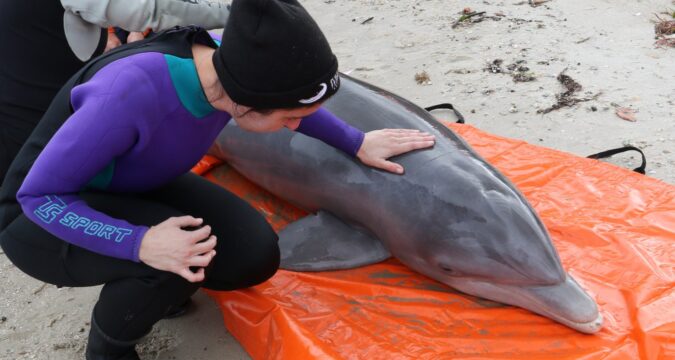
Dolphins living in the Indian River Lagoon faced Alzheimer’s-like changes to their brains during harmful algae bloom season, according to a recently released 10-year study.
The alterations in the dolphins’ brains include synapse dysfunction, increased expression of Alzheimer’s disease-related genes and changes in the brain that lead to symptoms of Alzheimer’s disease.
The study, conducted by researchers from Hubbs-SeaWorld Research Institute and the University of Miami, found that algae-bloom neurotoxin concentrations in the dolphins’ brains were nearly 3,000 times higher during warm weather algae bloom season than in cooler months.
High water temperatures and nutrient pollution from farms, lawns and faulty septic systems have driven harmful algae blooms in Florida, including in the Indian River Lagoon, where the study took place.
If the blooms are intense within an estuary, then can deplete oxygen, kill fish and spark seagrass die-offs.
They also can release neurotoxins that harm humans, pets, wildlife and marine animals. Depending on the type of algae, short-term symptoms in humans can include stomach pain, rashes, headache, watery eyes and sore throat.
Researcher Wendy Noke Durden of the Hubbs-SeaWorld Research Institute, who conducted the study, said that there is still a lot of research that needs to be done on the impact of cyanobacteria neurotoxins on humans.
Long-term exposure is less well studied, but some research shows a possible link between neurotoxins from algae blooms and humans diagnosed with neurodegenerative diseases.
The process
The Hubbs-SeaWorld Institute and University of Miami researchers took brain tissue samples from 20 bottlenose dolphins found stranded in the Indian River Lagoon from 2010 to 2019.
During that time, the Indian River Lagoon had a series of long-lasting algae blooms leading to vast seagrass die-offs.
The researchers divided the dolphins into seasonal groups: those found during algae bloom season (June–November) and those found in non-bloom season (December–May).
They found that the bloom-season dolphins had neurotoxin concentration levels nearly 3,000 times higher than in dolphins stranded during cooler non-bloom months.
The highest concentrations of neurotoxins related to algae were found in the dolphins who were stranded from June and August.
This does not mean the dolphins became stranded because of the neurotoxins, said Noke Durden. The study said the dolphins had died from various causes such as trauma, infection and exhaustion due to lack of nourishment. The strandings then gave researchers access to the animals.
“It may be that these neurotoxins just accelerate neurodegeneration, so we can have a correlation between what we’re seeing, but we can’t really prove causation,” said Noke Durden.
Related Articles
Dolphins starve when seagrass dies off in Florida, study finds
Dolphins are adapting to survive as seagrass dies off. Here’s how.
Save it or lose it: As seagrass vanishes, a mass death of marine life and a brown-water future
Noke Durden and her colleagues hypothesize that animals lower on the food chain consume the toxic algae and it rides up the food chain to the dolphins, which eat 15-20 pounds of fish per day.
“It’s likely that these animals bioaccumulate those biotoxins, probably from prey consumption, so over time you would see an increase in toxins,” she said.
There’s not much known about how humans are exposed to algae biotoxins in salt water environments, but assessing dolphins can lead to clues.
“Dolphins naturally have changes in their brain that are similar to those that are seen in Alzheimer’s in humans, so they’re a good species to study,” said Noke Durden.
She does not think dolphins are dying en masse because of Alzheimer’s disease-like changes. “There are a lot of other threats.”
She points out that during an intense harmful algae bloom in 2013 in the Indian River Lagoon, manatees, pelicans and dolphins all experienced high mortality rates due to seagrass die-offs.
The dolphins lost food sources such as spotted sea trout and had to shift to less nutritious fish, such as ladyfish. “The dolphins were literally starving to death that year,” she said.
When the seagrass died off, dolphins have to hunt more to find the same amount of calories. Noke Durden said the local dolphin population is still recovering, and most are underweight.
Dolphin groups tend to stay within their home ranges, said Noke Durden, so they’re unlikely to simply move to a new area because of an algae bloom or lack of food.
Climate change may be a factor in both algae blooms and the cascading effects they can have on the Florida coast.
Rising sea-surface temperatures will cause harmful algae blooms to occur earlier in the season and last longer, the study said.
“I think the study shows how dolphin and ecosystem health are connected,” said Noke Durden. “We need to be cognizant of protecting marine habitat, not just for wildlife, but for our health as well.”