Editor’s note: In a response that reached the Sentinel after our print deadline, the CFO’s office answered some of our questions regarding his criticism of Orange County. This editorial has been updated to reflect that.
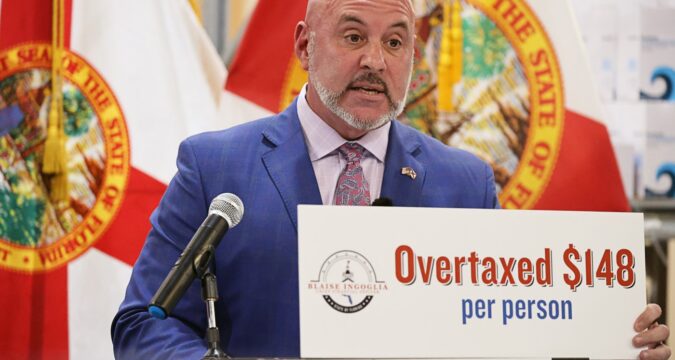
In a combative press conference Monday, Florida’s unelected Chief Financial Officer Blaise Ingoglia ripped into Orange County officials — accusing them of supporting a bloated government by bleeding taxpayers dry.
If only he had the numbers to back that up.
But he didn’t. The figures he used as proof of the county’s excessive spending were offered without context — and at times appeared to be manipulated to make things look worse than they were. Ingoglia’s entire argument was based on the presumption that any spending he identified as “excessive” was automatically bad. Inconvenient details — such as Orange County’s unique economic situation, or the impacts of a historic pandemic — were left out, starting with the fact that Orange County has one of the lowest property-tax rates in the state, especially among large counties. Moreover, the county hasn’t increased its millage rate (used to calculate property taxes) in more than five years.
Ingoglia left Orlando having achieved what he came for: News broadcasts and headlines talking about his claim of $190 million in “overspending,” capped with a heaping serving of spicy quotes.
“Governments are spending money left and right. Your property taxes have been going up and up … they think you are an endless ATM,” the former state senator proclaimed. (Watch the video here.)
Fight by numbers
But is Orange County really overspending? In some areas, maybe. It’s a $7.2 billion enterprise that incorporates dozens of departments and subdivisions — including some government functions it has little control over. (This page has detailed budget information for the past few years.) It’s all but guaranteed that some of the county’s spending could be challenged. But it’s not nearly as out-of-control as Ingoglia claimed.
It’s the oldest trick in the book — to avoid scrutiny of their own spending, which has also skyrocketed, state officials are pointing fingers at county and city governments.
Ingoglia worked hard to bolster the suspicions of county residents and discredit any attempt by the county to correct his numbers. “They will try to impugn the messenger and poke holes in the data,” he predicted. It was a safe bet. Later Monday, a visibly irritated Demings challenged several key claims Ingoglia made during his presentation. Untangling all the discrepancies may take time, but many of the mayor’s pushback claims appear to be valid.
There’s another problem here. The information Ingoglia used to condemn county leaders was stripped of critical context .
An extraordinary time
Think about the time frame Ingoglia chose to study. Five years ago, Orange County was in the razor-sharp grip of a pandemic just beginning to rage. Governments struggled with lockdowns, a fast-rising unemployment rate and the crippling blow to tourism. Many Orange County households were at the risk of capsizing, leaving county officials to figure out what they could do to help. At all levels of government, that involved a fair amount of flailing.
The bounce-back was nearly as traumatic. Inflation rates peaked at 9% by 2022, and the growth in housing prices and construction costs outstripped that. But many county residents struggled to find housing they could afford.
As a result, Orange County increased spending in some areas — including affordable housing. Ingoglia appears to be including some of that funding in his calculation of the budget increase
Ingoglia also blasted the county for adding 661 employees over the time he studied. That appears to be accurate, but it’s worth noting that every year, roughly half the new positions were under the supervision of the county’s constitutional officers. The County Commission has less discretion over the spending by those elected officials, which include the clerk of courts’ office, the supervisor of elections and of course the sheriff.
Wednesday afternoon, the CFO’s office responded via email to Sentinel questions, including a criticism of Orange County’s spending over the five-year period: “Wouldn’t they have used (federal) COVID dollars to fill the gaps instead of increasing their budget in a way that is unsustainable? Even so, decreased revenue should mean that spending decreases.”
We can see the CFO’s point here, but he hasn’t pointed out any spending that meets the definition of waste.
More math ahead
We spent the last few days trying to untangle the calculations behind Ingoglia’s claim that, over the past five years, the county had $190 million in excess tax collections. We haven’t seen the details of his math yet (and in the email response Wednesday, his office only offered a repeat of what he said during the press conference). So we can’t present a full critique. But we have found some holes.
For example, he claims his final number is adjusted for inflation and population growth, factoring in a 79,047-person increase in Orange County’s population. That figure is certainly understated, accounting for population growth from April 2020 through April 2024 — a time frame that leaves out at least one year of the period Ingoglia claimed to study. Demings says the actual growth tops 125,000.
More residents equals more demand on public services — which is not the county’s fault.
Ingoglia also disregarded the massive influx of tourists visiting the nation’s most popular vacation destination. According to Demings, that figure adds about 200,000 people to the daily population calculation.
Not everything Ingoglia said was off-base. He claims Orange County could “easily” drop its property tax rate by a significant amount. That might be true, if county officials were willing to abandon their current policy of maintaining sizable reserves and under-spending in many parts of the budget — creating fund balances that can be swept forward each year to bolster the bottom line. But that padding gives the county the ability to respond to unexpected circumstances such as big storms or another pandemic. That cushion will be particularly critical if a big storm rakes Orange County after President Donald Trump has made good on his promise to stop federal disaster aid to the state.
Ingoglia tried mightily to present Orange County government as a horde of reckless, bureaucratic pirates, seizing loot from property owners and lavishing it on unworthy programs that are as yet undefined.
A good look at the county’s finances doesn’t support the allegations of wasteful recklessness. Yes, spending has increased — but a large portion of that money has gone to priorities like children’s services, public safety, mental-health programs and homeless assistance.
Is it too much? Ingoglia hasn’t provided real, confirmable proof of overspending. When he does, we’ll certainly examine it. But right now, for all his sound and fury, Ingoglia has yet to state a criticism that sticks.
And if it’s budget growth he’s worried about, he should take a look at the state of Florida— which ballooned from approximately $86 billion in 2020 to over $117 billion for the current fiscal year. That is, after all, his official job. Yet he’s offered little criticism of the state’s free-spending ways.
That alone should be enough to cast his attacks on Orange County and other “blue” counties — including Duval County (which he put on blast Wednesday) — into doubt. But as we’ve said, there are plenty of gaps and flaws in this claims. For now, Floridians are justified in seeing his claims as unproven, politically motivated attacks on local officials whose politics disagree with his.
The Orlando Sentinel Editorial Board consists of Opinion Editor Krys Fluker, Executive Editor Roger Simmons and Viewpoints Editor Jay Reddick. Contact us at insight@orlandosentinel.com