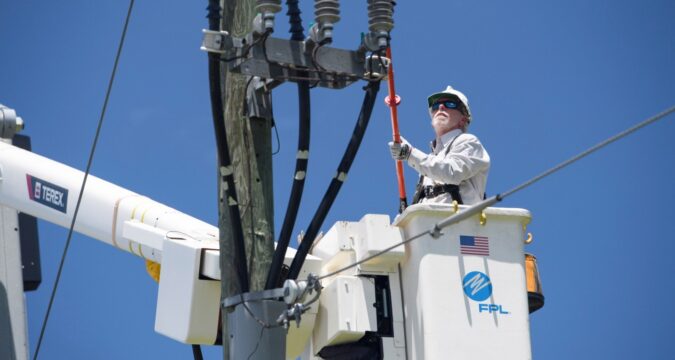
To call Florida Power & Light’s $6.9 billion rate increase a “settlement,” as the utility and its regulators do, is like calling a bank robbery a “transaction.” The terminology is facially correct. It’s also woefully wrong.
More accurately, it’s a swindle, a scam and a sellout of the vast majority of FPL’s six million customers, including nearly 600,000 residents of Lake Mary, Sanford and much of Volusia and Brevard counties. It will increase the average power bill for homeowners by about $2.50 a month, which may sound small — but before this rate hike, energy bills in Florida were actually set to decrease due to the phaseout of a storm recovery fee that FPL added to bills through 2025. And the agreement allows for three more increases before 2031.
Those customers’ legal representative, Florida’s public counsel, was not invited to the table where the company and some of its largest corporate customers cut their sweetheart deal. He objected, but the misnamed Public Service Commission approved it last month — unanimously.
Abandoning all judgment
This can’t really be called a “settlement” when most affected parties oppose it. Four of the five members of the PSC sounded like they had misgivings but seemed to follow some unspoken command.
“It’s not the dream settlement, but it is the one before us,” said PSC member Art Graham, who’s leaving next month.
So? Nothing in the law or in common sense required them to check their judgment at the office door.
They have a capable professional staff to advise them. That staff went unheard, which is significant.
Public Counsel Walt Trierweiler called the deal “disproportionately favorable” to corporate customers. When he tried to file a counterproposal, PSC Chairman Mike LaRosa rejected it because FPL wasn’t involved in creating Trierweiler’s plan, and the company is an “indispensable party” to any settlement. By that logic, the millions of households who must pay the freight are entirely dispensable — certainly they weren’t involved in the devilish deal cooked up by FPL in consultation with a list of corporations that includes several industry groups as well as Walmart, RaceTrac, Circle K, Wawa, and the Florida Retail Federation.
Consumer advocates and a bipartisan group of Florida elected officials — including several local leaders — also weighed in with their objections. But there was notable silence from James Uthmeier, currently acting as Florida’s attorney general, who failed to follow the precedent set by predecessors Charlie Crist and Bill McCollum. If Uthmeier wants to be elected to this job, he needs to explain why he didn’t challenge an obviously irregular agreement that will stick Floridians with increasing power bills.
Why it works this way
Understanding this betrayal of consumer interests requires knowing how the system is built to work and why it is that utilities always seem to win.
The PSC is an arm of the Legislature, which is under the spell of lobbyists. The PSC members are appointed by the governor, but must be nominated by a 12-member council dominated by legislators. FPL and its corporate parent, NextEra Energy, are consistently among the largest contributors to political campaigns in Florida.
Fifteen years ago, when Crist was governor, the Senate refused to confirm four of his PSC appointees after they rejected a major FPL rate hike. The neutered PSC has minded its manners ever since.
Trierweiler plans to appeal the FPL sellout to the Supreme Court and other opponents will probably join in. But higher regular bills will arrive next month, averaging $14 more per month to start. The increase is greater than the scheduled elimination of an $11.02 hurricane recovery surcharge.
A faux ‘settlement’
One way the “settlement” favors corporations over the public is in the financing of new data centers to satisfy the voracious demands of artificial intelligence and other high-tech consumers.
As first proposed by FPL, tech companies would be required to pay for at least 90% of anticipated energy costs, even if they turned out to use less. That would spare mom-and-pop ratepayers from having to front the expense of building unused capacity for those corporate consumers.
The “settlement” lowers the guarantee to 70%, which raises the potential liability for customers. In hearings on the rate case, FPL maintained that attracting data centers would benefit everyone. That’s recycled voodoo economics.
Data centers are enormous and have huge environmental consequences, including massive water use to cool their computers. Rate increases that favored data centers contributed to the recent losses of two Republican incumbents on Georgia’s elected Public Service Commission.
This “settlement” should rise to the top of Florida’s 2026 election issues. Uthmeier isn’t the only one who should be held accountable for his acquiescence. Legislators should also be questioned as to why they didn’t advance a reform bill, filed last year by Sen. Don Gaetz, R-Niceville, that would have given the public more opportunity to object to backroom deals.
Skeletons in FPL’s closet
Of related interest is that a three-judge panel of the 11th U.S. Circuit Court of Appeals has revived a stockholder’s suit against NextEra Energy and FPL on certain belated disclosures in its SEC filings, including FPL’s financial support of political groups involved in posting “ghost” candidates in the 2020 legislative elections. A mystery candidate was involved in the narrow defeat of then-state Sen. José Javier Rodríguez of Miami, an FPL opponent, now a Democratic candidate for attorney general. The utility’s dark money — described in a deep-dive investigation by the Orlando Sentinel — was also tied to the campaign of a woman running against now-Sen. Jason Brodeur, R-Sanford. The extensively detailed opinion by Judge Gerald Bard Tjoflat — a 95-year-old Florida resident (aside unnecessary? Cannon is also in Florida at less than half his age ) — capably describes the complaint that U.S. District Judge Aileen Cannon, one of President Trump’s most controversial appointees, had dismissed.
“The complaint has it all: corporate malfeasance, bribery, off-the-books recordkeeping, surveilling journalists, creating ‘ghost’ candidates, corrupting independent media outlets, and a failed acquisition that spiraled into two federal indictments,” Tjoflat wrote.
The ghost candidates were just the tip of the iceberg. The Sentinel’s Annie Martin laid out a web of shadowy groups that served as a pipeline, funneling money into local and legislative campaigns across Florida where candidates shared one common element: They’d voted in the past against FPL’s interests.
It’s hard not to see this settlement as the second act in that drama: The part where FPL reaps the benefits of its investments — not in energy technology, but in political influence.
The Orlando Sentinel Editorial Board includes Executive Editor Roger Simmons, Opinion Editor Krys Fluker and Viewpoints Editor Jay Reddick. The Sun Sentinel Editorial Board consists of Executive Editor Gretchen Day-Bryant, Editorial Page Editor Steve Bousquet, Deputy Editorial Page Editor Dan Sweeney and editorial writers Pat Beall and Martin Dyckman. Send letters to insight@orlandosentinel.com.
https://www.orlandosentinel.com/2025/12/05/editorial-florida-leaders-failed-to-block-fpl-cash-grab/