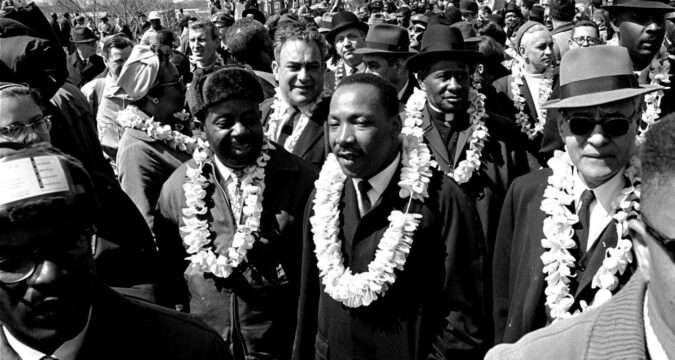
To commemorate Martin Luther King Jr. Day on Monday, the editorial board offers these quotes selected from some of his most pivotal and memorable speeches to honor his memory.
“We have seen our nation weighed in the balance of history and found wanting. We have come because we see this as a dark hour in the affairs of men. For most of us this is a new mood. We are traditionally the idealists…. I wish that I could say that this is just a passing phase in the cycles of our nation’s life; certainly times of war, times of reaction throughout the society but I suspect that we are now experiencing the coming to the surface of a triple-prong sickness that has been lurking within our body politic from its very beginning. That is the sickness of racism, excessive materialism and militarism. Not only is this our nation’s dilemma, it is the plague of western civilization.”
— from “The Three Evils of Society” speech delivered Aug. 31, 1967 to the National Conference on New Politics in Chicago.
“This dearth of positive leadership from the federal government is not confined to one particular political party. Both political parties have betrayed the cause of justice. The Democrats have betrayed it by capitulating to the prejudices and undemocratic practices of the southern Dixiecrats. The Republicans have betrayed it by capitulating to the blatant hypocrisy of right wing, reactionary northerners. These men so often have a high blood pressure of words and an anemia of deeds. …. In the midst of these prevailing conditions, we come to Washington today pleading with the president and members of Congress to provide a strong, moral and courageous leadership for a situation that cannot permanently be evaded. … The hour is late. The clock of destiny is ticking out. We must act now, before it is too late.”
— from “Give Us the Ballot” speech delivered May 17, 1957, at the Prayer Pilgrimage for Freedom in Washington, D.C.
“Non-violent resistance does call for love, but it is not a sentimental love. It is a very stern love that would organize itself into collective action to right a wrong by taking on itself suffering. While I understand the reasons why oppressed people often turn to violence in their struggle for freedom, it is my firm belief that the crusade for independence and human dignity that is now reaching a climax in Africa will have a more positive effect on the world, if it is waged along the lines that were first demonstrated in that continent by Gandhi himself.”
— from “My Trip to the Land of Gandhi” published in July 1959 by Ebony magazine.
“[I]n your life’s blueprint must be a commitment to the eternal principles of beauty, love, and justice. Don’t allow anybody to pull you so low as to make you hate them. Don’t allow anybody to cause you to lose your self-respect to the point that you do not struggle for justice. However young you are, you have a responsibility to seek to make your nation a better nation in which to live. You have a responsibility to seek to make life better for everybody. And so you must be involved in the struggle for freedom and justice.”
— from “What’s Your Life’s Blueprint” speech delivered Oct. 26, 1967, to students at Barratt Junior High School in Philadelphia.
“Victor Hugo once said that there is nothing in all the world more powerful than an idea whose time has come. The dynamic idea whose time has come today is the quest for freedom and human dignity. Men are tired of being trampled over by the iron feet of oppression. They are tired of being plunged into the abyss of exploitation where they experience the bleakness of nagging despair. And so all over the world formerly oppressed people are making it palpably clear that they are determined to be free.”
— from “A Creative Protest” speech delivered Feb. 16, 1960, at White Rock Baptist Church in Durham, N.C.