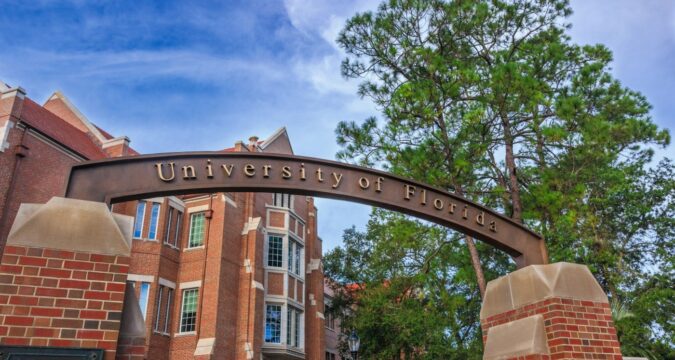
For more than a year, the University of Florida has lacked a permanent president, and things may stay that way awhile longer. UF trustees just named a second interim president, Daniel Landry of Columbia University.
No wonder. Acknowledging the obvious, Kent Fuchs, the first temporary president, told the Faculty Senate that the search process has become “more challenging” since the state Board of Governors ditched the UF trustees’ unanimous choice, Santa Ono.
It’s hard to imagine any worthwhile academicians being willing to risk similar humiliation or being passed over for the next Florida politician who covets the prestigious post.
Ono, a scientist of distinction, gave up the University of Michigan presidency when UF trustees offered him the helm of Florida’s flagship university. The Board of Governors’ 10-6 rejection vote left him humiliated and looking for another job.
Opponents claimed Ono was not sufficiently enthusiastic about erasing diversity at Michigan and was insufficiently opposed to antisemitism. It had the odor of a smokescreen.
Political jockeying
It’s more likely that another politician wants this highly paid university presidency to fatten his or her pension. Patronage presidents, once rare in the Florida higher education system, have become routine under Gov. Ron DeSantis.
Of 25 higher-ed vacancies in his administration, 11 were filled by former Republican legislators or lobbyists. Jeanette Nuñez, who was his lieutenant governor, is now president at FIU. Manny Diaz, lately his education commissioner, is interim leader at the University of West Florida, where he’s well-positioned to get the permanent presidency. Marva Johnson, a politically connected telecom executive, got the Florida A&M presidency despite intense opposition from faculty and students.
Richard Corcoran, DeSantis’ first education commissioner and a former House speaker, is overpaid $1 million a year as president of New College in Sarasota. Under his rocky tenure (which is best visualized as a dumpster full of discarded books on such “woke” topics as the U.S. civil rights movement and the changing role of women in society that were culled from the college’s collection in 2024) state costs at New College have soared and enrollment has plummeted. Corcoran’s tenure almost makes former Osceola county commissioner and state legislator Fred Hawkins look good. It’s notable that when Hawkins was tapped as president for South Florida State College in 2023 he had only a bachelor’s degree — oh, and an arrest record on charges of impersonating a police officer. Still, his tenure at the college has been relatively controversy-free.
All this cronyism played out under cover of a law the Legislature passed three years ago, SB 520, to exempt presidential searches from Florida’s open-meeting and public records laws. It requires disclosure only of three finalists in each case, but it’s rare to hear of more than one. Applicants game the system by refusing to be considered unless identified as the only finalist.
That’s how Ono got his offer. It’s how Ben Sasse, a Republican senator from Nebraska, was chosen at UF in 2023. He was gone 15 months later, citing his wife’s health, not dispelling suspicions that he was forced out.
A Democratic collapse
The law that made presidential search secrets was a Republican priority that passed on a largely party-line vote.
Although badly outnumbered, the Democrats could have prevented it because sunshine law exemptions require a two-thirds vote.
The bill would have died had four more Democratic senators voted no. In the House, 11 Democrats who voted “yes” gave the measure the exact margin it needed.
The pretext for SB 520 was to attract more qualified applicants. It has worked just the opposite and to the benefit of politicians — just as opponents warned.
That includes the Sun Sentinel editorial board, which predicted in 2022: “The result will intensify backstage competition for highly lucrative jobs among ambitious Republicans.”
A flood of exemptions
There are now some 1,200 exemptions to public records law, according to the Florida First Amendment Foundation, which opposed many of them. Even worse, says Bobby Block, its executive director, is that “increasingly … records that are not exempt from disclosure are not being disclosed.
“The new default from state agencies on down to the lowest local boards is delay, deny or ignore, with the last one being the most prevalent,” Block said. “As politics has become more polarized and power is becoming more consolidated in the hands of extremists, fewer and fewer records custodians are willing to go against the instructions of their boards or officials.”
DeSantis is notorious for slow-walking or simply ignoring public records requests, and his example is widely followed. For his utter contempt for “sunshine” alone, DeSantis cannot leave office soon enough.
Chapter 119 requires that new exemptions “sunset” or expire after five years, unless they are renewed by another two-thirds vote. But the Legislature renews them as casually, if not more so, as when they were first enacted. Florida’s “Government in the Sunshine” was once a model for the nation. It’s now a model of darkness.
This ought not be partisan, because open government matters as much to conservatives as to liberals.
We see an opportunity for someone to get elected governor or attorney general by proposing to sunset all exemptions at once. That would compel the Legislature to get serious about justifying those it thinks worth renewing, and the public would regain the upper hand.
In the short term, the creeping corruption of higher education must stop. To that end, repealing SB 520 is urgent.
The Orlando Sentinel Editorial Board includes Executive Editor Roger Simmons, Opinion Editor Krys Fluker and Viewpoints Editor Jay Reddick. The Sun Sentinel Editorial Board consists of Executive Editor Gretchen Day-Bryant, Editorial Page Editor Steve Bousquet, Deputy Editorial Page Editor Dan Sweeney and editorial writers Pat Beall and Martin Dyckman. Send letters to insight@orlandosentinel.com.
https://www.orlandosentinel.com/2025/09/03/the-poisoning-of-higher-education-job-searches-editorial/