And Brightline and Spirit Airlines think they’re in a financial squeeze.
Tri-Rail, another of South Florida’s money-losing transportation companies, has a date certain for its potential demise: June 2027. The red flag goes up if the Florida Department of Transportation, which owns the rail corridor over which the three-county commuter line’s trains travel, refuses to restore a dramatic subsidy reduction it decided to impose earlier this year, and no replacement sources can be found.
Instead of contributing up to $62 million annually as it has in the past, the state agency recently informed David Dech, executive director of the South Florida Regional Transportation Authority, which operates Tri-Rail, that the new figure will be $15 million starting with the 2025-26 fiscal year which started in July. The FDOT has yet to make a public announcement.
The agency did not respond to an emailed request from the South Florida Sun Sentinel last week seeking the reason behind the cut. The email also asked whether the state is comfortable with the idea of allowing Tri-Rail to go out of business.
Between now and mid 2027, Tri-Rail is dipping into dwindling reserves to cover its $150 million budget, the railroad says.
The FDOT decision would place the onus on Palm Beach, Broward and Miami-Dade counties to raise their respective individual contributions to $10 million from slightly more than $4 million.
Dech, who arrived at Tri-Rail in 2022 after running CapMetro, a bus-train transit system in Austin, Texas, has spent part of his summer on the road, informing government officials of the consequences if the state money is not restored or alternate funding fails to materialize.
Non-starter
If the recent reactions from Palm Beach County commissioners are any indicator, the quest for funding increases from each of the counties appears to be a dead letter. One commissioner wondered where local governments would get their money if Gov. Ron Desantis succeeds with his idea to drastically cut or eliminate property taxes in the state. Another complained of an “unfunded mandate” to further back a rail enterprise the county doesn’t even own.
“I think the message was clear that they see Tri-Rail as a valuable service, but they feel the state should pay to maintain their asset,” Dech said in an interview last week with the South Florida Sun Sentinel after laying out Tri-Rail’s plight at a commission budget workshop in West Palm Beach. “They sent the message loud and clear.”
Passengers line up to board a Tri-Rail train at the Dania Beach station. An estimated 15,000 people ride daily. (Carline Jean/South Florida Sun Sentinel file)
Broward County’s elected commissioners have yet to publicly discuss the issue and declare their preferences, said county spokesman Gregory Meyer. But he said staff members from all three counties have been meeting to discuss the sudden cash shortfall. Tri-Rail has attended some of those discussions, a railroad spokesman said.
The funding reduction comes at anything but a fortuitous time for the rail line, which was founded in 1989 by the state as a traffic relief valve while Interstate 95 and Florida’s Turnpike were being widened. In the late 1980s, FDOT bought the line from the Jacksonville-based CSX freight railroad for $264 million, the equivalent of $720 million today, Dech said.
The South Florida Regional Transportation Authority, the overseer of Tri-Rail, was created in 2003 by the Legislature, according to an FDOT history of the commuter line. It replaced the Tri-County Commuter Rail Authority “which managed Tri-Rail until that point.”
CSX and Amtrak, the national passenger rail system, also use the line under lease agreements. So whether Tri-Rail stays or goes, money must still be spent to maintain the corridor, which runs mostly west of I-95 through the three counties.
“If Tri-Rail didn’t exist, the state still owns this railroad and the line has to stay open,” Dech said. The cost ranges between $42 million and $49 million per year.
The money appears to have been worth it. For its fiscal year from July 2024 to June 2025, Tri-Rail posted a record 4,578,680 rides, which surpassed the 4,465,750 rides in fiscal year 2019.
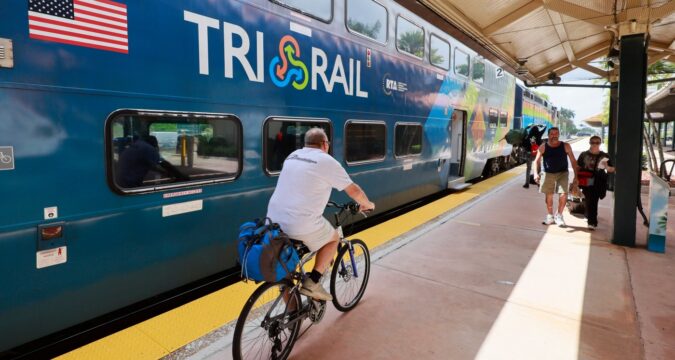
Passengers (many with bicycles in tow) include students headed for school, workers headed for jobs and leisure travelers bound for one of South Florida’s three international airports or regional entertainment events.
In January 2024, Tri-Rail opened a long-promised service to downtown Miami along an east-west spur that connects its main line with Brightline’s MiamiCentral station.
All of it goes by the boards without a new funding source, rail officials say.
Here are some options, some already under consideration with others raised in the Sun Sentinel interview with Dech:
Fare increases
“I think there is a fare increase in our future, but it’s not going to bridge this gap,” Dech said.
The risk, Dech has said previously, is that fare hikes might chase away loyal customers who have made riding Tri-Rail a habit — traveling through 19 stations from just north of West Palm Beach to Miami International Airport, with side trips to downtown Miami.
Under a zone system. one-way fares are as low as $2.50; a roundtrip for a ride up and down the entire system is $17.50.
Tri-Rail hasn’t lifted ticket prices since January 2020, “and before that it was ten years,” Dech said.
Three years into the job, David Dech, executive director of the South Florida Regional Transportation Authority, is leading an urgent quest to find new dollars for the Tri-Rail commuter line after a dramatic funding cut by the Florida Department of Transportation. (Mike Stocker/South Florida Sun Sentinel)
Cut expenses
In the Sun Sentinel interview, Dech said he had been hoping to restructure contracts with companies that perform maintenance and operational functions.
“We were going to bundle those to find efficiencies,” he said. “We were ready to move forward.”
The strategy is now on hold due to the cut in state funding. It’s hard to work out long-term deals with contractors, he said, when a business’ existence comes into question.
Dech has said he and his staff have been looking hard to scrub internal costs, freezing positions and reducing the operations department, for example.
But administrative expenses constitute only 10% of the company budget as many services are contracted out.
Dech says he’s looked at cutting weekend trains, weekday service and reducing a recently introduced express train operation into Miami. But those moves are constrained by a funding agreement with the Federal Transit Administration to operate 48 trains daily.
Moreover, a contract with the City of Miami requires Tri-Rail to operate 26 trains daily into downtown Miami. The company is judicious with its train deployment. Earlier in the year, it cut a late-night service that drew nominal numbers of riders.
Tri-Rail is also re-evaluating capital projects. They include a maintenance facility on the northern end of its 73.5-mile line near West Palm Beach, and the acquisition of new locomotives and passenger coaches that would replace 35% of the line’s “rolling stock.”
Ride-share passengers wait at the Fort Lauderdale Tri-Rail station. As Tri-Rail looks for ways to stay afloat amid funding cuts, one program that could be cut or eliminated is the ride-share service it offers to and from stations. (Joe Cavaretta/South Florida Sun Sentinel)
At a recent monthly SFRTA board meeting, a debate broke out among members over whether the line should cut all or some of a subsidized ride service Tri-Rail provides to and from its stations. It is 50% funded by the railroad and 50% backed by an FDOT grant. Besides taxis, it funds a shuttle bus at Fort Lauderdale-Hollywood International Airport and emergency buses that ferry passengers around Tri-Rail accident scenes.
One board member, Raquel Regalado, a Miami-Dade County commissioner, suggested the service should be ended or reduced as a sign of good faith in any future negotiations with FDOT. The board intends to revisit the issue next month.
Exploit real estate deals
The term, “Transit Oriented Development” gained wide currency over the years as Brightline gained operational traction along the Florida East Coast corridor in multiple downtown areas and developers went on a building binge near the train line’s stations with high-rise apartments, condos and office buildings.
Tri-Rail, too, has identified areas around its stations in Boca Raton, Boynton Beach, Fort Lauderdale (Cypress Creek) and the Hialeah Market station for development.
But developments take time and the payoffs from leases would not be immediate.
“There are really only two of them,” Dech said of near-term income generating possibilities near Tri-Rail stations.
One is a recently announced plan in Boca Raton from the developer 13th Floor Investments called Link at Boca — a mixed-use development with 340 apartments and a retail component covering 24,000 square feet.
A rendering illustrates Link at Boca, a mixed-use project rising next to the Boca Raton Tri-Rail station. The development will feature an eight-story 340-residence tower and 24,000 square feet of retail. It’s a “Transit Oriented Development” that would generate badly needed funds to help the commuter line to sustain itself. (13th Floor Investments/Courtesy)
Dech said land around the Boynton Beach station would be next to be placed on the market.
The Fort Lauderdale and Hialeah properties have severe limitations. The land around the Cypress Creek station lost its residential zoning component, and there is a three-story height restriction out of deference to planes flying in and out of the nearby Fort Lauderdale Executive Airport.
The Hialeah scenario is “very awkward” with an array of small lots, Dech said.
Sue the FDOT
An ultimate fallback position could be to take the FDOT to court for reneging on its financial commitment, which calls for a minimum $42 million annual subsidy.
“It’s probably not a good idea,” Dech said. “Could we? We could. Nothing is off the table.”
But the court route could take years.
“We certainly want to work with partnerships,” Dech said. “I think we’re all much more interested in resolving this.”
Sell bonds, go public?
Miami-based Brightline, the higher speed rail line that operates between Miami and Orlando mostly along the Florida East Coast Railway corridor, and Spirit Airlines, have relied on the private funding for years as both wracked up sizable losses. Brightline, while it has built a strong following, is still suffering through startup pains caused by refinancing and infrastructure buildout costs. Spirit, a low-cost budget operator, has been buffeted by stiff industry competition.
Brightline sold private activity bonds to finance its startup and raise operating capital. It is currently seeking equity funding.
Spirit Aviation Holdings, Inc., parent company of Spirit Airlines, received a new equity infusion from large creditors and a new issue of common stock started trading in late April after the airline emerged from Chapter 11 bankruptcy protection in spring, although just last week entered Chapter 11 bankruptcy proceedings for the second time in a year.
Tri-Rail, though, lacks the collateral to pull off a bond offering. It does not own the railroad and owns only four of its 19 stations, Dech pointed out.
And no commercial lenders are poised to extend a multimillion-dollar credit line to Tri-Rail.
Set up taxing districts
The idea of creating taxing districts to raise funds was among the options suggested by a consulting firm retained by SFRTA to explore financing avenues.
“It has come up,” Dech said. “I don’t know that it has gone into a serious discussion. It was one of the items as a possible way to raise funds.”
Such districts are specific areas designed to provide services such as capital improvement projects, security, maintenance, landscaping or neighborhood street lighting.
But it would take action by a county or city to create and manage any district, which would have to encompass land around a station so the tax dollars raised would benefit the railroad.
Merge with Brightline?
Not in the cards.
“They run inter-city railroads, not commuter railroads,” Dech said.” I don’t think there is a merger in the works.”
File for bankruptcy?
As a public entity, Tri-Rail’s governing authority could explore a Chapter 9 bankruptcy filing, a route normally reserved for debt-ridden municipalities.
“I don’t know — I don’t think so,” Dech said. “I haven’t gone that far. The word bankruptcy hasn’t come up.”
If replacement money doesn’t come through, he said, “we would just cease to exist and pay our existing debt.”