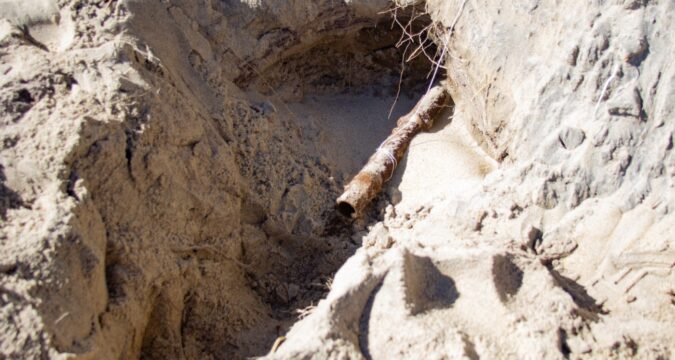
The site of a Cold War era Navy base is about to be turned inside out as the U.S. Army Corps of Engineers continues investigating an unrelenting fuel leak on the Outer Banks.
Excavation could go “deeper than 10 feet” and it’s possible forgotten structures “and hidden dangers” may be revealed, the Corps of Engineers said in an email.
Crews intend to remove all soil and groundwater found contaminated by the fuel, and will remove anything below the surface that gets in their way, officials said.
“Infrastructure that is incidental to accessing and/or excavating petroleum-impacted soil or groundwater (potentially creating preferential pathways for petroleum migration) will be removed,” officials said. “Otherwise, (the project) does not have authority to remove remnant infrastructure not associated with petroleum contamination.”
That means hidden structures not linked to the leak will be left and reburied.
Dare County requests ‘immediate action’ from government officials on Buxton beach cleanup
The fuel oozes up at the south end of Old Lighthouse Road at the Buxton Beach Access, National Park Service officials say. The odor and oily sheen has forced Cape Hatteras National Seashore to keep three-tenths of a mile of beach closed to the public since 2023.
The area was once home to a 40-acre military facility known for conducting “secret monitoring of submarines,” and it included 12 buildings, according to a 2013 report in CoastalReview.org.
It operated from the mid 1950s into the early 1980s, and was then ceded to the U.S. Coast Guard until 2005, the National Park Service said. Once closed, the base structures were removed and the land became part of part of Cape Hatteras National Seashore.
The base was largely forgotten until beach erosion began to expose buried infrastructure and a mysterious petroleum leak that has defied multiple cleanup projects.
Seven ground storage tanks were located and removed in 1989 by the Army Corps of Engineers, and three more were found and removed in 1991, officials said.
In June 2024, the Army Corps of Engineers conducted an investigation at the site using electromagnetic induction and magnetometer equipment.
“The Corps of Engineers identified subsurface infrastructure and utilities but did not identify any remaining underground storage tanks,” officials said.
Past efforts to clean up the site has included removing: 4,599 cubic yards of soil; 99,526 gallons of petroleum-impacted water; 278,000 pounds of concrete and 1,153 feet of pipe, officials said.
https://www.pilotonline.com/2025/09/30/outer-banks-excavation-fuel-leak-origin/