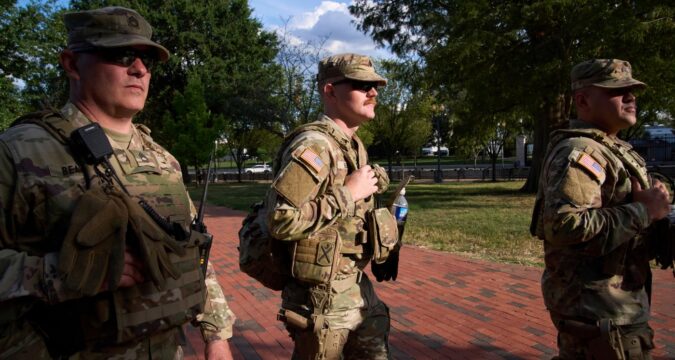
In an unprecedented breach of law and decency, the president is threatening to send federal forces to our city, in an unironic attempt to combat nonexistent lawlessness in Chicago. The Tribune Editorial Board called a similar dispatch of the National Guard to Washington “dystopian”; that dystopia has featured the racial profiling of delivery drivers and the clearing of homeless encampments by troops armed with pistols and rifles.
If this performance in D.C. indicates what awaits Cook County, National Guard troops arriving here will be tasked with disappearing homeless people and deporting people of color.
These attacks on the vulnerable are the physical manifestation of what this administration has achieved through the legal rubric of policy. This summer, a Republican majority passed the big beautiful bill. That this legislation, which threatens food assistance for nearly 3 million children in poverty or medical care for more than 10.5 million elderly and disabled Americans, can be called “beautiful” is almost as large of a crime against the English language as it is a vicious attack on America’s safety net.
To ensure this move isn’t being read as coincidental, the Department of Homeland Security posted memes on its social media account glorifying a pre-civil rights-era America, with the slogan: “We Can Return.” The reversal of a century of progress in human rights — the unlawful oppression of the foreigner, the poor and the distressed — seems to be the new American way.
“The people of the land have run rampant in oppression and violence; they have wronged the needy and destitute, and oppressed the foreigner unlawfully” is an apt description of our time. However, this was no warning by a political pundit; these are the words of the prophet Ezekiel. What he called for in response to lawlessness in his time, in ancient Israel in seventh century B.C., was a single solution: just one individual willing to stand up against the pervasive culture of injury and oppression. “A solitary person willing to stand in the breach.”
However, not a single person came forward to rise up and call the lawlessness of that age what it was: a moral crime, a sin. With none willing to stand in the face of enmity, spite and oppression, Jerusalem was destroyed.
Our quartet of faith leaders believes the role of the prophet is to remind people of morality and justice and warn them of the consequences of their actions. We believe that if we do not heed Ezekiel’s warning, if we do not rise up to fill the incredible breach in American society that widens every day, it is hard to see anything but darkness in the future.
We are not being simplistic. We know how difficult it can be for leaders of different faith traditions — with overlapping yet distinct values, with different guiding principles and texts, each with its history that includes long periods of strife with the other — to partner together, sometimes even to stand together. It is hard work for religious communities to stick together despite differences.
But the vulnerable and needy are being harmed every day; the stranger isn’t just being oppressed but rounded up outside the bounds of the law, imprisoned without due process and repatriated to countries they’ve never known. Now is not the time to focus on differences. Now is the time for Christians, Jews and Muslims to put aside any differences and unite in our common foundation to love our neighbor, to care for the poor, the vulnerable and the neglected. All our holy books have foundational teachings of justice and love. How can we not now — at this most needed of moments — join arms to be a moral voice for a country spinning out of control?
Whether we base our action in Ezekiel’s warning, Matthew’s charge to the righteous to take care of “the least of us,” a treasured teaching from the Quran or the drive of our inner conscience, many of us feel the need to stand up against the lawlessness of our time and stand up for fundamental religious values and basic humanity. As one of us has said, “America is getting more dangerous by the day. If folks don’t speak up now, it’s over.”
Before the sun sets on American democracy, let us stand up together. That is precisely what we did with Gov. JB Pritzker last week. We stood together in this breach when a president seeks to send armed troops into Chicago. We stood with a governor who said, “Look to the members of the faith community standing behind me today for guidance on how to mobilize,” and we have committed ourselves to do just that. To organize the faith community of Chicago to speak up for and protect human rights and human beings.
We will host trainings in nonviolent resistance, we will warn about falling into the trap of providing the administration with a pretext for a state of emergency, we will remind our communities that any National Guard troops must be treated with decency, and we will remind our national officials we need resources for our children, not soldiers in the street.
Let us fill the streets in protest. Let us fill the courts with cases. Let voices of care ring out of every pulpit, speak from every heart and be extended with kind acts from every hand. May nonviolence rule our lawless time. May your voice and your hands join together with ours.
Ezekiel explained what happened in his time when no one was willing to step into the breach. Matthew, shared a different vision of what it means to live a religious life of value. He envisioned Jesus celebrating the righteous in heaven, thanking them: “For I was hungry and you gave me something to eat; I was thirsty and you gave me something to drink. I was a stranger and you invited me in; I was naked and you clothed me. I was sick and you looked after me; I was in prison and you came to visit.” The righteous, having no memory of these deeds, wondered aloud: When did we do all this for you? The reply: Whatever you did for one of the least of these, you did for me.
Those with the least in America are under constant attack. A recent meme captured this inconsistency with Christian values: “I was hungry and you cut SNAP; I was thirsty and you cut funding to ensure clean water. I was sick and you cut Medicaid; I was a stranger and you deported me. I was in prison and you just left me there to rot.”
Chicago faith leaders Rabbi Seth Limmer, the Rev. Otis Moss III, the Rev. Ciera Bates-Chamberlain and the Rev. Michael Pfleger joined the Tribune’s opinion section in summer 2022 for a series of columns on potential solutions to Chicago’s chronic gun violence problem. The column continues on an occasional basis.
Submit a letter, of no more than 400 words, to the editor here or email letters@chicagotribune.com.
https://www.chicagotribune.com/2025/08/31/opinion-chicago-donald-trump-protecting-democracy/