Like many congregations, we were back on Zoom the past two Sundays at St. Martin’s, and it has felt like a flashback to 2020.
Remembering to mute and unmute, navigating between gallery and speaker views, sharing our screens to play music and video, keeping an eye on the chat, raising and lowering that little hand emoji — it’s a lot. But the strong sense of déjà vu these past couple of weeks came not just from navigating online worship, but from reliving that paradoxical Covid combination of being holed up at home while very weighty things were unfolding out in the world — including, once again, in Minneapolis.
Coming up on six years ago, the killing of George Floyd prompted protests and statements, including one from St. Martin’s Vestry (the lay leaders elected by the parish). “We must speak out with clarity and determination against the sins of racial injustice, racism, and oppression,” we wrote that June. “Striving for justice and peace among all people, we affirm the dignity of every human being of any race, background, creed, gender, sexual orientation, age and ability.”
The Rev. Lisa Green is rector of St. Martin’s Episcopal Church in Williamsburg.
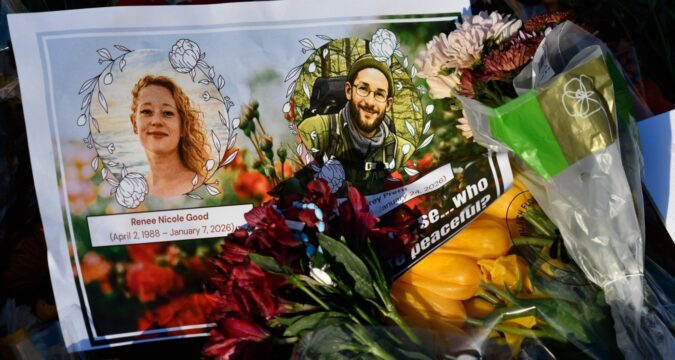
And now, in the wake of last month’s nearby killings of Renee Good and Alex Pretti by ICE agents, religious leaders are again speaking out. Last week I watched a PBS interview with Bishop Rob Hirschfeld of New Hampshire, a former clergy colleague from my time in Western Massachusetts. Since his remarks at a vigil for Renee Good went viral, Bishop Hirschfeld said, he’s gotten lots of comments along the lines of “stay in your lane,” as if the church should just concern itself with spiritual matters.
But nothing in Scripture or tradition suggests that there is a stark separation between the sacred and the secular. As one of our prayers last week puts it, God governs all things both in heaven and on earth. And Jesus, in his teachings and in his ministry, doesn’t shy away from questions of public life. Religion’s “lane” is the world.
That doesn’t mean that most clergy will tell you who to vote for, even if the IRS’ recent reinterpretation of the Johnson amendment says we can. We may not often preach for or against specific laws or political positions, but the ethics, the morality and the underlying public policy is fair game, especially where it overlaps with the explicit implications of living faithfully.
Since different people will have different opinions about those implications, we need to be careful how we navigate our diversity of all kinds, both within and among our congregations. We can listen across differences, not assume that everyone feels the way we do, not “heap contempt upon our neighbors,” as Psalm 15 says.
The title of a recent email from Krista Tippett, the host of the public radio show and podcast “On Being,” resonates with a lot of what I’ve been feeling: “My heart is sore. Your heart is sore. Let this be common ground between us. Enough of us see that we have a world to remake,” she went on. “We want to meet what is hard and hurting. We want to rise to what is beautiful and life-giving. We want to do that where we live, and we want to do it walking alongside others. We’re asking, where to begin?”
One way to begin is by being careful with the words and images that inform our opinions, political and otherwise. Our understandings of complex situations can be framed, and our emotions triggered, by the logarithms that govern what we see on our computers and phones. Renee Good and Alex Pretti, for example, are just two of eight people who have died in dealings with ICE so far this year; the others are Luis Gustavo Núñez Cáceres, Geraldo Lunas Campos, Victor Manuel Díaz, Parady La, Luis Beltrán Yáñez-Cruz and Heber Sánchez Domínguez.
“Whose dignity matters?” asks a statement signed by more than 150 Episcopal bishops this past weekend. “Our faith gives a clear answer: everyone’s.” As much as at any time since I started writing for this regular “Faith & Values” column, I am praying that all of us, of different faiths, backgrounds, ways of loving and living and voting, will see beyond those differences to recognize and protect each other’s humanity and dignity.
I believe we can all take one of the “small, faithful steps” the bishops point to, supporting small businesses and food banks, contacting our elected officials, choosing love over fear, seeing each other as neighbors rather than strangers or enemies.
“Every act of courage matters. We must keep showing up for one another. We are bound together because we are all made in the image of God,” they write. “By the grace of God, may this season of grief become a season of renewal. May courage rise from lament, and love take root in every heart.”
The Rev. Lisa Green is rector at St. Martin’s Episcopal Church.
https://www.pilotonline.com/2026/02/08/faith-values-religions-lane-is-the-world/