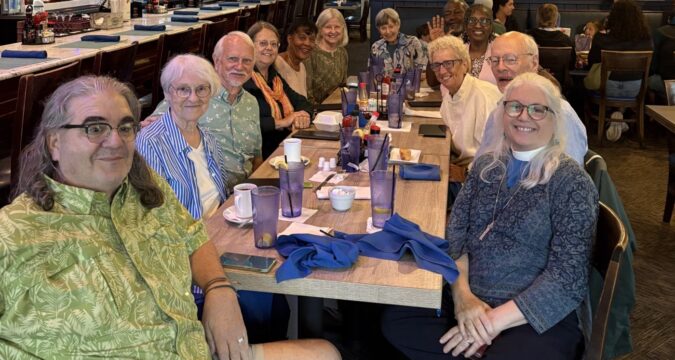
In a couple of weeks, my husband and I will be part of a group of travelers from All Together Williamsburg heading south for a Road Scholar trip, “The Civil Rights Movement: Atlanta, Montgomery, Selma, Birmingham.”
It’s a trip I’ve wanted to do for many years, having long marveled at the spiritual fortitude of the Rev. Dr. Martin Luther King Jr. and all those who persisted in the struggle for racial equality in the face of violence. Our tour feels especially timely today, when the fruits of that struggle are being challenged daily, and the quest for nonviolent solutions to social and political conflict feels more elusive than ever. This week’s killing of Turning Point USA founder Charlie Kirk is the latest in a wave of assassinations and attacks stoking outrage and talk of retaliation, so I’m particularly grateful for the chance to walk in the footsteps of those who embodied the path of peaceful resistance and sacrificial love.
All Together is celebrating its 30th anniversary this year and was recently awarded Phi Beta Kappa’s Lifelong Learner Award for its work in bringing people together across racial, ethnic and cultural lines. I was part of one of the group’s dialogue circles shortly after returning to Williamsburg almost eight years ago, and more recently St. Martin’s has been hosting its monthly meetings. Several of our group have been involved in All Together since its beginnings and have long dreamed of making this journey to the heart of the Civil Rights movement. Although Road Scholar doesn’t use this word, our upcoming trip feels like a pilgrimage.
A pilgrimage is “a transformative journey to a sacred center,” writes Phil Cousineau in his classic book, “The Art of Pilgrimage.” Rather than just reading or talking about places and events, pilgrims take themselves there, experiencing firsthand the sights and sounds of holy landscapes. I’ve done a few official pilgrimages in the past decade — two trips to the Holy Land, a local commemoration of the arrival of the first enslaved Africans to Point Comfort and a week in Iona, Scotland — but I also set the bar low for what constitutes a “sacred center.” Visits to my childhood homes and haunts, including a sabbatical stint in Kill Devil Hills, and even my return to Williamsburg 34 years after graduating from William & Mary, have been transformative journeys, reconnecting me with the places that made me who I am. If we’re on the lookout for the sacredness that can be found all around us, any trip can be a pilgrimage.
The Rev. Lisa Green is rector of St. Martin’s Episcopal Church in Williamsburg.
Our journey will begin in Atlanta with visits to the Martin Luther King Jr. National Historic Site and Memorial and Ebenezer Baptist Church, where King was baptized, where both he and his father served as pastors, and where his funeral was held in 1968. In Montgomery, we’ll visit the Rosa Parks Museum and Dexter Avenue King Memorial Baptist Church. A focal point for the bus boycott that eventually integrated public transportation, Dexter Baptist is also where King first preached and is a National Historic Landmark. We’ll also visit the National Legacy Museum and Memorial of Peace and Justice — a lynching memorial begun in 2010, where we’ll confront the reality of racial terror in America and its legacy.
At a time when such truth-telling in museums and cultural institutions is being characterized as “divisive,” I’m grateful for the vision and courage of Legacy Museum founder Bryan Stevenson and all those who know that racial healing depends on acknowledging our painful history. Sixty years ago, Jonathan Daniels, an Episcopal seminarian, was killed in Hayneville, Alabama, not far from Montgomery, and that diocese hosts an annual pilgrimage in his memory. I was struck by this description from the organizers: “There is something profoundly moving about going back to a sacred place and remembering, that enables the pilgrim to resolve, to repent, and to carry on the work of building the beloved community.”
After a stop in Selma and a walk across the Edmund Pettus Bridge, the site where thousands walked in support of voting rights after “Bloody Sunday” in 1965, our pilgrimage will end in Birmingham. Ever since I spent my sabbatical researching St. Martin’s history, I’ve been struck by the fact that our first service in September 1963 was exactly one week after the bombing of the Sixteenth Street Baptist Church by the KKK. Four little girls — Addie Mae Collins, Denise McNair, Carole Robertson and Cynthia Wesley — were killed in that attack 62 years ago this weekend.
I’ve often imagined how it must have felt to pray for them and others who lost their lives in the movement, while birthing a new congregation where people of all races could worship together. As I consider what to say to St. Martin’s this Sunday in our own time of division and violence, I’m praying these words from our Book of Common Prayer: “O God, you made us all in your image. Look with compassion on the whole human family; take away the arrogance and hatred which infect our hearts; break down the walls that separate us; unite us in bonds of love; and work through our struggle and confusion to accomplish your purposes on earth that we all may serve you in harmony. Amen!”
The Rev. Lisa Green is rector at St. Martin’s Episcopal Church.