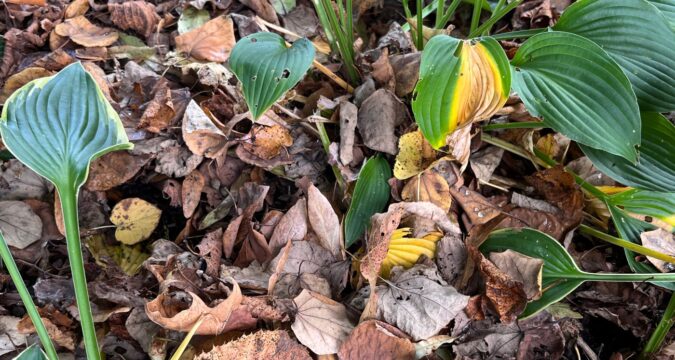
Here comes the free mulch! And compost, and fertilizer, and insulation ꟷ all swirling down from the trees in the form of colorful leaves.
“The leaves that fall in autumn are a gift,” said Spencer Campbell, Plant Clinic manager at The Morton Arboretum in Lisle. “They can do so much in our gardens.”
Keeping fallen leaves in your yard is more sustainable than packing them up to be trucked away as landscape waste. It saves emissions from the trucks and the huge machines used in commercial composting.
It also saves effort. “You don’t need to rake away every leaf from your yard,” Campbell said. “It’s best to clear most leaves off the lawn, but when they fall on perennial beds or around trees and shrubs, you can just leave them be.” They’ll decay gradually, like they do in nature, and your plants will be the better for it.
For millions of years, plants have been growing under a layer of last year’s leaves and stalks. As that layer is gradually consumed by fungi, bacteria and other organisms, they release nutrients that plants need and improve the soil structure to make it a better home for plants’ roots. This is part of the process that builds healthy soil all over the world.
Leaves are also nature’s insulation. The layer of leaves you see on a walk in the woods protects plants’ roots from extremes of hot and cold, holds in moisture and shelters seeds that will sprout and bloom in spring.
“When we spread mulch in our yards, we’re just imitating what fallen leaves do in nature,” Campbell said. “So why not use leaves?”
Here are some tips for making the most of this gift from the trees.
Use leaves as mulch. Simply rake them onto perennial beds or around trees and shrubs, or spread them on vegetable gardens or raised beds. By spring, the leaves will have partly broken down and mostly disappeared as soil organisms consume them and release their nutrients. Still, there will be enough mulch left to insulate the soil so plants don’t come out of dormancy too early in a late-winter warm spell. The Arboretum uses partially composted leaves as mulch in its garden beds.
Shred them, if you like. Shredded leaves look tidier and won’t blow around as much when they are used as mulch. They also break down faster in a compost pile. To shred leaves, pile them on the lawn and run your lawn mower over them a couple of times. “It’s fine to leave some shredded leaves scattered on the grass,” Campbell said. “They’ll break down quickly and improve the soil for your grass.”
Rake most leaves off the lawn. A few whole leaves or a scattering of shredded leaves will quickly decay and feed the grass. But a thick mat of leaves left on the turf may encourage disease and will block the sunlight that the grass plants need.
Make compost. The partially decayed organic matter that gardeners call compost is a versatile soil amendment and source of nutrients for your plants, and it’s free to make. Leaves are a major ingredient. Mix them with end-of-season annuals, weeds, and selected vegetable and fruit scraps from the kitchen. Moisten them and stir them up from time to time, and in a few months, you’ll have compost. Learn more at mortonarb.org/composting.
Protect plants. You can extend the fall harvest of root vegetables such as carrots and beets by covering them with a layer of leaves so the soil freezes more slowly. Keep a pile of leaves handy to toss over late leafy crops such as spinach or cabbage to protect them against the first freezes. To insulate tender ornamental plants such as hybrid tea roses, make a cylinder around the plant with wire mesh or burlap and add leaves. “Don’t pack them down,” Campbell said. “Keep them fluffy.”
Stash leaves for later. Find a spot for a pile or bin of leaves to use during next year’s growing season. They can be an ingredient in compost, a layer of free mulch and a way to add organic matter to the soil of planting beds. Shred leaves so they take up less room and you will be able to stash away more of them.
For tree and plant advice, contact the Plant Clinic at The Morton Arboretum (630-719-2424, mortonarb.org/plant-clinic or plantclinic@mortonarb.org). Beth Botts is a staff writer at the Arboretum.
https://www.chicagotribune.com/2025/10/05/falling-leaves-fertilizer-garden/