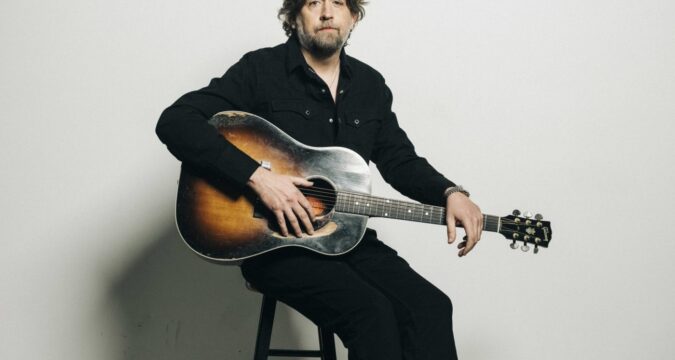
Texas-born singer/songwriter Hayes Carll is one of those cult phenomenon “songwriter’s songwriter” types whose talents are widely praised but who still can be seen in reasonably sized venues where you’re privileged to listen up close and appreciate his song craft.
Hamden’s Space Ballroom, where Carll will perform on Wednesday at 8 p.m., is an ideal venue for him, whether he’s solo acoustic or, as he will be this week, playing with a full band.
You may know Carll’s songs without knowing he wrote them. His “Chances Are” was covered by Curtis Stigers, Lee Ann Woman, Marie Hodson and others. He’s collaborated on records with The Brothers Osborne, Band of Heathens and his wife, the country singer/songwriter Allison Moorer. His best-known songs include “You Get It All,” “Drunken Poet’s Dream,” “Bad Liver and a Broken Heart” and “She Left Me for Jesus,” several of them from his landmark 2008 album “Trouble in Mind.”
His new album “We’re Only Human” is practically a concept album, full of songs about remorse, reflection and the human condition. Songs include “Progress of Man (Bitcoin & Cattle),” “What I Will Be,” “Good People (Thank Me),” “Making Amends” and “I Got Away With It.”
In his live shows, Carll is known not just a skilled singer/songwriter but as an entertaining raconteur. In a recent conversation with the Courant he discussed the differing types of fans he tries to please at his shows, his assessment of his own talent and what it’s like to earn comparisons to other one-of-a-kind American songwriters.
Hartford Courant: The sort of singer/songwriters you get compared to — John Prine, Lyle Lovett, Randy Newman – are not the type whom others usually get compared to. How do you relate to that?
Hayes Carll: On one hand there’s the young fan in me that desperately wanted to be in the conversation as a decent songwriter who is thrilled by that. Then there’s the other part of me that feels that those are singular artists and that comparing anybody to anybody is challenging. I’ve always been uncomfortable with any kind of comparison. Early on I got a lot of Townes (Van Zandt) comparisons, and I don’t think I’m anything like Townes at all, certainly not anywhere near the depth and talent that he possessed, but I came up in a region and a club which had a lot of Townes associations. Some of those things kind of stuck, but I remember I used to go and tear down posters that said “the next Townes!” because it was just mortifying to me. At the same time, I’m flattered. Those are my musical heroes.
My Mount Rushmore was Willie Nelson and Bob Dylan, but those guys felt unattainable. The scope of what they did and the impact that it had felt like they were from another planet. Lyle Lovett and John Prine felt like they were my people. They still were amazing to me, and godlike, but there was a relatibility there for me. Lyle grew up 20 minutes from where I was, and I used to watch him all through high school when he would come to town every year to play. He was writing these weird quirky songs about things I didn’t know you could write about. Prine, similarly, had this language and this ability and simplicity to what he did that it felt like OK, I may never be able to do what I do as well as that guy but I see a path for how you can be an artist with the limitations that I had — not an amazing voice, not a guitar shredder, not a big singer, I don’t dance. … It’s like, how can you take your weird strange personality and point of view and turn them into something that can really affect people and touch them and express what you’re going through? Lyle and John both have this sense of humor and a point of view and a way with language that I was very very drawn to.
Did you want to be a performer or would you be OK writing songs for others to perform?
Absolutely I wanted attention when I was a kid. I was an only child for a long time, and I spent a lot of time hoping someone would recognize me and think I had something. I did theater all through high school and it gave me a chance to find myself and be onstage from time to time. That stuff was addictive, and it helped me find a community of people at a time when I really needed one. When it came to music, I knew I always wanted to write songs and sing songs. I had no real expectation or anticipation that I would be able to perform, because it was a long time before anybody told me I was decent. This is when people like Kris Kristofferson, who were not the typical great singers, came in and changed the world. It gave me hope that maybe I could be a performer but if I couldn’t maybe I had some aptitude for writing. I could write for other people who could take it out and share it with the world, and that would be an amazing job. But I did always have the passion for the performing part of it and, fortunately, it worked out.
Acclaimed folk/honkytonk singer/songwriter Hayes Carll. (Joshua Black Wilkins)
You’ve rarely played Connecticut. This time you’re at the Space Ballroom, a nice room that has everything from indie bands to punk bands to you. Is there a particular kind of venue you prefer?
I think I played The Space once before, and I think a fight broke out, if I remember correctly.
Because of you?!
It’s hard to say, but I have this weird thing where I came up through folk rooms as a solo singer/songwriter. That was important to me, and a big part of what I do. Then I made a record that was more rockin’ and my crowd sort of went up fivefold and I started playing with a band and I really loved that as well. That was more of a honky-tonk rock thing. So I always had this struggle between “What am I?,” “How do I present my shows?” and “What does my audience expect?”
I don’t want to scare people off. I’m quite certain there won’t be a fight at this show, but for a long time there would be fights at all these shows. It was embarrassing. It was usually folk clubs, and the club owners would come up and say “We haven’t had a fight here in 40 years.” I’m like, “What is going on?” My music is not that aggro. I’m not sure what’s happening. I finally came to the conclusion that what happens is that I have two different audiences and they don’t really know how to behave around each other. Particularly in the folk clubs there’d be a group there to listen and then some people come in thinking it’s going to be a big party. Those two things don’t get along. Somebody will shush somebody, that person doesn’t want to be shushed, and the next thing you know, punches are thrown and I’m just sitting up there with a guitar thinking ‘”hat is happening?!”
In this case we’re going to have a big band and I think we’re going to cover all the range of what I do. Hopefully everyone can just have a good time and enjoy themselves.
Are you playing a lot from the new album?
I’ll definitely lean heavily on the new stuff because I’m excited about it and it’s a lot of fun for me to play but yes, we’ll be pulling stuff from the whole catalogue, a well-rounded show.
Another thing people love to say about you is how funny you are, but that could get misunderstood, since a lot of your humor is dry. Can that perception backfire?
I do talk a lot onstage. I’m not telling jokes but when I first started, I only had a few songs, so I would just kill time by talking. I love that in a show. I love Ray Wiley Hubbard or Fred Eaglesmith or Todd Snider and those people who can really entertain in between the songs. It helps me connect to the songs as well. When I was first starting out I found out pretty quickly that there were a lot of people who were better than I was, who could write better or sing better or play better but didn’t have a ton of stage presence. As an audience member, that’s something I crave. Connect with me. Bring me into your world. So that’s always been a big part of what I do. As far as the music itself, I write some stuff that’s funny and some stuff that’s tongue in cheek, but I’ve always been wary of being pigeonholed as being a funny writer, which can be very limiting. I remember when I wrote “She Left Me for Jesus” I would think of Rufus Wainwright or Ray Wiley or people who had a song that defined them that was not reflective or how great they were and I was very afraid of that. So on that record that “She Left Me for Jesus” was on, there were 14 songs and I put it 14th — this is back when people listened to a whole record — because I wanted people to hear all the sides of me before they got to that side.
The new record was about me just taking stock with life, with what was working and what wasn’t, and ways to navigate the human experience with a little more grace than I had been and avoid having the same talks with myself that I’ve been having my whole life. This human experience is a difficult one for everybody. I’m trying to find the things that help me with it. A lot of that is about commonality and trying to drop back in to a quiet place where we reflect and be present and appreciative rather than be sucked up into the chaos. In this day and age, it’s harder and harder to avoid all the news and the tragedy and the opinions, all the animosity. This is my personal experiment of how to get right and enjoy my life more than I have.
So are people going to be hugging at your shows now and not fighting?
I hope so! As a songwriter I aspire to capture the whole human experience. Some of that is laughter and some of that is tears. That’s the kind of show I like to put on, where we run the gamut of experiences and, by the end of it, come together and feel like we’ve shared something and felt some feeling and had a good time.
Hayes Carll performs Sept. 24 at 8 p.m. at Space Ballroom, 295 Treadwell St., Hamden. Tickets are $32.34. spaceballroom.com.