Farage Crushes Clacton By-Election With 63% As Comedy Candidates Dominate Longest Ballot In British History
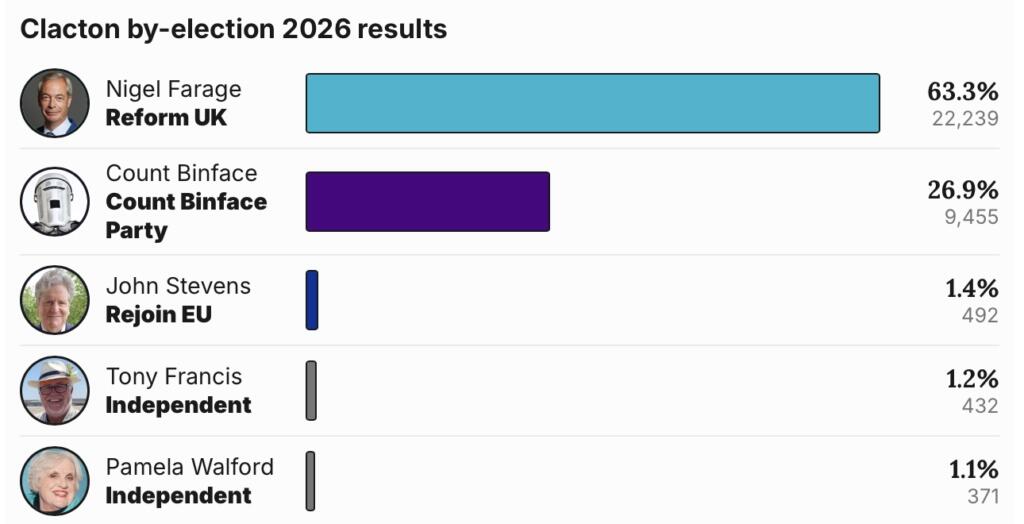
Nigel Farage has romped to victory in the Clacton by-election with 63.3% of the vote, seeing off 33 rivals including Count Binface, who won a quarter of the votes cast, on the longest ballot paper in British electoral history.
The Reform UK leader secured victory with 22,239 votes, which was 63.3% of the total vote and an increase on the 21,225 votes he secured when he was elected to the Essex seat at the 2024 General Election.
Count Binface, a comedian standing as a 5,900-year-old space warrior whose key policy was to freeze the price of ice cream in Clacton at 99p, was second with 9,455 votes, 26.9% of the total vote.
Mr Farage had triggered the poll and cast it as a ‘people vs the Establishment’ contest amid mounting questions over a £5 million donation from cryptocurrency tycoon Christopher Harborne.
However, a parliamentary inquiry into Mr Harborne’s donation has yet to conclude, and Mr Farage could still face another by-election within months if he is found to have broken House of Commons rules. He is expected to be interviewed by a standards watchdog within weeks of MPs returning to Westminster after their summer break.
The Reform leader, 62, declared himself the winner of the Clacton by-election in the early hours of Friday morning while ballot papers were still being counted. He then took the unprecedented step of skipping the formal result declaration, with his party claiming police had advised him to stay away due to a ‘credible threat’.
But, as Mark Angelides reports for LibertyNation.com, none of the big parties fielding a contender, what remains is who wins the narrative war.
Farage Stands Down to Step Up
The election was triggered by Farage resigning his seat last month. He did so voluntarily because of mounting stories over his financial situation, including donations and gifts he had received before running for Parliament. His argument was that it should be the voters of Clacton who decide his political fate rather than a scrutiny committee.
To be abundantly clear, Mr. Farage receiving a gift of £5 million is not illegal. Not declaring it is a breach of protocol because it occurred within 12 months of him running for office. With his return to the House of Commons, the internal investigation will continue. But what is the likely outcome? And what punishment – if any – is likely to befall the veteran campaigner?
If he is found to have broken the rules, the committee could suspend him from the House for a short period. In such a case, there is a possibility of a recall petition that would trigger a fresh by-election – which poses a conundrum. The purpose of such a contest would be to determine whether his Clacton constituency still had faith in him to be its Member of Parliament. This question was put to bed yesterday with Farage increasing his vote count and share compared with the 2024 general election.
And crucially, Nigel will have spent the last six weeks in his constituency gathering data. If he ends up having to fight yet another election, he will have up-to-date major information which other parties do not have access to. When it comes to campaigning, the data advantage cannot be underestimated.
But, as ever, the knives are out for Nigel Farage.
Establishment Closes Ranks
Former Prime Minister Keir Starmer, before his ousting, described Farage’s Reform Party as a threat to the nation. This is echoed across the myriad parties that make up British Parliament. In other recent by-elections, we have seen parties run what can best be described as paper candidates to unite around any party other than Reform.
The dominant narrative from the more established party leaders is that although they refused to stand a candidate in this “stunt” election triggered by Farage, they would certainly stand one in the potential next contest after the results of the scrutiny committee are released. But it is more than reasonable to argue that the other parties did engage in yesterday’s election. Conservative Party leader Kemi Badenoch posted on social media that voters should support “the Bin,” a reference to a parody candidate, “Count Binface,” who wears a trashcan on his head and a shiny “spacesuit.” By tacitly backing any competitor – even a joke contender – the party essentially threw its hat in the ring. Notably, Count Binface came second with almost 27%.
A Political Parallel
The current mantra is that Nigel Farage has triggered an unnecessary election that has cost taxpayers roughly £250,000 and was an affront to voters. And yet the same voices uttered no such displeasure when now-PM Andy Burnham was the beneficiary of a palace coup through a similar mechanism earlier this year.
With around 24,000 votes from one of the Labour Party’s safest seats, Mr. Burnham was drafted into Parliament and installed as leader and PM without a general election or even a vote by the party members. For those who do not support Labour, there is the mild stench of hypocrisy.
Both politicians foisted a by-election on the British public to better secure their positions. One did so to retain his position, the other to gain advancement.
Where is Reform Now?
Mr. Farage’s Reform Party has dominated polling for the last 18 months. While Mr. Burnham’s Labour Party has received a polling bounce of around 6% – quite a typical bump when a leader is changed mid-Parliament – almost every survey has suggested Reform would be the largest party at the next general election.
Farage is a threat to the Westminster establishment that has not been seen in at least 100 years. Assuming he navigates the committee’s results and commits no major faux pas in the next three years, he may well be Prime Minister. And more so, he may be the harbinger of doom for the Conservative Party and relegate Labour to a desultory second-place finish.
It seems no wonder that the Westminster establishment wants to end his career as early as possible.
Tyler Durden
Fri, 08/14/2026 – 08:45