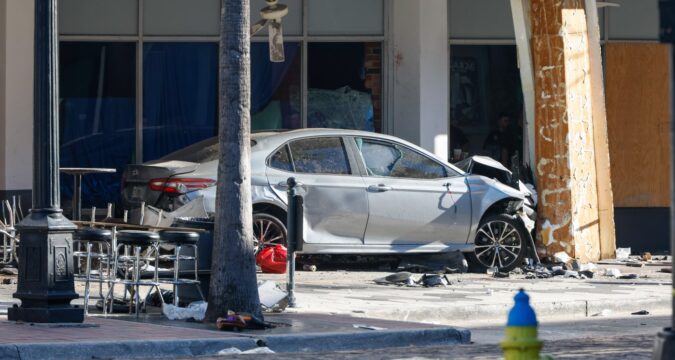
About two minutes before a speeding driver crashed into an Ybor City crowd last weekend, he passed a Tampa police officer and two Florida Highway Patrol troopers heading in the opposite direction.
The three cops turned and followed.
It was a key moment preceding a catastrophic crash that killed four and has shaken Tampa since last Saturday. Made in a matter of seconds, the decision to pursue has revived a long-running question about when cops should chase.
“I haven’t received a call yet from anyone who is a retired or current cop that said FHP should have been chasing that guy,” former Tampa police Chief Brian Dugan told the Tampa Bay Times.
Ybor’s crash is a violent reminder of a discrepancy in which state troopers can chase vehicles — and try to force them off the road — in places where local agencies have been prohibited from using the same maneuvers. The Highway Patrol in recent years has loosened its restrictions on chases even more, exacerbating the gap.
Two controversial accidents connected to police pursuits in Orlando — whose police department, like Tampa, has a policy strictly limiting chases — underscore the danger. Last week, the Orange-Osceola State Attorney declined to pursue manslaughter charges against an Orlando officer whose out-of-policy pursuit of a driver with an unreadable license plate led to the death of a homeless pedestrian.
The chase and crash
The seven-minute chain of events that led to the Ybor City crash began at 12:39 a.m., according to court documents and police accounts. A Tampa police helicopter spotted the Toyota Camry headed south on Interstate 275 near Dr. Martin Luther King Jr. Boulevard.
The person behind the wheel, later determined to be 22-year-old Silas Sampson, was driving “in a reckless and erratic manner,” court records state. Word came over the radio that the driver and another car were “racing on the highway.”
Sampson exited onto Doyle Carlton Drive and headed north, then east onto Palm Avenue, records state.
At 12:45 a.m., Sampson turned south onto Nebraska Avenue and passed the Tampa police and Highway Patrol cars.
At least one of the Highway Patrol troopers, identified in court documents as “A. Carrasco,” turned around and tried to make a traffic stop. Sampson turned left from Nebraska onto Seventh Avenue.
About a half-mile west of 15th Street, Carrasco tried what’s known as a precision immobilization technique, or PIT maneuver, striking the rear end of a fleeing vehicle to stop it.
Helicopter video shows Carrasco’s patrol car making contact with the Camry, causing its rear wheels to slide sideways. But the car kept moving.
At the intersection of Nuccio Parkway, “Trooper Carrasco terminated the high-speed pursuit due to heavy pedestrian traffic further ahead on Seventh Avenue,” a court document states.
The video shows Carrasco slowing as the Toyota passes beneath the arch that marks the Ybor City historic district.
An arrest affidavit states that the car was moving between 92 and 100 mph as it approached 15th Street. Surveillance footage and data from the car showed the driver applied the brakes and veered left, slowing to 82 mph as he moved onto the north sidewalk, the document states.
Lisa Sherell Johnson and Marlon Collins were the first pedestrians hit. Both were killed. Two others, Kristina Richards and Sherman Jones, were also killed, and 13 more were injured.
Sampson was arrested at the scene, police said. He faces vehicular homicide and other charges.
Silas Kenneth Sampson, the driver accused of fleeing police and causing a crash that killed four and injured 13 in Ybor City on Nov. 8, arrives to his pretrial detention hearing before Chief Judge Christopher Sabella in Tampa on Thursday. He faces more than a dozen charges including four counts of vehicular homicide. He was ordered to be held without bond.
Two agencies, two policies
Though Highway Patrol troopers are often seen patrolling Florida’s interstates, they have jurisdiction on virtually every road in the state. Troopers can start chases or continue them through those areas. When they do, they typically have much more leeway than local cops.
Until about two years ago, Florida Highway Patrol policy allowed troopers to chase felony suspects, as well as reckless drivers and DUI suspects. They needed permission from a supervisor to start a chase and conduct PIT maneuvers.
In 2023, under the direction of Florida Highway Safety and Motor Vehicles Director Dave Kerner, the policy was loosened. Now troopers have discretion to chase fleeing drivers for virtually any reason. PIT maneuvers no longer need prior approval. They can also do things like drive in the wrong direction or on the wrong side of the road in a chase.
The policy notes that troopers should consider factors like traffic and pedestrians and should “avoid contributing to the danger.” But it also says pursuits “are critical to the effective enforcement of laws, preservation of law and order, and preservation of life.”
The Times sent questions to the Tampa Police Department and the Florida Highway Patrol, including a query about how they determine who takes the lead in an attempted traffic stop.
Tampa police responded with a brief statement.
“Each call we respond to is dynamic and coordination among other agencies is determined by the circumstances and factors available,“ the statement said. ”While we coordinate with FHP in many instances, troopers do have statewide jurisdiction.”
The Florida Department of Highway Safety and Motor Vehicles, which includes the Highway Patrol, did not respond to questions.
When asked on the day of the crash if the agency would consider a rule change, a spokesperson pointed to the driver.
“Our troopers followed policy, disengaged prior to when the suspect entered a crowded area, and the driver lost control on his own,” said Madison Kessler, communications director for the department. “This tragedy rests solely on the suspect’s reckless actions, not law enforcement.”
Local law enforcement agencies in Florida often ask for the Highway Patrol’s help, said William “Bill” Smith Jr., president of the Florida Highway Patrol chapter of the Police Benevolent Association, the union that represents state troopers. Smith said that troopers do not have direct communication with Tampa police and its helicopter, so in this case, a direct request from Tampa police would have been made.
Such requests regularly come from local agencies in the state with more restrictive pursuit policies, Smith said.
Is that in part because troopers have more leeway to chase?
“Absolutely,” Smith said.
Yet local leaders told the Times that they do not seek the FHP’s help when their agencies are prohibited to pursue. Some said they are forbidden to make such a request.
Mayor Jane Castor said she would not weigh in on the Florida Highway Patrol’s policies but said the city “never (calls) another agency to pursue a vehicle.”
To chase or not
Despite some agencies clamping down on pursuits, there remain many cases of people being injured or killed as a result of chases — some that began for non-violent offenses.
A 2024 investigation by the San Francisco Chronicle, which compiled data from the federal government, private research organizations and news reports, found that at least 3,336 people across the country were killed in pursuits from 2017 through 2022. Most began over traffic offenses, nonviolent crimes or no crime at all.
Geoffrey Alpert, a professor of criminology and criminal justice at the University of South Carolina who studies high-risk law enforcement activities, has conducted surveys to gauge public support for police pursuits.
“Overall, they support pursuits for violent crimes, and they do not support pursuits nearly as much for these kinds of events,” he said.
Alpert pointed to a 2023 report by the Police Executive Research Forum, a national nonprofit think tank on policing standards, that urged agencies to start pursuits only when a violent crime has occurred and the suspect poses an imminent threat.
Chases should be rare, said the report, written by a committee of experts and policing executives and funded by the federal Department of Justice and the National Highway Traffic Safety Administration. That’s because the dangers to suspects, officers and bystanders often outweigh the urgency of apprehending a suspect.
“That’s the dilemma you have with these chases,” Alpert said. “They threaten public safety. If you look at the Tampa policy, the only reason you’re allowed to chase is if the need to apprehend is less than the risk to the public. And when you’re chasing in Ybor City, the risk to the public is enormous.”
Alpert, who has family ties to Ybor and has walked Seventh Avenue himself, said fleeing suspects might not immediately slow down when police stop chasing, which is why the decision to pursue the driver so close to a packed entertainment district is so problematic.
“The minute he took off, (the trooper) should have said, ‘No, this is heading towards Ybor City, it’s not worth it,” Alpert said.
Smith, the Florida Highway Patrol union president, said he has been involved in law enforcement for more than four decades and the patrol’s pursuit policy has changed “180 degrees.”
Years ago, he said, “people would just run from you, and you’d have to call it off.” Now, though, Smith thinks more people stop because they know “there are consequences, and we’re going to put you in jail.”
“Maybe the question you should ask is how many people have we pitted and we’ve chased and put bad people in jail,” Smith said.
Smith noted that officers had mere seconds to make a choice — and that the crash could still have happened even if the trooper didn’t chase.
“It’s always easy to sit back and criticize and critique when it’s a matter of seconds that you have to decide, ‘OK, we need to stop this guy now,’” Smith said. “And maybe that was the thought process: ‘We need to stop this guy now before he gets down into that populated area.’”
Alpert said studies show that the notion that restrictive pursuit policies lead to higher crime rates is “a myth.”
State trooper chases that resulted in deaths rose after the agency loosened its policy, according to an examination this year by Treasure Coast newspapers, which cited the agency’s data.
The report showed one pursuit-related death in 2022, then five a year later, then 15 last year. The numbers include cases in which pursuits result in multiple fatalities.
People pay their respects during a vigil on Nov. 8 at the Bradley’s on 7th nightclub in Ybor City for victims of a crash earlier in the day.
Dugan, the former Tampa chief, said the Camry driver is clearly to blame. But he noted that the Tampa police helicopter was following the suspect and no Tampa officer was pursuing, which Dugan said was “a red flag.”
“The cops aren’t at fault,” Dugan said. “But you have to question the risk versus reward.”
Times staff writers Nina Moske and Colbi Edmonds contributed to this report.
©2025 Tampa Bay Times. Visit tampabay.com. Distributed by Tribune Content Agency, LLC.