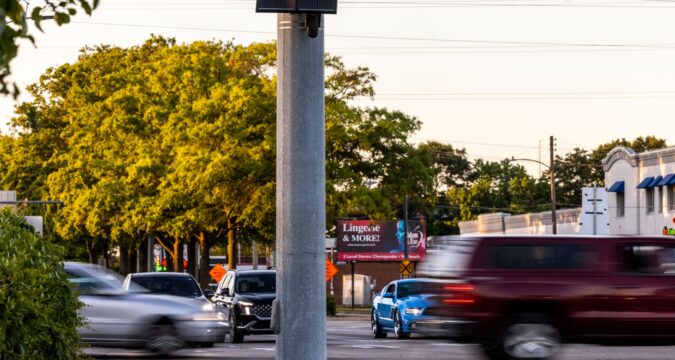
The federal government filed a statement in support of Norfolk’s ability to use controversial automatic license plate reader cameras, saying the camera system does not violate constitutional privacy rights.
A Department of Justice attorney filed the statement Sept. 27 in a federal court case in which two Hampton Roads drivers argue the Flock Safety system — dozens of city traffic cameras that upload license plate information to an online database — amounts to a search under the Fourth Amendment and requires a warrant.
In the statement of interest, U.S. Attorney Lindsey Halligan argues that the plate readers do not constitute a search, saying the technology is different than those that Supreme Court and Fourth Circuit cases have ruled violate the Fourth Amendment.
“From a pragmatic perspective, these differences render ALPR technology minimally invasive — both generally and relative to the public safety benefits that the technology offers,” Halligan said.
The Institute for Justice, a nonprofit law firm specializing in civil liberties cases that filed the lawsuit on behalf of the drivers, criticized the statement and said Halligan was arguing drivers cannot reasonably expect privacy on public roads.
“This unusual decision to wade into a lawsuit to defend an ever-growing mass surveillance network should raise alarm bells over how the federal government plans to use this surveillance,” said Michael Soyfer, an Institute for Justice attorney, in a release.
Halligan, a former lawyer for President Donald Trump, was recently appointed to her position after previous attorneys did not bring cases against Trump’s political opponents, according to The Associated Press. Halligan convinced a federal grand jury Sept. 25 to indict former FBI Director James Comey on two counts related to alleged lying to Congress.
The statement also comes after a federal judge denied Flock Safety from intervening in the case. In a May 27 order, Eastern District of Virginia Chief Judge Mark S. Davis said the late entry into the lawsuit would be untimely.
“Flock made a conscious gamble to not show up to the platform on time; it is not this Court’s fault that the train had already left the station by the time Flock arrived,” Davis said in the opinion.
Norfolk installed 172 automatic license plate reading cameras in mid-2023. The cameras automatically take pictures of license plates and use machine learning to upload vehicle details into an online database. Any police department with a Flock subscription can then access that information without a search warrant if approved by Norfolk police. For 30 days, the system can track a car’s movements.
Hampton Roads police argue the cameras improve public safety by helping them catch suspects and locate people reported missing.
The lawsuit was filed in October 2024 by Norfolk’s Lee Schmidt and Portsmouth’s Crystal Arrington. As part of the suit, the plaintiffs are seeking to bar Norfolk from operating the system, delete all Flock camera data, forbid police from using the system or accessing data without a warrant and pay for attorney fees and legal costs.
Spokespeople for Flock and the city of Norfolk declined to comment on the lawsuit. A spokesperson for the Justice Department, affected by the government shutdown, did not respond to a request for comment.
Both parties in the lawsuit filed motions asking the court to rule in their favor. Davis can rule in favor of either party or let the case proceed to a trial in February.
Trevor Metcalfe, 757-222-5345, trevor.metcalfe@pilotonline.com
https://www.pilotonline.com/2025/10/06/flock-cameras-norfolk-lawsuit/