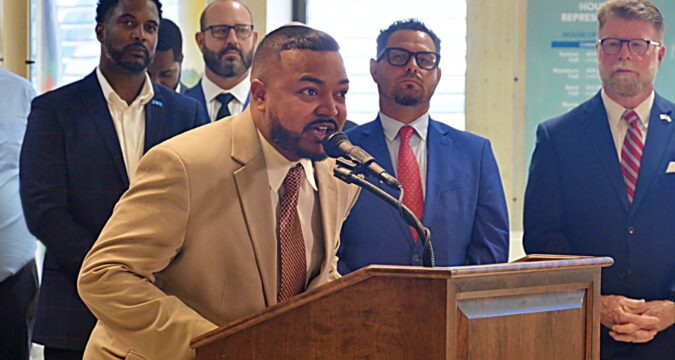
The Florida Coaches Coalition has been trying to raise awareness about inadequate salaries for the state’s public high school coaches for four years, since the group’s inception in 2021, and the FCC has finally reached its first legitimate milestone.
The Coalition, with a huge assist from former NFL player Corey Simon, now a state senator, R-Tallahassee, and state representative Adam Anderson, R-Palm Harbor, got legislation introduced before the Florida Senate on Monday, and the ball is rolling to at least bring official notice to the problem.
“I feel great. It’s seeing all of the hard work that myself and the staff has put in,” FCC executive director Andrew Ramjit said Tuesday. “Seeing everything come into fruition, seeing all of those long nights and countless drives up and down the state, seeing everything finally work out. It’s just an amazing feeling.”
The group contends that payment for high school coaches in the state, most notably for football, is below minimum wage. Salaries in Florida pale in comparison to neighboring states Georgia, Alabama and South Carolina. Those states have pulled many coaches away from Florida for years.
Senate Bill 538, which was filed before the Nov. 14 deadline, would remove the lock on coaching stipends from the teachers’ unions collective bargaining agreements and allow district school boards to control and negotiate, without limits, compensation for coaches, assistant coaches and athletic officials.
It would also remove a rule that does not allow school booster clubs to be involved in the negotiation of coaching salaries, which is in large part how other states are able to offer bigger paychecks. Coaches are currently limited to the stipends with no incentive or bonus programs. This bill would end those limits and remove coaches from any union-negotiated salary schedules.
The exodus of successful coaches includes Cameron Duke, who left Edgewater High for Georgia this past spring, as did Justin Roberts from Orange City University High. Travis Roland of Daytona Beach Mainland was off to Georgia two years ago. Don Stark fled Sanford Seminole for Georgia in 2020 and is now in South Carolina.
Edgewater football coach Cameron Duke steps down, heads to Georgia
Georgia salaries are the draw. They are often six-figure deals that can include incentives such as vehicles, homes and country club memberships. In comparison, Florida public-school coaches receive stipends that average $3,300 and $8,400. Those supplements are tacked onto their regular teaching salary, which for Orange County Public Schools currently sits at a minimum of just more than $50,000 per year, which are typically based on the 10-month educational calendar.
A two-page graphic, widely published in social media circles two years ago, listed coaching salaries in Georgia for the top 100 earners. The No. 100 coach was making more than $109,000. Six of those 100 coaches migrated from Florida. No public-school coach in Florida makes that much money, at least within state policies.
This past year, according to the FCC, there were 120 coaching vacancies out of 604 football programs statewide. A factor in resignations, in addition to the low pay, is frustration for coaches who see players transferring away. State statute demanded that the Florida High School Athletic Association relax its transfer rules in to match the state’s school choice policies.
A number of head coaches bolted for higher-paying jobs as assistant coaches. Fewer headaches for more money.
“The anticipation and just the feedback that we have been receiving is that coaches and booster clubs across the state are ready,” Ramjit said. “They have realized that we have had an epidemic of coaches leaving Florida. These booster clubs see what football does for their communities and the schools and they are willing to step up.
“When schools and communities rally around athletics, there are endless possibilities.”
The bill includes starting points for negotiations. School districts would be allowed to pay coaches what they deem reasonable.
The plan for football is based on head coaches working a required 1,500 hours a year. It would pay a $22,500 stipend, based on the 2026 state minimum wage of $15 per hour. Most football head coaches now receive less than $5,000. One hourly estimate put coaches pay at a paltry $3 per hour.
For baseball, basketball, soccer, softball, and volleyball, the head coaches would be required to work 1,000 hours a year for a $15,000 stipend. Head coaches in other sports, as well as football assistant coaches, would be required to work a minimum of 750 hours, with a $11,250 payment.
The FCC has estimated that it will cost about $2 million for each of the state’s 67 school districts to fund the increases. The estimate for OCPS would be an increase in coaching salaries of 241% based on the 2024-25 school year. That would raise coaching costs from $4,481,182 overall to an estimated $6,325,943 for 2026-27, based on the minimum salaries within the bill.
The big question is where will the money coming from? The bill does not specifically address funding.
Rep. Anderson has suggestions that would allow the state to pitch in and help school districts meet the costs, including using money gained from possible windfall from the state’s deal with the Seminole Gaming Commission and it’s first-year Hard Rock Betting app, as well as from a hemp tax, a special lottery game and possible specialty license plates.
Those potential allocations could ease the pressure on school districts to find funding.
“One hundred percent,” Ramjit said of state involvement in funding. “I think it all revolves around data and being able to compile all of the data from the other states and being able to show those numbers and the discrepancies that exist between the other states and Florida. That really helped propel this forward.”
He said schools that may not have profitable booster clubs will have a bottom line that is standard across the board.
“So we will have a standard minimum wage and set amount of hours across the state, and we talk about the floor and the ceiling. The ceiling is getting coaches removed from union bargaining and having boosters clubs allowed to supplement, and there is no real cap on that,” said Ramjit, the former athletic director for Brevard County Schools.
“The floor is the smaller schools and schools in the rural areas that may not have that booster support, making sure that they get the standard amount of pay for the amount of hours that they work. We want to make sure the state is taking them seriously and taking the coaching profession seriously.”
Now the FCC waits as the bill goes through its different stages. Ramjit and the committee have been meeting with state leaders since January of last year.
The Senate legislative session is scheduled to end in March. If passed, the coaching bill would be ushered into law.
In his eight seasons at Edgewater, Cameron Duke posted a record of 85-14. He stepped down this past spring to take a similar position at Marietta (Ga.) High. Marietta finished 5-6 in his recently-completed first season. (Chris Hays/Orlando Sentinel)
Other big-name figures have helped in the push to get the attention of state leaders, including FSU coach Mike Norvell, former FAMU and current FIU coach Willie Simmons, former Tampa Bay Bucs running back Mike Alstott and former FSU Heisman Trophy winner Charlie Ward.
“We’ve just been trying to educate everyone on what coaches in the state are going through and really trying to gather that support,” Ramjit said. “We left a meeting in Tallahassee in April knowing that something was going to happen. Everything that we have done is setting us up for January when the final draft of the bill has to be presented.”
The coalition is a registered non-profit organization funded through sponsorships by Dave & Busters, Raising Canes and Bakers Sports of Jacksonville, among others.
Future goals include better professional development and education for state coaches and better facilities for athletic programs.
“I received a call from a coach, and he asked how I felt and said I felt great, but more than anything, I feel happy and excited for the future generations of coaches coming to Florida,” Ramjit said. “And the coaches at the youth level that are interested in coaching at the high school level.
“My generation and the generations before me, we went into this knowing we would be paid pennies. So knowing the next generations that come after us, and knowing that they will be treated fairly, that all brings joy to me, just knowing we were the ones to really move the needle.
“This was, at one time, just a dream.”
Chris Hays can be found on X.com @OS_ChrisHays.