When gubernatorial candidate James Fishback addressed students at the University of Central Florida, he revealed his willingness to desecrate the sacred in pursuit of political power.
“I will not visit the country of Israel under any circumstances,” Fishback declared. “There’s no reason for me to do that.”
He went on to mock the Western Wall, calling it a “stupid wall” and sneered at the act of kissing it, a gesture of prayer and devotion cherished by people of faith across three religions.
This is how antisemitism rebrands itself in 2026.
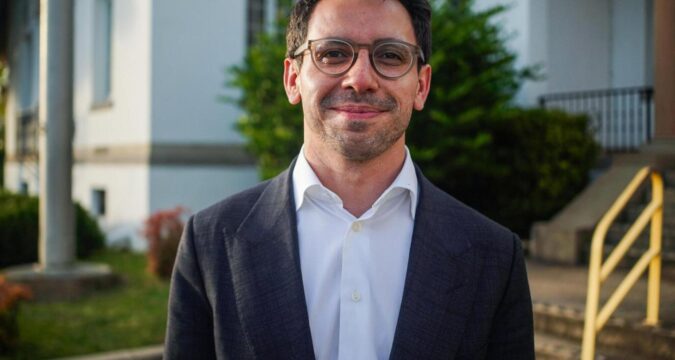
Rabbi Steven Burg is the International CEO of Aish. (courtesy, Aish)
The Western Wall stands as one of the holiest sites in Jerusalem, where Judaism, Christianity and Islam converge. For thousands of years, people have traveled from every corner of the earth to touch those ancient stones, to pray, to find solace, as it was the closest place they could go to be near the Temple Mount.
Political and cultural leaders from around the globe visit, and some choose to kiss the Wall, in recognition of the presence of the divine and the dignity of faith.
Fishback’s comments are sacrilegious, and they reveal a candidate who cannot understand what binds Americans together across all differences: faith itself.
My organization, Aish, has spent decades building bridges between faiths. We’ve hosted Christians, Muslims, Jews and people of every background at our center opposite the Western Wall. We’ve celebrated what unites us rather than what divides us.
One cannot build a civilized society by insulting the deeply held beliefs of others. Neither Fishback nor anyone else can build a future among a diverse population while mocking prayer.
Fishback also made an economic argument that he would visit Brazil, as it is Florida’s most important trading partner, yet he had no reason to visit Israel. In 2022, bilateral trade between Florida and Israel totaled $651 million, making Israel Florida’s fourth-largest trading partner in the Middle East and 47th-largest partner overall. That trade has grown 66% in just one year and more than 175% over the past decade.
But Fishback insists there’s “no reason” to visit Israel. His dismissal of Israel as irrelevant while praising Brazil might sound like economic policy. It isn’t. It’s Israel-bashing wrapped in a balance sheet.
Fishback’s rhetoric couches religious bigotry in the language of economic populism. We’ve seen this playbook in the country’s other major political party as well with Zohran Mamdani, who rode antisemitism and anti-Zionism into New York’s mayor’s office. The Republican Fishback himself has cited the Democrat Mamdani as an inspiration, admiring his “focus on affordability” while deploying identical tactics of scapegoating Israel and insulting Jewish sacred spaces.
Over the past eight years, under Gov. Ron DeSantis, Florida has become a model for protecting Jewish communities, supporting Israel, and ensuring the safety of all people of faith.
Even adversaries in the Arab world have never sunk to attacking the holiness of the Western Wall. They recognize the difference between political disagreement and religious desecration. But Fishback crosses that line with apparent glee, using a Jewish sacred space as a punchline to score political points.
This is warfare against God rather than politics.
Florida deserves leaders who respect faith, who understand that shared values transcend partisan divisions, and who recognize that sacred spaces of prayer remain beyond the reach of cynical manipulation.
Of the 37 candidates running for governor, I hope the other 36 refuse to adopt these despicable tactics. I urge Floridians of every faith and political persuasion to reject candidates who mock prayer and desecrate holy sites.
Florida is too proud a state to have a governor who goes to war with God. The Western Wall has stood for millennia. It will outlast James Fishback’s campaign. But the question before Floridians is whether they will allow candidates to desecrate faith itself in their quest for power.
Florida knows the answer.
Rabbi Steven Burg is the International CEO of Aish, a global Jewish educational movement. He formerly served as eastern director of the Simon Wiesenthal Center, where he oversaw the Museum of Tolerance in New York City. He resides in Teaneck, N.J.