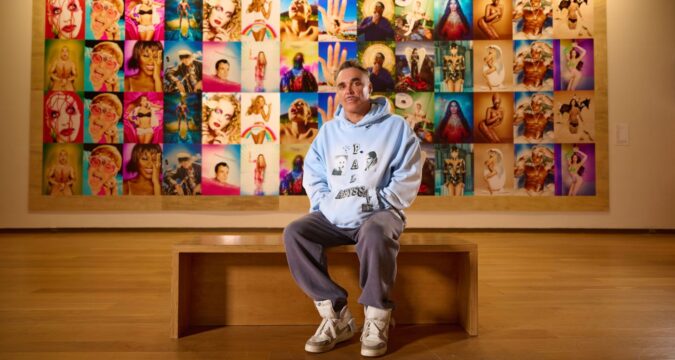
David LaChapelle’s most eye-popping works of art are larger than life: Celebrities in unexpected places and poses, towering religious figures, and that gargantuan hamburger crushing the poor soul underneath.
Has he got your attention? Good. Because he has plenty to say, and he wants to chat with you.
“A lot of people really feel left out of the artistic conversation because they walk in a museum and don’t understand what they see. It’s intimidating to a lot of people,” says LaChapelle, 62. “I want to connect with people. I want people to understand what I’m saying.”
Orlando Museum of Art is hosting the largest-ever LaChapelle exhibition in a U.S. institution. It’s a broad retrospective of the artist, best known for his carefully and often elaborately staged art photography, stretching back decades.
“It’s like a group show because it is 42 years of work, going back to 1984,” says LaChapelle, who also has paintings on view. “I’m one of those artists who tries different things that are on my mind.”
The works displayed at Orlando Museum of Art include the famous celebrity-driven images, but also Hawaiian-inspired natural scenes, religious subjects, editorial photography for magazines, even still lifes after the manner of Dutch masters, providing reminders of death and the cycle of life.
“This is a really great opportunity to show the whole breadth of my work,” says LaChapelle of the exhibition, put together by Coralie Claeysen-Gleyzon, the museum’s chief curator.
“I love the choices she made of the different pieces, the way they work together,” he says. “You see another perspective that you don’t usually see.”
“Archangel Uriel,” a 1985 work by David LaChapelle, is on view at Orlando Museum of Art. (Courtesy of the artist via Orlando Museum of Art)

Study in extremes
Claeysen-Gleyzon sees a common thread in LaChapelle’s varied work, despite differences in style and theme.
“It’s about extremes,” she says. “Of consumption, of celebrity.”
That thread is clear on a recent tour of the galleries. Because the work is so colorful, filled with unexpected and sometimes outrageous details, it’s easy to take at face value and appreciate for the sake of the artistry alone. But if you think about an image for a moment, often a deeper element comes to light.
Orlando Museum of Art presents “David LaChapelle: As the World Turns,” the largest U.S. museum exhibition of that artist’s work. (Courtesy Macbeth Studio via Orlando Museum of Art)

That’s the conversation LaChapelle wants to have with you.
“We are living in such precarious times. You hear the word ‘unprecedented’ five times a day. That word is worn out,” he says. “Our heads are spinning, the world is struggling in so many areas, from climate to geo-politics to America itself.”
Those are some of the topics he wants to talk about.
In various works you can find a riot of American excess, from Wonder Bread to Pop Tarts, Juicy Juice to Bud Light; clowns examining a patient over a pile of oversized pills; a power plant made of straws and styrofoam and other byproducts of the fast-food industry. All eye-catching, all with something to say in a way that isn’t threatening or divisive, but thoughtful, and dare I say, entertaining as well.
“Death by Hamburger” is an example of artist David LaChapelle’s attention-getting style. (Courtesy David LaChapelle via Orlando Museum of Art)

Claeysen-Gleyzon says that dichotomy in LaChapelle’s art contributes to its success.
“There are a lot of works both dramatic and humorous at the same time,” she says.
LaChapelle puts it this way: “There’s a shallow end and a deep end, and I work in both ends of the pool.”
Another intriguing dichotomy in his creations is the juxtaposition of truthfulness and artifice. It suddenly prompts me to sheepishly ask “a dumb question” during my tour: “How much of this is real?”
David LaChapelle’s Stations of the Cross fill a gallery at Orlando Museum of Art. (Courtesy Macbeth Studio via Orlando Museum of Art)

Claeysen-Gleyzon laughs — but in delight, not at me.
“That’s not a dumb question, that’s what the show is all about,” she says. Her thoughts turn to our renowned theme-park industry and the fantasy worlds it creates for the millions of tourists each year who travel to a city with the marketing slogan “Unbelievably real.”
“Our city was built on ingenuity, creativity, selling a dream, right? But how much of it is real?” she says. “That’s why I wanted to bring this to Orlando.”
A theatrical process
It turns out, of course, that even the most fantastical images are real — in the theatrical sense. LaChapelle spends weeks staging his scenes, costuming live models, finding and building props, getting the lighting just right before taking the photographs.
“Usually, at the end, people start applauding because it is like a theatrical experience,” he says of the elaborate photo shoots. He used to keep the process a mystery, “not wanting to let the magic out.”
David LaChapelle’s lastest work is titled “The Second Coming” and demonstrates the influence art history and religion have on his artistry. (Courtesy Orlando Museum of Art)

Now, with today’s technology, he finds it necessary to record the creation of his art — so people have proof that it’s being made by hand, so to speak.
“People think it’s AI,” he says. “They can’t believe we would put this much work into it.”
His latest creation, “The Second Coming,” is part of OMA’s exhibition. It involved arranging costumed models in positions on a floor and shooting from above to create an image reminiscent of religious works of old — with contemporary figures taking the places of angels in the heavens.
LaChapelle’s 2023 series “Jesus Is My Homeboy,” reframing biblical events in contemporary settings, and his series depicting the Catholic Stations of the Cross are on view in the exhibit. Like “The Second Coming,” both are reverential and encourage thoughts about what Jesus would make of today’s world.
LaChapelle, who remembers his eyes brimming with tears during his first visit to the Sistine Chapel, is bemused by the reaction faith-based imagery gets from critics and experts today.
“The art world doesn’t really accept religious work unless it’s blasphemous or ironic,” he says. “Everything is politicized. If you say you’re religious or believe in God, people think that’s a political statement. You must be conservative, you must be Republican. They make assumptions.”
He smiles at the irony that religion, namely the Catholic church, played a major role in the development of art.
“At one point in art history, everyone had a halo,” he says.
Inspired by art history
Religious references go back to some of his earliest work, from the mid-1980s. After losing friends to AIDS, “he started to portray them as angels,” Claeysen-Gleyzon explains.
Born in Connecticut in 1963, LaChapelle enrolled as a painter at the North Carolina School of the Arts. He showed his knack for innovation early: After turning to photography, he developed a technique of hand-painting his negatives to create an explosion of color before processing the film.
Moving to New York City at age 17, he was soon hired by no less a personage than Andy Warhol to work at Interview Magazine. And from there his career kept climbing, as he exhibited worldwide to critical and popular acclaim.
Orlando’s poet laureate sees her art as ‘mirror, map and microphone’
“He’s adored in Europe and had an incredible career there.” says Claeysen-Gleyzon, a native of France who herself fell in love with his work as it leapt off the pages of magazines she read as a teenager. “America needs to reclaim him.”
The art of great European painters often inspires LaChapelle. On view at OMA is a take on Delacroix’s “Liberty Leading the People,” with rapper-actor Megan Thee Stallion as the central figure.
I was particularly drawn to “The Rape of Africa,” an homage to Botticelli’s “Venus and Mars,” in which an African woman replaces the Roman goddess of love and a Western colonizer stands in for the god of war. In place of the original’s cherubim are children, carrying weapons as the ravages of exploitation fill the scene’s bacground.
“The next generation is ominously armed for what comes next.” says Claeysen-Gleyzon.
LaChapelle remembers seeing “Venus and Mars” in London, where it’s usually on view in The National Gallery.
“It really spoke to me,” he says. “The conflict those two natures have, we’re still dealing with that today. I wanted to breathe life into it and bring it into the 21st century.”
Trailblazing theater celebrates 100th birthday with a huge homecoming
He’s intrigued, and perhaps dismayed, that the themes of such classic works still have relevance today. The message in his own creations often seems to be that humanity’s moral progress hasn’t kept pace with our scientific progress.
“Ideas in human nature haven’t changed. We’re still dealing with the same issues as the Greeks and Romans,” LaChapelle says. “We’ve developed all this technology, and that’s replaced God for a lot of people, but we haven’t changed.”
Celebrity spotter
Today’s secular gods and goddesses are the celebrities who permeate our lives, and LaChapelle’s work in that arena is well-represented in the OMA retrospective.
One striking large-scale piece features poster-like images of notable names from Dolly Parton to Daniel Day-Lewis, Leo DiCaprio to Lady Gaga, Whitney Houston to Stevie Wonder. There’s something poignant about the work, a subtle reminder of the fleeting nature of fame.
“You know those posters are going to be replaced by the next pop stars,” Claeysen-Gleyzon says.
Other pieces call for a fresh look at familiar faces: Tupac Shakur in the shower, his tough-guy persona replaced by a sense of vulnerability.
Much-ogled Pamela Anderson is depicted in a glass case, on display like a creature in a zoo. But she looks defiant.
Among the many celebrities David LaChapelle has photographed is Tupac Shakur, on view here in LaChapelle’s 1996 work “Tupac, Becoming Clean.” (Courtesy David LaChapelle via Orlando Museum of Art)

“She’s kind of reclaiming rights to her own body,” Claeysen-Gleyzon says.
You might have a different reaction. Whatever it is, LaChapelle hopes your thoughts and opinions join the artistic conversation. Feel the connection, he urges, take ownership of it.
“When you are standing in front of the art, it’s yours,” he says. “And if you keep it in your mind’s eye, it’s yours forever.”
Follow me at facebook.com/matthew.j.palm or email me at mpalm@orlandosentinel.com. Find more entertainment news and reviews at orlandosentinel.com/entertainment or sign up to receive our weekly emailed Entertainment newsletter.
David LaChapelle hopes his art inspires a conversation with its viewers. A retrospective exhibit, titled “As the World Turns,” is on view at Orlando Museum of Art. (Courtesy Thomas Canet via Orlando Museum of Art)

‘As the World Turns’
• What: The largest U.S. museum exhibition looking at David LaChapelle’s career
• Where: Orlando Museum of Art, 2416 N. Mills Ave. in Orlando
• When: Through May 3 (Museum hours are 10 a.m.-4 p.m. Tuesdays-Fridays and noon-4 p.m. Saturdays and Sundays)
• Cost: $20 adults, $12 seniors, $10 students. This exhibit is for ages 18 and older.
• Film: As part of La CinOMAtheque, the museum’s ongoing film collaboration with Enzian Theater, OMA will host a screening of “Rize” at 6 p.m. Feb. 19. Directed by LaChapelle, “Rize” is an energetic documentary on the birth of two Los Angeles dance movements: clowning and krumping, which to their practitioners mean far more than an artistic pastime. Free, as part of the monthly Access for All Day with free admission and extended hours until 8 p.m.
• Drawing: A life-drawing workshop will take place 9 a.m.-noon Feb. 28. Following a light brunch with mimosas and a tour of the exhibition, artist Channing Gray will guide participants through drawing two live models. For ages 21 and up. $60; register at omart.org/events.
• Fashion: Photographer Michael Giragosian will lead a hands-on workshop, noon-3 p.m. March 22, that covers the fundamentals of fashion photography. Participants will shoot a professional model as part of the experience, which costs $85. Register at omart.org/events.
• Info: omart.org
https://www.orlandosentinel.com/2026/02/09/david-lachapelle-exhibit-orlando-museum-of-art/