This nation was founded on a radical promise: The government, not the accused, must carry the burden of proof when it deprives someone of their liberty. That principle is not abstract; it is the bedrock of our democracy. When we allow the state to detain someone without cause, even briefly, we erode the very soil this country was built upon.
The Supreme Court’s recent ruling, which green-lights racial profiling and indefinite questioning based on skin color or accent, shatters that promise. It transforms “equal protection” into a hollow phrase. It tells brown and Black Americans and immigrants with accents: Your citizenship is conditional, your freedom is negotiable.
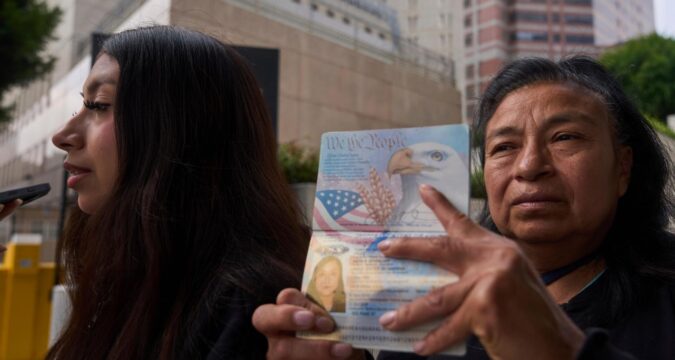
Alfredo Olvera is an American citizen who emigrated from Ecuador.
Justice Brett Kavanaugh’s opinion attempts to soften the blow. He insists that citizens mistakenly detained will be “promptly let go.” But what does “promptly” mean when you are shoved against a fence, locked in a storage facility, or grilled about where you were born? What does it mean when the days stolen from you will never be returned?
Consider Andrea Velez, a U.S. citizen born in Los Angeles. As reported in The Guardian, she was picked up by ICE officers who weren’t even wearing uniforms. Terrified she was being kidnapped, she ran to the police for help. The police handed her back to ICE. She spent two days in jail. Two days of her life taken as an American citizen. This is not merely an inconvenience.
Now picture your own wife, your daughter, your partner. They run to Target on an ordinary afternoon. A van pulls up, masked men in plain clothes jump out, and suddenly she is gone. She didn’t bring her birth certificate, because why would she? For days, she is detained with no access to you or an attorney. The only difference between your family and mine is that your skin is lighter.
This is not a hypothetical. It is happening in America today.
When the government claims the right to detain citizens simply for existing in brown skin or speaking accented English, that is not law enforcement. That is state-sanctioned racial profiling. It reduces citizenship to a guessing game — one in which people like me, naturalized Americans from Ecuador or Mexico or the Dominican Republic, are forced to carry proof of belonging everywhere we go. Stapled to our chest.
This is not only cruel. It is unconstitutional.
The right to live free from arbitrary detention is not a gift; it is a right. It is woven into the very fabric of the Constitution. The founders knew the danger of unchecked government power, and they enshrined protections to prevent exactly this — a state that can detain people first and ask questions later.
And yet, today, we are watching those protections unravel.
For those who say, “If you have nothing to hide, you have nothing to fear,” I ask: Would you accept being hauled off the street because of your last name, your accent or the shade of your skin? Would you accept your daughter being locked in a facility for two days without explanation? Or does the right to walk freely, without fear of arbitrary arrest, only belong to families who look like yours?
We must not become numb to this reality. We must not allow prejudice to rewrite the Constitution. Because once the government is allowed to detain some of us without cause, it is only a matter of time before it can detain any of us.
Do you understand why this is terrifying? Do you understand why this is contradictory to everything America claims to be?
As an immigrant who became a U.S. citizen, I believed in this nation’s promise. I still do. But belief is not enough. We must demand that America live up to its ideals, because freedom is not self-executing. America is strongest when it protects its people equally. To do otherwise is not only unjust. It is un-American.
Alfredo Olvera is a Fort Lauderdale resident, proud U.S. citizen and immigrant from Ecuador.