Gov.-elect Abigail Spanberger promises to take quick action after her inauguration on Jan. 17 to fill vacancies on the governing boards of three Virginia colleges and universities that have been caught in the crossfire between Gov. Glenn Youngkin and Senate Democrats who have blocked almost two dozen of his board appointments.
Spanberger, in a wide-ranging interview with the Richmond Times-Dispatch on Friday, said, “My commitment is announcing those appointees Day 1, and my expectation is that my counterparts in the legislative branch will confirm them quickly, so that all of our boards can have a full complement of membership immediately.”
“It’s not a question of how large their majority is. It’s a question of how did they get that majority? And the same is true for me,” Gov.-elect Abigail Spanberger said Friday of the Democrats’ advantage in the House of Delegates next year.
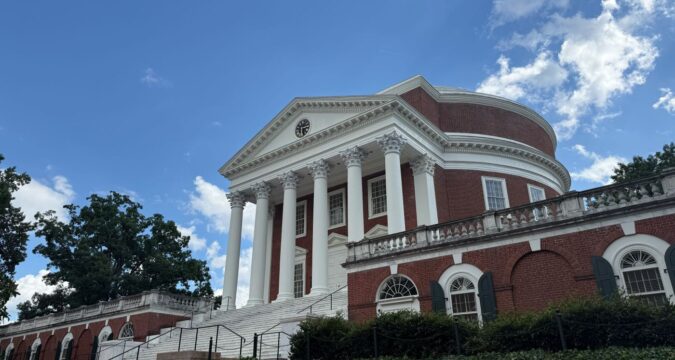
The Virginia Supreme Court last week let stand a lower-court injunction that prevents 22 appointees that a Democratic-controlled Senate committee blocked from continuing to serve on the boards of visitors at the University of Virginia, George Mason University and Virginia Military Institute. That raised questions about whether the boards have enough members to act legitimately. The decision leaves 10 vacancies at George Mason, seven at VMI and five at UVa.
Spanberger said filling the vacancies is particularly important for the Board of Visitors at UVa, her alma mater, “because they’re pursuing a presidential search.”
“I think it is of the utmost importance to the university, to Virginia, to governance, and ultimately to the success of a potential president, that that president be appointed by a fully constituted and statutorily compliant board,” she said during the interview at her transition office.
With Democrats Abigail Spanberger and Jay Jones set to take office as governor and attorney general, the Supreme Court’s decision effectively ends the appeal, leaving the appointments to the new governor.
Youngkin and Spanberger have been engaged in a pre-inauguration duel over her request to the UVa board that it pause the presidential search process until she can fill the five vacant seats, while meeting statutory requirements that a certain number of its members live in Virginia and have graduated from the university. The Republican governor accused the Democratic governor-elect of a “breach of protocol” by publicly interfering with the board’s search before she is inaugurated.
Youngkin advised the board to continue its search for a new president, but Spanberger made clear that she expects the process to pause until she has made her own appointments after her inauguration as Virginia’s 75th governor.
Making history
Spanberger, who will be Virginia’s first female governor, recalled her Henrico County family’s disappointment in 1993 when former Attorney General Mary Sue Terry, the first woman to win statewide office in Virginia, lost her bid to break that barrier.
She said she does not remember Terry’s concession speech on Nov. 2, 1993, in which Terry said: “Somewhere in Virginia tonight, the first woman governor of Virginia is watching.”
But, as the eldest of three daughters, Spanberger does remember how excited her family had been – particularly her mother, Eileen Davis, a longtime activist for passage of the Equal Rights Amendment – that a woman was running to become Virginia’s first female governor. Terry lost to Republican George Allen.
“I remember my mom’s disappointment,” she said.
“Certainly, having been a legislator, I have the experience of what it is like to work with an executive in circumstances where you agree, disagree and everything in between,” Gov.-elect Abigail Spanberger said in her transition office on Friday.
Spanberger is preparing now to serve as governor, after serving three terms in the U.S. House of Representatives for the 7th Congressional District.
As a congresswoman, she served during President Donald Trump’s first term and under President Joe Biden, which she said will help her in her first experience as an executive.
“Certainly, having been a legislator, I have the experience of what it is like to work with an executive in circumstances where you agree, disagree and everything in between,” she said.
She also cited her “skill set” as a former case officer at the Central Intelligence Agency and as a U.S. Postal Service inspector. “In the intel world, I was taking in vast amounts of information,” she said. “You’ve got to make quick decisions, and there’s a lot on the line.”
Affordability agenda
Spanberger grew up in the Richmond suburbs, but she is new to state government. She will work with Democratic majorities in both chambers of the General Assembly to enact the “affordability agenda” she promoted in her campaign that led to a 15-percentage-point victory over Republican Lt. Gov. Winsome Earle-Sears on Nov. 4.
She commended House Speaker Don Scott, D- Portsmouth, for saying Democrats must govern with restraint after picking up 13 seats in the House of Delegates. Democrats will now hold 64 seats to Republicans’ 36.
“It’s not a question of how large their majority is. It’s a question of how did they get that majority? And the same is true for me,” Spanberger said.
“When I look at what is the mandate that I have as governor, it’s what did people vote for?” she said. “What did I promise? What did I talk about? What were the things that were driving my campaign? And those are the things that I view as the mandate.”
Spanberger said issues of affordability of essential goods and services for Virginians – such as an expanded supply of affordable housing, lower prescription drug prices and restraints on the rising cost of electricity – will be “the thematic drive” across her administration.
She acknowledged that delivering on those promises will not be easy.
Energy crisis
Lowering electricity prices and avoiding what Spanberger has described as “a looming energy crisis” will require her to confront the need for expanding the supply of power to meet demand that is growing exponentially because of the proliferation of data centers in Northern Virginia and other parts of the state.
“We’re the largest net importer of energy in the country,” she said. “That is not a good place for us to be.”
“We’re seeing it impact energy costs for Virginians, but looking at the trajectory run four years from now, when I’m on my way out of the governorship, if I haven’t gotten a handle on the impending or almost-here energy crisis, I’ll be leaving a real crisis to the next incoming governor,” she said.
Producing more energy in Virginia could test the relationship between state and local governments over siting of power generation, whether it’s solar farms or power plants fired by natural gas. The energy challenge also will test the provisions of the Virginia Clean Economy Act, which the General Assembly enacted five years ago to promote clean sources of energy, such as solar and wind, while committing the state to a 2045 deadline to eliminate use of fossil fuels, such as coal and natural gas, to produce electricity.
Spanberger is confident that state policymakers can strike a balance that addresses urgent energy needs without sacrificing the state’s commitment to reducing pollution linked to climate change.
“One of the things that I was struck by along the campaign trail is at times people would view it as we either abide (by) everything that was put in place a couple years ago with the Clean Economy Act, or we just give up on all of those goals,” she said. “And I don’t think that it has to be viewed as that sort of zero-sum circumstance.”
Budget challenges
Spanberger also has been educating herself on another potential crisis with the next two-year state budget, which Youngkin will propose next month and the General Assembly will begin to consider when it returns to Richmond on Jan. 14, three days before her inauguration.
She attended budget retreats this week by the House Appropriations Committee in Prince William County and Senate Finance & Appropriations Committee in Radford. The state faces huge bills in the drawer for Medicaid, K-12 public education and food assistance benefits that the Trump administration and Republican Congress have shifted to the states.
The tax cut package that the president signed on July 4 also will cost Virginia at least $1.1 billion over the next three years to conform state and federal tax law, and possibly double that amount if the state also adopts other provisions of the law, such as tax exemptions for income from tips or overtime.
“For me, there were really no surprises,” she said, citing her votes in Congress for federal emergency funding to Virginia during the COVID-19 crisis that helped to produce big state revenue surpluses during Youngkin’s term.
“This fiscal trajectory that we’re on as a state, it’s a challenge if you compare (it) to where the state has been the last couple of years, but it’s where I expected we would be,” she said.
Spanberger did not directly address how she would respond to potential tax increases that the legislature might adopt, such as applying the sales tax to some services, adding a new income tax bracket for the highest earners or providing new sources of revenue to local governments to eliminate the so-called “car tax.”
She said the General Assembly is looking at potential ways to address the revenue challenge beyond the next budget.
“What are the types of revenue streams that could be added to the mix to ensure that the general fund (budget) in Virginia is meeting the needs, not just of the moment, but five, 10 years down the road?” she asked.
© 2025 Richmond Times-Dispatch, Va.. Visit www.timesdispatch.com. Distributed by Tribune Content Agency, LLC.