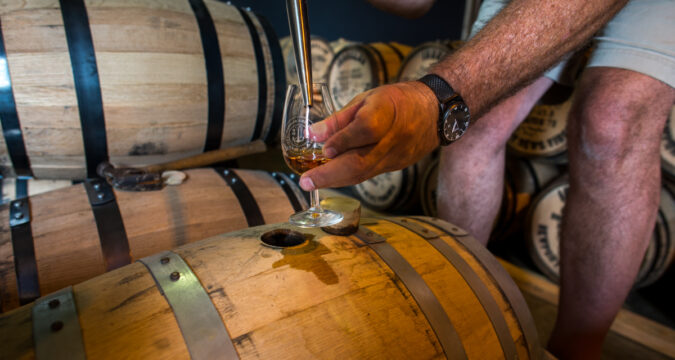
Over the past 12 years, Stephen King said his business, along the banks of the James River, has experienced its share of ups and downs.
“You got to do whatever you got to do and we’re doing everything we can think of,” said King, owner of Ironclad Distillery.
Newport News-based Ironclad had been growing every year since its start in 2015, King said, and business really took off during the pandemic when the distillery, considered an essential business, never had to shut down.
“We were making hand sanitizer in addition to bourbon,” he said. “And life was wonderful.”
But at the beginning of 2025, he said it just fell off a cliff.
Americans are drinking less. Last year, 54% of U.S. adults reported consuming alcohol, the lowest in Gallup’s 86 years of conducting the survey. And the number of U.S. distilleries declined by 26% from August 2024 to August 2025, according to the American Craft Spirits Association.
“A lot of Virginia distilleries are struggling,” said Becky Harris, president of Virginia Distillers Association. “We have a number of distilleries where people are looking to sell their businesses.”
Between the tariffs on imports and exports and restrictive policies placed on distilleries within the state, disparate producers are all feeling the squeeze at different intensities, she said.
“And I think we’ll probably see more going out of business if we don’t start seeing the price pressures ease up and/or we start getting more ability to sell our products,” Harris said.
Harris, also the co-owner of Catoctin Creek Distillery in Purcellville, Virginia, said she tells people if they like the variety of products from big spirits companies, that’s great, but it’s important to also support local distillers because that’s what keeps innovation going.
‘We’ll sell it in Europe’
In late 2024, Ironclad began to explore export sales and was on the cusp of securing substantial orders from Canada and Denmark, King said.
But after President Donald Trump was inaugurated in January 2025, he announced tariffs on Canadian imports and expressed interest in taking Greenland from Denmark. That’s when King’s phone began to ring.
“They said retailers were taking American products off the shelf as fast as they can dump ‘em and we’re not interested in buying anything American,” he said.
Turning in another direction, King attended inbound trade missions in North Carolina and Tennessee and received interest in his product from Sweden, Germany, Poland and Mexico. With no tariffs on bourbon imported to the European Union, Ironclad expanded its export sales. (Trump on Wednesday backed off threats to impose additional tariffs on European allies who didn’t support his plan to take control of Greenland, preventing retaliatory tariffs.)
“We are pursuing European sales as fast as we can because if we can’t sell it in the United States — for whatever reason, if alcohol consumption is down or if tariffs are up — we’ll sell it in Europe,” King said in December.
On the buying side, few domestic glass bottle manufacturers mass produce 750-milliliter bottles, King said.
In 2023, Ironclad started purchasing container loads of bottles from China at almost half the cost of what U.S. distributors were selling them for, he said. But with recent tariffs, the business is paying 47% above and beyond the cost of the bottles.
“We have to have bottles to put our product in,” King said.
And they need corks, too. He said 10,000 corks cost at least 40% more than the last time he ordered them.
Fortunately, the distillery’s grain and the majority of its barrels is bought from Virginia growers or businesses. But overall, King said the distillery is paying about $20,000 a year in additional costs.
“We’re pretty much eating it,” he said. “We don’t have much choice if we want to stay in business, but it’s more heartache and headache for us.”
Ironclad has temporarily halted production since August to give the company a chance to conserve funds, weather the reduced sales and get its revenue back on track, he said.
“Fortunately, we had a lot of inventory of bourbon that does nothing but grow older and better as it ages,” King said.
Bottles of bourbon whiskey line the walls at Ironclad Distillery in downtown Newport News in March 2018. Located in the former S.W. Holt & Co. warehouse, built in 1913, the distillery looks over the James River. (Staff/File)
Cost of doing business
Navy veterans Lou Shepard and Dave Hall started their business, Mean Spirits Distillery, in 2020.
They crafted the idea during a Master of Business Administration program at William & Mary and have been building the Norfolk-based small business side by side ever since.
They took a distilled spirits business certificate course at the University of Louisville and then attended Moonshine University, a learning center in Kentucky focused on the ins and outs of making spirits.
In November 2024, they launched their first product and introduced the remainder of their line the following year.
Shepard and Hall — who consider their business model to be flexible and agile — feel they can position themselves to keep the lights on as they scale to market demands. They’ve been ramping up production slowly and don’t face exporting challenges.
“The news would have you believe the sky’s falling and it is for some and maybe for us,” Shepard said. “We’re just not big enough to feel the shock.”
Though Shepard said they feel the pinch more on the supply chain side.
“The price of barrels has gone up exponentially since we started,” he said. Originally priced at around $200, a new charred American oak barrel now costs around $330 each, Shepard said. That’s a 65% increase.
“Some of that had to do with the post-COVID supply chain issues — recovery and backlogs — and it’s probably exacerbated by some of the tariff issues,” Shepard said.
Corks come from the United Kingdom, medallions from France, and glass bottles from a U.S. distributor who sources from India, so they said they have felt the squeeze from tariffs on those materials.
“That’s been a bit of a challenge,” Hall said. “We just wrap it up into our cost of goods and it cuts into our margins a bit, but that’s the cost of doing business.”
Equipment costs get ‘crazy’
Randy Thomas, managing member of The Vanguard, opened the brewpub and distillery within the historic Hampton armory in February 2018.
“When the tariffs first kicked in, we had a lot of emails from people saying we’d see price increases,” Thomas said. “But not all of those materialized.”
The grain for The Vanguard’s whiskeys comes from Scotland and there haven’t been any increases on that, Thomas said.
The biggest challenge has been the overall shift in attitude toward drinking, he said.
“The government shutdown really hurt us,” Thomas said. Langley Air Force Base, NASA Langley Research Center and the shipyard are all a big part of The Vanguard’s client base.
He said October, November and December were all slower than in years past and then “Dry January” rolled around, further impeding business as usual.
Pricewise, Thomas said he kept his beer prices the same and even lowered his liquor prices to try to offset some of the slowdown. He has been offering a special on appetizers and core beers — $5 until 5 p.m.
“It’s not sustainable long-term for me financially,” Thomas said. “But it’s helped get people out.”
People aren’t going out like they did pre-pandemic, he explained.
“We’re a music venue so the bands that used to bring 800 or 900 people will bring 300 to 400 people, sometimes even less,” he said. Nowadays, The Vanguard is scaling down with more event-oriented gatherings.
Finding good workers has also been a huge challenge, he said. Before the pandemic, he employed 101. That number dropped to as low as six at one point. Today, he has 36 on staff.
As an 8-year-old business, the cost to maintain and repair equipment — such as refrigeration and pumps — is where Thomas said he is seeing the most increase in cost.
“Just to repair the refrigeration equipment is almost as expensive as what I paid for the equipment brand-new eight years ago,” he said. “The prices on those things have just gotten crazy.”
Sandra J. Pennecke, 757-652-5836, sandra.pennecke@pilotonline.com
https://www.pilotonline.com/2026/01/27/hampton-roads-distilleries-challenges/