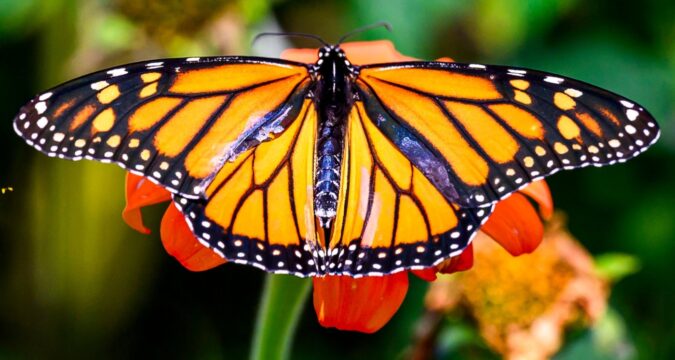
Lehigh Valley residents may be noticing streaks of black and orange flitting through their back yards in recent days. The “king” of the Lepidoptera family, the monarch butterfly, is passing through the Lehigh Valley on the 3,000-mile migration it makes each year.
Throughout August and September, the charismatic insects frequent flowering gardens in the area as they journey south.
Several local organizations hold monarch tagging events to help scientists track their flight to better understand this unique phenomenon. Here’s what to know about the 2025 monarch migration.
When is the migration happening?
Monarch butterflies begin their migration in late summer. But the best time to see monarchs is in early and mid-September, when peak numbers of the butterflies travel through Pennsylvania. When days get shorter and temperatures fall, the butterflies begin migrating. They travel during the day and roost together in forests at night.
Where can I see monarchs migrating?
Anywhere milkweed grows is a good place to find monarchs, according to Jeanne Hamscher, an environmental educator at the Wildlands Conservancy in Emmaus.
Monarchs lay their eggs on the backs of milkweed leaves and the caterpillars that emerge feed exclusively on milkweed plants. Adults enjoy nectar-rich flowers such as goldenrod and coneflowers, as well as milkweed. Backyard gardens with these flowers will attract monarchs and other pollinators such as bees, even in more developed areas. However, monarchs prefer open areas such as meadows, grasslands or even roadsides.
Why are the monarchs migrating? What does the migration process look like?
The annual mass migration takes monarchs to the forests of central Mexico to escape chilly northern winters. Unlike most insects found in temperate climates, they cannot withstand cold temperatures.
The migration takes place over four to five generations of individual butterflies. The larvae emerging now, in the late summer and early fall, are called the “super generation.” Most monarch butterflies only live two to six weeks but those born in super generations live up to 9 months because they produce less of a hormone that regulates aging in normal monarchs. They also possess larger bodies and wings, qualities that allow them to undertake the arduous journey south in one generation alone.
Once they arrive at one of several mountaintop forests in Mexico, they overwinter there on stored energy. Warming weather gives them the cue to start migrating back north and triggers the production of the anti-aging hormone. This hormone also gives them the ability to reproduce. Flying back to the southern U.S., the females lay eggs and die shortly thereafter. These eggs become butterflies that continue the flight north.
How do the butterflies know where to go?
Studies have shown that monarchs read the position of the sun, which moves from east to south to west throughout the day. Their antennae help them tell the time of day to know where the sun should be relative to the direction they want to go. How they know to stop at the same Mexican forests every generation remains a mystery.
What is monarch tagging?
Tagging is a technique used to collect data on monarch migrations where a small sticker is stuck onto the strongest part of the wing of a butterfly. After the tagged insect is released, observers anywhere can record sightings.
Members of Monarch Watch, a nationwide citizen science initiative, have coordinated monarch tagging efforts since 1992. Tagging does not harm butterflies, according to their analyses.
Jacobsburg Environmental Education Center, Wildlands Conservancy and Lehigh Gap Nature Center offer monarch-tagging programs that contribute to the Monarch Watch database.
“It’s a beautiful, wonderful way to connect with nature,” said Hamscher, who helped start monarch tagging at Wildlands Conservancy eight years ago. “And loss of habitat is one of the lessons you try to teach.”
She has noticed a decline in milkweed growth at the Pool Wildlife Sanctuary over the years that has corresponded with a decrease in the monarch population.
“We’ve also noticed that [migration] seems to get later every year,” she said.
Are monarch butterflies at risk?
The eastern population of monarch butterflies has declined by 80% in the last few decades based on recent estimates, and those west of the Rocky Mountains experienced a 96% decline from the 2023 to 2024 overwintering season.
The U.S. Fish and Wildlife Service proposed listing monarchs as a threatened species in December. (The species entered the endangered species list for one year before its removal in 2023.)
“Most people are familiar with the story that monarchs are in decline and it’s certainly gathered national attention,” says Kate Ebel, senior restoration ecologist at Wildlands Conservancy. “Some of [the reasons for decline are] pesticide and herbicide use. Another factor is loss of habitat. That includes grassland and meadow habitat, which is actually one of the habitat types that we’ve lost the most of across the continent really, but certainly in Pennsylvania.”
Meadows are easy pickings for development because they are less cost intensive to develop compared with habitats like forests, which need to be cleared, Ebel said. Consequently, fewer milkweed and flowering meadow plants are around for adult monarchs to reproduce and feed on, contributing to their reduced numbers.
Meadow restoration has become a major project for Wildlands Conservancy in part to bring back pollinators like monarchs. These projects involve identifying lawns and meadows not in use and transitioning them into meadows by growing native plants. Most recently, they collaborated with Northampton County to restore 18 acres of meadow across six municipal parks as well as Lehigh Valley Health Network to restore 9 acres at the Hecktown Oaks campus.
“[We are] trying to bring back those habitat types so when they do migrate through our area, there are places for them to both rest and lay their eggs.”
What can I do to help?
Plant milkweed and other native flowers like black-eyed Susans, asters or meadow blazing stars in backyard gardens to provide resources for monarchs and invite them into closer proximity during migration season.
Of the three main species in eastern Pennsylvania, Hamscher recommends swamp or butterflyweed over common milkweed, which can easily take over home gardens.
According to Penn State Master Gardeners, milkweed grows easily from seed. In the fall or early winter, drop — don’t bury — the seeds onto soil and press them into the ground. They will germinate and grow with little need for maintenance in the spring.
“I think people hear these things and think there’s nothing they can do, but truly even the smallest efforts can have a really big impact on monarch populations,” Ebel says. “Anything you can do to plant milkweed, plant other native flowering species — that’s going to have an impact on monarchs. The more we can do that, the more we can help [them].”
Monarch Events in the Lehigh Valley
Pollinator Fest: 10 a.m. to 5 p.m. Sept. 6, Da Vinci Science Center, Allentown; $22 or free for members
Family Science Night — Monarch Madness: 6:30-8 p.m. Sept. 12, Jacobsburg Environmental Education Center; free
Monarch tagging with Master Gardeners (Wildlands Conservancy): 10-11 a.m. Sept. 13, Saucon Valley Rail Trail Parking Lot, Reading Drive, Lower Saucon Township; free
Migration Fest: 10 a.m. to 3 p.m. Sept. 20, Lehigh Gap Nature Center; free
Monarch tagging and meadow restoration tour (Wildlands Conservancy): 10 a.m. to noon Sept. 20, Louise Moore Park, Bethlehem Township; free
Tara Wu is a freelance writer.